Since 1984 the United States, under the Rewards for Justice program, has offered large rewards for information leading to the capture or killing of high level terrorists.
In this Stratfor article Scott Stewart discusses how the program functions, the successes it has had, and reason why the program, considering the large bounties offered, isn't even more successful
It is an interesting read. I've excerpted the beginning of it below, and at the end of the excerpt is a link to the full article.
All the talk of cash payout in the article brought to mind gold diggers when I went to select the article's Hot Stratfor Babe. That led to the movie The Gold Diggers of 1933 and Ruby Keeler, one if its female leads.
Ms Keeler started her dancing career at the age of 14 in a speakeasy called the El Fay nightclub. she soon caught the eye of Broadway producers who cast her in musicals. On Broadway she was noticed by Flo Ziegfeld, who launched her film career.
She had a rocky marriage to Al Jolson. However, her second marriage to John Warner Lowe was was a happy one, and she left show business to raise her children. She returned to television briefly in the early 1960s, and died in 1993.
Why U.S. Bounties on Terrorists Often Fail
By Scott Stewart, April 12, 2012
U.S. Deputy Undersecretary of State Wendy Sherman announced April 3 that the U.S. government's "Rewards for Justice" (RFJ) program was offering a $10 million reward for information leading to the capture and conviction of Hafiz Mohammad Saeed, the founder of Lashkar-e-Taiba (LeT). In other Rewards for Justice cases involving Pakistan, suspects such as Osama bin Laden, Ayman al-Zawahiri, Abdel Basit and Mir Amal Kansi have hidden in Pakistan and maintained relatively low profiles. In this case, Saeed is a very public figure in Pakistan. He even held a news conference April 4 in Rawalpindi announcing his location and taunting the United States by saying he was willing to share his schedule with U.S. officials.
While the Saeed case is clearly a political matter rather than a pure law enforcement or intelligence issue, the case has focused a great deal of attention on Rewards for Justice, and it seems an opportune time to examine the history and mechanics of the program.
Rewards for Justice
In the shadow of the 1983 and 1984 bombings of the U.S. Embassy in Beirut, the 1983 bombing of the U.S. Embassy in Kuwait and the 1983 Marine barracks bombing in Lebanon, the U.S. Congress established the Rewards for Justice program under the 1984 Act to Combat International Terrorism. The program is administered by the U.S. Department of State's Diplomatic Security Service, which was established by the Omnibus Diplomatic Security and Antiterrorism Act of 1986.
The program was intended not only to reward people who provide information that leads to the arrest or conviction of people who plan, commit or attempt terrorist attacks against U.S. targets but also to obtain information that prevents such attacks. U.S. government employees and the employees of other governments are not eligible for the program. The law also authorizes program participants to be entered into the U.S. Department of Justice witness protection program to ensure their safety after providing information. The statute covers arrests of and convictions for the subjects sought and contains a clause for "favorable resolution" of such cases that can be applied when a military strike results in the death of the suspect.
While the RFJ program currently offers large rewards -- $25 million for Ayman al-Zawahiri, the leader of al Qaeda, and $10 million for figures such as Saeed and Taliban leader Mullah Mohammad Omar -- the rewards initially offered by the program were much smaller, up to $500,000. That amount was increased to $1 million in 1990, and then augmented to $2 million total through matching funds provided by the Air Transport Association and the Air Line Pilots Association. The program gained the ability to offer large payments for figures such as al-Zawahiri under the 2001 Patriot Act, which was passed after the 9/11 attacks.
The RFJ got off to a slow start and didn't really begin to have much of an impact until the early 1990s. Its first significant success occurred during the 1991 Persian Gulf War, when an informant in Bangkok tipped off American officials to a pending attack against U.S. interests there by agents of the Iraqi Intelligence Service. The informant received a significant reward and was relocated to a safe place along with his family. However, rewards paid for information leading to the prevention of attacks have proved to be the exception rather than the rule for the RFJ.
The program also figured prominently in the February 1995 capture of Abdel Basit in Pakistan. Basit, widely known as Ramzi Yousef (the name on one of his fraudulent passports), is a Pakistani citizen born in Kuwait. He was the principal operational leader and bombmaker in the 1993 World Trade Center bombing. After fleeing the United States he also planned a number of other failed or thwarted attacks in Manila, Bangkok and Pakistan. Basit is also the nephew of alleged 9/11 planner Khalid Sheikh Mohammed, with whom he conspired. The widespread use of the Ramzi Yousef name and Iraqi passport provided a great deal of confusion regarding his true identity, but it also allowed the government of Pakistan to extradite the Pakistani citizen to the United States with very little public backlash.
The RFJ was also used by the CIA to entice Pakistani tribesmen in June 1997 to hand over Mir Amal Kansi, who was convicted and executed in Virginia, for a January 1993 shooting outside the CIA headquarters in Langley, Va. Kansi, a Pakistani citizen, was rendered from Pakistan instead of extradited, which generated a great deal of controversy inside Pakistan.
While the RFJ advertises that it has paid out more than $100 million in rewards, it must be pointed out that a great deal of that money has been paid in Iraq, where the reward paid for the deaths of Udai and Qusay Hussein alone was $30 million. More than $11 million has been paid out in recent years for leaders of the Abu Sayyaf group in the Philippines. Although $25 million rewards were offered each for Saddam Hussein and Abu Musab al-Zarqawi, rewards were not authorized in their cases.
Read more: Why U.S. Bounties on Terrorists Often Fail | Stratfor
Friday, April 13, 2012
Thursday, April 12, 2012
On the anniversary of Gagarin's flight into space
![]() |
| Uri Gagarin (click any image to enlarge) |
Perhaps even more than Sputnik, Gagarin's flight added fuel to the Cold War space race between the U.S. and the U.S.S.R.
At the time, because America's program seemed to lag behind the Russians, there was considerable alarm in the States over the situation. Now, we can appreciate his achievement and tip our hats to the Russian engineers who made it possible. My question -- when are we headed to Mars?
These pictures are from the EnglishRussia post Again About Him On April, 12. Follow the link for many more pictures of Gagarin, the other cosmonauts in the Vostok program as well as pictures of later Soviet space programs.
Wednesday, April 11, 2012
Soviet anti-alcohol posters
![]() |
| Click any image to enlarge |
There are more after the jump, and even more at Vintage Everyday where I found these examples.
Tuesday, April 10, 2012
Stratfor and Mitra Hajjar
This week George Friedman discusses Iran's strategic situation. Iran is attempting to assert itself as the dominant regional power, but is constrained to some degree by the United States, Russia, Turkey and the Sunni Gulf State's led by Saudi Arabia.
With the U.S. withdrawal from Iraq, Iran has opportunities, but the deteriorating situation in Syria could still work against them. Friedman also wonders if their nuclear program isn't more like North Korea's -- that is the ongoing program is a threat enough without a deliverable warhead that might trigger a lot more robust response.
I tend to think Friedman overestimates Iran (although a nuclearized Iran is a very alarming thought). For example, early on he tended to undersell the dangers chaos in Syria presented to Iran, and particularly to her support of Hezbollah, her proxy in the Sunni world.
Beyond terrorism, and whatever inroads it can make into Shiite Iraq (which is potentially a two-edged sword as ideas leak across its borders as well), because of logistics shortcomings, Iran really can't project power easily. For that reason I think Iran is doing more than playing games with their nuclear program. I think they do want deliverable weapons.
Still, from our viewpoint Iran is a bad boy in the neighborhood. I've excerpted the beginning of Friedman's article below, and you can follow a link to the full article at the end of the excerpt.
For the article's Hot Stratfor Babe I turned to Iranian cinema and after my usual exhaustive search I decided that Mitra Hajjar deserved the award.
Ms. Hajjar is a well established and popular Iranian actress, having been in movies since 1998. Recently she spent time on the stage in Paris, and there is talk of her going to the U.S. to do movies, however her latest films (2012) are Iranian and in Farsi so that may have fallen through for her.
Iran's Strategy
By George Friedman, April 10, 2012
For centuries, the dilemma facing Iran (and before it, Persia) has been guaranteeing national survival and autonomy in the face of stronger regional powers like Ottoman Turkey and the Russian Empire. Though always weaker than these larger empires, Iran survived for three reasons: geography, resources and diplomacy. Iran's size and mountainous terrain made military forays into the country difficult and dangerous. Iran also was able to field sufficient force to deter attacks while permitting occasional assertions of power. At the same time, Tehran engaged in clever diplomatic efforts, playing threatening powers off each other.
The intrusion of European imperial powers into the region compounded Iran's difficulties in the 19th century, along with the lodging of British power to Iran's west in Iraq and the Arabian Peninsula following the end of World War I. This coincided with a transformation of the global economy to an oil-based system. Then as now, the region was a major source of global oil. Where the British once had interests in the region, the emergence of oil as the foundation of industrial and military power made these interests urgent. Following World War II, the Americans and the Soviets became the outside powers with the ability and desire to influence the region, but Tehran's basic strategic reality persisted. Iran faced both regional and global threats that it had to deflect or align with. And because of oil, the global power could not lose interest while the regional powers did not have the option of losing interest.
Whether ruled by shah or ayatollah, Iran's strategy remained the same: deter by geography, protect with defensive forces, and engage in complex diplomatic maneuvers. But underneath this reality, another vision of Iran's role always lurked.
Iran as Regional Power
A vision of Iran -- a country with an essentially defensive posture -- as a regional power remained. The shah competed with Saudi Arabia over Oman and dreamed of nuclear weapons. Ahmadinejad duels with Saudi Arabia over Bahrain, and also dreams of nuclear weapons. When we look beyond the rhetoric -- something we always should do when studying foreign policy, since the rhetoric is intended to intimidate, seduce and confuse foreign powers and the public -- we see substantial continuity in Iran's strategy since World War II. Iran dreams of achieving regional dominance by breaking free from its constraints and the threats posed by nearby powers.
Since World War II, Iran has had to deal with regional dangers like Iraq, with which it fought a brutal war lasting nearly a decade and costing Iran about 1 million casualties. It also has had to deal with the United States, whose power ultimately defined patterns in the region. So long as the United States had an overriding interest in the region, Iran had no choice but to define its policies in terms of the United States. For the shah, that meant submitting to the United States while subtly trying to control American actions. For the Islamic republic, it meant opposing the United States while trying to manipulate it into taking actions in the interests of Iran. Both acted within the traditions of Iranian strategic subtlety.
The Islamic republic proved more successful than the shah. It conducted a sophisticated disinformation campaign prior to the 2003 Iraq war to convince the United States that invading Iraq would be militarily easy and that Iraqis would welcome the Americans with open arms. This fed the existing U.S. desire to invade Iraq, becoming one factor among many that made the invasion seem doable. In a second phase, the Iranians helped many factions in Iraq resist the Americans, turning the occupation -- and plans for reconstructing Iraq according to American blueprints -- into a nightmare. In a third and final phase, Iran used its influence in Iraq to divide and paralyze the country after the Americans withdrew.
As a result of this maneuvering, Iran achieved two goals. First, the Americans disposed of Iran's archenemy, Saddam Hussein, turning Iraq into a strategic cripple. Second, Iran helped force the United States out of Iraq, creating a vacuum in Iraq and undermining U.S. credibility in the region -- and sapping any U.S. appetite for further military adventures in the Middle East. I want to emphasize that all of this was not an Iranian plot: Many other factors contributed to this sequence of events. At the same time, Iranian maneuvering was no minor factor in the process; Iran skillfully exploited events that it helped shape.
There was a defensive point to this. Iran had seen the United States invade the countries surrounding it, Iraq to its west and Afghanistan to its east. It viewed the United States as extremely powerful and unpredictable to the point of irrationality, though also able to be manipulated. Tehran therefore could not dismiss the possibility that the United States would choose war with Iran. Expelling the United States from Iraq, however, limited American military options in the region.
This strategy also had an offensive dimension. The U.S. withdrawal from Iraq positioned Iran to fill the vacuum. Critically, the geopolitics of the region had created an opening for Iran probably for the first time in centuries. First, the collapse of the Soviet Union released pressure from the north. Coming on top of the Ottoman collapse after World War I, Iran now no longer faced a regional power that could challenge it. Second, with the drawdown of U.S. forces in the Persian Gulf and Afghanistan, the global power had limited military options and even more limited political options for acting against Iran.
Iran's Opportunity
Iran now had the opportunity to consider emerging as a regional power rather than solely pursuing complex maneuvers to protect Iranian autonomy and the regime. The Iranians understood that the moods of global powers shifted unpredictably, the United States more than most. Therefore it knew that the more aggressive it became, the more the United States may militarily commit itself to containing Iran. At the same time, the United States might do so even without Iranian action. Accordingly, Iran searched for a strategy that might solidify its regional influence while not triggering U.S. retaliation.
Anyone studying the United States understands its concern with nuclear weapons. Throughout the Cold War it lived in the shadow of a Soviet first strike. The Bush administration used the possibility of an Iraqi nuclear program to rally domestic support for the invasion. When the Soviets and the Chinese attained nuclear weapons, the American response bordered on panic. The United States simultaneously became more cautious in its approach to those countries
Read more: Iran's Strategy | Stratfor
With the U.S. withdrawal from Iraq, Iran has opportunities, but the deteriorating situation in Syria could still work against them. Friedman also wonders if their nuclear program isn't more like North Korea's -- that is the ongoing program is a threat enough without a deliverable warhead that might trigger a lot more robust response.
I tend to think Friedman overestimates Iran (although a nuclearized Iran is a very alarming thought). For example, early on he tended to undersell the dangers chaos in Syria presented to Iran, and particularly to her support of Hezbollah, her proxy in the Sunni world.
Beyond terrorism, and whatever inroads it can make into Shiite Iraq (which is potentially a two-edged sword as ideas leak across its borders as well), because of logistics shortcomings, Iran really can't project power easily. For that reason I think Iran is doing more than playing games with their nuclear program. I think they do want deliverable weapons.
Still, from our viewpoint Iran is a bad boy in the neighborhood. I've excerpted the beginning of Friedman's article below, and you can follow a link to the full article at the end of the excerpt.
For the article's Hot Stratfor Babe I turned to Iranian cinema and after my usual exhaustive search I decided that Mitra Hajjar deserved the award.
Ms. Hajjar is a well established and popular Iranian actress, having been in movies since 1998. Recently she spent time on the stage in Paris, and there is talk of her going to the U.S. to do movies, however her latest films (2012) are Iranian and in Farsi so that may have fallen through for her.
Iran's Strategy
By George Friedman, April 10, 2012
For centuries, the dilemma facing Iran (and before it, Persia) has been guaranteeing national survival and autonomy in the face of stronger regional powers like Ottoman Turkey and the Russian Empire. Though always weaker than these larger empires, Iran survived for three reasons: geography, resources and diplomacy. Iran's size and mountainous terrain made military forays into the country difficult and dangerous. Iran also was able to field sufficient force to deter attacks while permitting occasional assertions of power. At the same time, Tehran engaged in clever diplomatic efforts, playing threatening powers off each other.
The intrusion of European imperial powers into the region compounded Iran's difficulties in the 19th century, along with the lodging of British power to Iran's west in Iraq and the Arabian Peninsula following the end of World War I. This coincided with a transformation of the global economy to an oil-based system. Then as now, the region was a major source of global oil. Where the British once had interests in the region, the emergence of oil as the foundation of industrial and military power made these interests urgent. Following World War II, the Americans and the Soviets became the outside powers with the ability and desire to influence the region, but Tehran's basic strategic reality persisted. Iran faced both regional and global threats that it had to deflect or align with. And because of oil, the global power could not lose interest while the regional powers did not have the option of losing interest.
Whether ruled by shah or ayatollah, Iran's strategy remained the same: deter by geography, protect with defensive forces, and engage in complex diplomatic maneuvers. But underneath this reality, another vision of Iran's role always lurked.
Iran as Regional Power
A vision of Iran -- a country with an essentially defensive posture -- as a regional power remained. The shah competed with Saudi Arabia over Oman and dreamed of nuclear weapons. Ahmadinejad duels with Saudi Arabia over Bahrain, and also dreams of nuclear weapons. When we look beyond the rhetoric -- something we always should do when studying foreign policy, since the rhetoric is intended to intimidate, seduce and confuse foreign powers and the public -- we see substantial continuity in Iran's strategy since World War II. Iran dreams of achieving regional dominance by breaking free from its constraints and the threats posed by nearby powers.
Since World War II, Iran has had to deal with regional dangers like Iraq, with which it fought a brutal war lasting nearly a decade and costing Iran about 1 million casualties. It also has had to deal with the United States, whose power ultimately defined patterns in the region. So long as the United States had an overriding interest in the region, Iran had no choice but to define its policies in terms of the United States. For the shah, that meant submitting to the United States while subtly trying to control American actions. For the Islamic republic, it meant opposing the United States while trying to manipulate it into taking actions in the interests of Iran. Both acted within the traditions of Iranian strategic subtlety.
The Islamic republic proved more successful than the shah. It conducted a sophisticated disinformation campaign prior to the 2003 Iraq war to convince the United States that invading Iraq would be militarily easy and that Iraqis would welcome the Americans with open arms. This fed the existing U.S. desire to invade Iraq, becoming one factor among many that made the invasion seem doable. In a second phase, the Iranians helped many factions in Iraq resist the Americans, turning the occupation -- and plans for reconstructing Iraq according to American blueprints -- into a nightmare. In a third and final phase, Iran used its influence in Iraq to divide and paralyze the country after the Americans withdrew.
As a result of this maneuvering, Iran achieved two goals. First, the Americans disposed of Iran's archenemy, Saddam Hussein, turning Iraq into a strategic cripple. Second, Iran helped force the United States out of Iraq, creating a vacuum in Iraq and undermining U.S. credibility in the region -- and sapping any U.S. appetite for further military adventures in the Middle East. I want to emphasize that all of this was not an Iranian plot: Many other factors contributed to this sequence of events. At the same time, Iranian maneuvering was no minor factor in the process; Iran skillfully exploited events that it helped shape.
There was a defensive point to this. Iran had seen the United States invade the countries surrounding it, Iraq to its west and Afghanistan to its east. It viewed the United States as extremely powerful and unpredictable to the point of irrationality, though also able to be manipulated. Tehran therefore could not dismiss the possibility that the United States would choose war with Iran. Expelling the United States from Iraq, however, limited American military options in the region.
This strategy also had an offensive dimension. The U.S. withdrawal from Iraq positioned Iran to fill the vacuum. Critically, the geopolitics of the region had created an opening for Iran probably for the first time in centuries. First, the collapse of the Soviet Union released pressure from the north. Coming on top of the Ottoman collapse after World War I, Iran now no longer faced a regional power that could challenge it. Second, with the drawdown of U.S. forces in the Persian Gulf and Afghanistan, the global power had limited military options and even more limited political options for acting against Iran.
Iran's Opportunity
Iran now had the opportunity to consider emerging as a regional power rather than solely pursuing complex maneuvers to protect Iranian autonomy and the regime. The Iranians understood that the moods of global powers shifted unpredictably, the United States more than most. Therefore it knew that the more aggressive it became, the more the United States may militarily commit itself to containing Iran. At the same time, the United States might do so even without Iranian action. Accordingly, Iran searched for a strategy that might solidify its regional influence while not triggering U.S. retaliation.
Anyone studying the United States understands its concern with nuclear weapons. Throughout the Cold War it lived in the shadow of a Soviet first strike. The Bush administration used the possibility of an Iraqi nuclear program to rally domestic support for the invasion. When the Soviets and the Chinese attained nuclear weapons, the American response bordered on panic. The United States simultaneously became more cautious in its approach to those countries
Read more: Iran's Strategy | Stratfor
Monday, April 09, 2012
A small Christian chapel in India
![]() |
| Click any image to enlarge |
Sunday, April 08, 2012
Afternoon at a train bridge
Peace by George Herbert
Sweet Peace, where dost thou dwell? I humbly crave,
Let me once know.
I sought thee in a secret cave,
And ask'd, if Peace were there,
A hollow wind did seem to answer, No:
Go seek elsewhere.
I did; and going did a rainbow note:
Surely, thought I,
This is the lace of Peace's coat:
I will search out the matter.
But while I looked the clouds immediately
Did break and scatter.
Then went I to a garden and did spy
A gallant flower,
The crown-imperial: Sure, said I,
Peace at the root must dwell.
But when I digged, I saw a worm devour
What showed so well.
At length I met a rev'rend good old man;
Whom when for Peace
I did demand, he thus began:
There was a Prince of old
At Salem dwelt, who lived with good increase
Of flock and fold.
He sweetly lived; yet sweetness did not save
His life from foes.
But after death out of his grave
There sprang twelve stalks of wheat;
Which many wond'ring at, got some of those
To plant and set.
It prospered strangely, and did soon disperse
Through all the earth:
For they that taste it do rehearse
That virtue lies therein;
A secret virtue, bringing peace and mirth
By flight of sin.
Take of this grain, which in my garden grows,
And grows for you;
Make bread of it: and that repose
And peace, which ev'ry where
With so much earnestness you do pursue,
Is only there.
Have a good Easter
Don't ask me why gnomes instead of the Easter Bunny is delivering the egg in this old card. Have a good Easter.
Saturday, April 07, 2012
Old timey concept cars
![]() |
| Click any image to enlarge |
There are more after the jump. I found them at the Today's Whisper web magazine post Creative cars of the past, where you can see many more examples.
Bike Stunts
Pretty impressive bike stunts by Andrew Dickey. You can visit his YouTube feed, AndrewTrials, to see more.
Friday, April 06, 2012
Stratfor and Hélène de Fougerolles
Using the Toulouse shootings as a jumping-off point, in this Stratfor article Scott Stewart discusses the difficulty in identifying and tracking lone wolf or small, autonomous cells of terrorists.
Among radicalized Moslems, and for that matter radicals in general, there is a spectrum that stretches from dedicated terrorists to just loud-mouthed, but passive, cheerleaders. It is a difficult task for security agencies to sort the noise from the signal, and it can be made even more difficult by when in the terror planning cycle a potential terrorist is observed.
It is a good read. I've excerpted the beginning of it below, with a link to the full article at the end of the excerpt.
As for the article's Hot Stratfor babe, since it dealt with people fading into the background, Hélène de Fougerolles was obviously the logical choice. As you no doubt recall, she played the part of "Beach Community Member" in the movie The Beach, which is the type of credit that means you're about as blended into the background as you can get in a movie.
If you haven't seen The Beach, it is a sort of Lonely Planet Backpacker fantasy/morality tale. There is a secret beach in Thailand where all sorts of attractive young folks hang around in swimming suits, practice free love, smoke a lot of dope and so forth. However, greed, passion and desire soon raises their ugly heads, and things don't go so good from that point.
As for Ms. Fougerolles, I can't say I know a thing about her. In fact, I don't even recall her role as "Beach Community Member" in The Beach, but I'm sure she did a fine job of acting as she ran around in the background. Regardless, from her credits, it seems as if she's had an active career and isn't hurting for parts.
Tactical Realities of the Toulouse ShootingsBy Scott Stewart, April 5, 2012
Mohammed Merah, the suspect in a string of violent attacks culminating with the March 19 shooting deaths of three children and a rabbi at the Ozar Hatorah School in Toulouse, France, committed suicide by cop March 22 after a prolonged standoff at his Toulouse apartment. Authorities believed Merah also to have shot and killed a paratrooper March 11 in Toulouse and two other paratroopers March 15 in Montauban.
While Merah's death ended his attacks, it also began the inevitable inquiry process as French officials consider how the attacks could have been prevented. The commissions or committees appointed to investigate such attacks normally take months to complete their inquiries, so the findings of the panel looking into the Merah case will not be released in time to have any impact on the French presidential election set to begin April 22. However, such findings are routinely used for political purposes and as ammunition for bureaucratic infighting.
Like the suspects in many recent terrorist attacks in other countries, Merah had previously come to the attention of French authorities. He reportedly traveled at least twice to the Afghanistan/Pakistan border region and was interviewed by authorities upon his return to France in November 2011. Some media reports have even suggested that Merah had worked as an informant for French authorities. Merah's older brother, Abdulkader Merah, also reportedly was investigated in 2007 for helping French Muslim men travel to Iraq to fight. These facets of the case will certainly be examined in detail.
While it will be many months before the official reports are published, already we can draw several conclusions from this case. This is because the same essential problems occur whenever a Western government attempts to pre-empt vague, potential threats posed by an amorphous enemy. Indeed, these issues surfaced several times following attacks by Islamist militants in the United States, the Netherlands, Spain and the United Kingdom. They also were seen in the July 2011 attacks in Norway.
In short, government bureaucracies do not deal well with ambiguity -- and terrorist actors, particularly at the grassroots and lone-wolf levels, are nothing if not ambiguous. They tend to be insular and dedicated, and they might not be meaningfully connected to the command, control and communication mechanism of any known militant group or actor. This makes them exceedingly hard to identify, let alone pre-empt, before an attack is carried out.
As the political debates in London following the 2005 attacks (and in Washington following 9/11) have shown, that governments somehow are expected to prevent all terrorist attacks. When one occurs, political investigations into the cause of intelligence failures ensue and, on occasion, considerable finger-pointing and agency reorganizing. The public, after all, needs to feel secure.
But the uncomfortable truth is that there is no such thing as complete security. Given the nature of the terrorist threat and terrorist actors, no intelligence or security service in the world could identify every aspiring militant who lives in or enters a country or could pre-empt their potential acts of violence. This is impossible even in states that employ draconian security measures, and the challenge is obviously amplified in societies that value civil liberties and due process. The challenge is especially pronounced in cases where the subject is a citizen who has not yet broken any laws, or there is not sufficient evidence to support prosecution for any violations. A distinct tension exists between security and individual liberties.
Within that context, then, the tactical challenges and expectations faced by counterterrorism agencies are useful to consider.
Puzzles
Certainly, when the Merah case is reviewed in hindsight and in isolation it will become obvious that there were clues -- pieces of a puzzle -- that could have been fitted together to indicate Merah posed a threat and warranted focused intelligence and investigative efforts. As noted above, a few of those clues already have appeared in the press, and there are sure to be other clues revealed as the investigation progresses.
Anyone can be a brilliant investigator after the fact, but solving a puzzle in real time is very difficult -- especially considering that Merah did not exist in isolation but was one of myriad potential threats French authorities faced. France is not North Korea, a homogeneous society where the few resident foreigners easily can be monitored. France is a huge, multicultural country that is home to many religious and political dissidents and refugees. Moreover, France's Muslim population may number as many as 5 or 6 million, which equates to somewhere between 8 and 10 percent of the total population. Thus, even if one were to use profiling techniques, which can be problematic in their own right, identifying radical Islamists -- who make up only a small percentage of France's Muslim population -- would be a tremendous undertaking.
Even if one were able to positively identify all the radical Islamists in France, there would be a further challenge of differentiating between what could be called "jihadist cheerleaders" -- radicals who voice political or ideological support for the jihadist cause but are not actually violent -- from those militant jihadists willing to commit attacks. The most vociferous are not always the most likely to conduct an attack, but their heated rhetoric usually draws a lot of scarce government resources. Even among those willing to wage physical jihad, there is an additional difference between those who believe they can fight only in Muslim lands and those who believe they can conduct attacks in the West.
Sorting through the galaxy of potential suspects is a daunting task for the French government. Obviously, if there is intelligence that a suspect is directly linked to al Qaeda or another known terrorist group, it is easy to classify that individual as a high-priority intelligence target. Such a suspect would then merit 24/7 physical and electronic surveillance, an endeavor that could tie up as many as 100 people, including surveillance operatives, supervisors, technicians, photographers, forensics experts, analysts and interpreters -- and this would be to monitor only one suspect.
But in the real world, intelligence is seldom, if ever, so black-and-white. And quite often, investigators and analysts are left to work with bits of partial information. This problem is compounded by the very structure of the jihadist movement, which consists of al Qaeda, its franchises, grassroots sympathizers and lone wolves. The jihadist landscape has been described as a "network of networks" or a "network of relationships," a characterization that has become even more apt as the capabilities of the central al Qaeda group have been degraded. In application, this means that when considering any particular plot, there may not be any clear-cut chain of command or communications networks on which to focus intelligence resources. The network within which jihadists operate is difficult to delineate, as are the targets they choose to attack. This same ambiguity also exists in the non-jihadist realm as seen in attackers such as Anders Breivik, Timothy McVeigh, Theodore Kaczynski and Eric Rudolph.
This means that, without hard intelligence indicating a link between a particular suspect and a known militant group or network, government agencies often place suspected operatives into lower priority categories, which means they receive less investigation and intelligence monitoring. Indeed, it is often nearly impossible to gather hard intelligence about a person's thoughts and intentions, and this is the crux of the dilemma facing the French and other governments as they attempt to assess the threat posed by individuals and small, insular groups.
Not all puzzles are equal. Investigating an attack after the fact is a matter of identifying the puzzle pieces and placing them together to form a complete picture of what happened. But identifying plotters and their plans before an attack occurs is far more difficult. It is more like sifting through the pieces of thousands of different puzzles, all jumbled together in one big pile, and then attempting to create a complete picture, without knowing what the end result -- the attack -- will look like.
Read more: Tactical Realities of the Toulouse Shootings | Stratfor
Among radicalized Moslems, and for that matter radicals in general, there is a spectrum that stretches from dedicated terrorists to just loud-mouthed, but passive, cheerleaders. It is a difficult task for security agencies to sort the noise from the signal, and it can be made even more difficult by when in the terror planning cycle a potential terrorist is observed.
It is a good read. I've excerpted the beginning of it below, with a link to the full article at the end of the excerpt.
As for the article's Hot Stratfor babe, since it dealt with people fading into the background, Hélène de Fougerolles was obviously the logical choice. As you no doubt recall, she played the part of "Beach Community Member" in the movie The Beach, which is the type of credit that means you're about as blended into the background as you can get in a movie.
If you haven't seen The Beach, it is a sort of Lonely Planet Backpacker fantasy/morality tale. There is a secret beach in Thailand where all sorts of attractive young folks hang around in swimming suits, practice free love, smoke a lot of dope and so forth. However, greed, passion and desire soon raises their ugly heads, and things don't go so good from that point.
As for Ms. Fougerolles, I can't say I know a thing about her. In fact, I don't even recall her role as "Beach Community Member" in The Beach, but I'm sure she did a fine job of acting as she ran around in the background. Regardless, from her credits, it seems as if she's had an active career and isn't hurting for parts.
Tactical Realities of the Toulouse ShootingsBy Scott Stewart, April 5, 2012
Mohammed Merah, the suspect in a string of violent attacks culminating with the March 19 shooting deaths of three children and a rabbi at the Ozar Hatorah School in Toulouse, France, committed suicide by cop March 22 after a prolonged standoff at his Toulouse apartment. Authorities believed Merah also to have shot and killed a paratrooper March 11 in Toulouse and two other paratroopers March 15 in Montauban.
While Merah's death ended his attacks, it also began the inevitable inquiry process as French officials consider how the attacks could have been prevented. The commissions or committees appointed to investigate such attacks normally take months to complete their inquiries, so the findings of the panel looking into the Merah case will not be released in time to have any impact on the French presidential election set to begin April 22. However, such findings are routinely used for political purposes and as ammunition for bureaucratic infighting.
Like the suspects in many recent terrorist attacks in other countries, Merah had previously come to the attention of French authorities. He reportedly traveled at least twice to the Afghanistan/Pakistan border region and was interviewed by authorities upon his return to France in November 2011. Some media reports have even suggested that Merah had worked as an informant for French authorities. Merah's older brother, Abdulkader Merah, also reportedly was investigated in 2007 for helping French Muslim men travel to Iraq to fight. These facets of the case will certainly be examined in detail.
While it will be many months before the official reports are published, already we can draw several conclusions from this case. This is because the same essential problems occur whenever a Western government attempts to pre-empt vague, potential threats posed by an amorphous enemy. Indeed, these issues surfaced several times following attacks by Islamist militants in the United States, the Netherlands, Spain and the United Kingdom. They also were seen in the July 2011 attacks in Norway.
In short, government bureaucracies do not deal well with ambiguity -- and terrorist actors, particularly at the grassroots and lone-wolf levels, are nothing if not ambiguous. They tend to be insular and dedicated, and they might not be meaningfully connected to the command, control and communication mechanism of any known militant group or actor. This makes them exceedingly hard to identify, let alone pre-empt, before an attack is carried out.
As the political debates in London following the 2005 attacks (and in Washington following 9/11) have shown, that governments somehow are expected to prevent all terrorist attacks. When one occurs, political investigations into the cause of intelligence failures ensue and, on occasion, considerable finger-pointing and agency reorganizing. The public, after all, needs to feel secure.
But the uncomfortable truth is that there is no such thing as complete security. Given the nature of the terrorist threat and terrorist actors, no intelligence or security service in the world could identify every aspiring militant who lives in or enters a country or could pre-empt their potential acts of violence. This is impossible even in states that employ draconian security measures, and the challenge is obviously amplified in societies that value civil liberties and due process. The challenge is especially pronounced in cases where the subject is a citizen who has not yet broken any laws, or there is not sufficient evidence to support prosecution for any violations. A distinct tension exists between security and individual liberties.
Within that context, then, the tactical challenges and expectations faced by counterterrorism agencies are useful to consider.
Puzzles
Certainly, when the Merah case is reviewed in hindsight and in isolation it will become obvious that there were clues -- pieces of a puzzle -- that could have been fitted together to indicate Merah posed a threat and warranted focused intelligence and investigative efforts. As noted above, a few of those clues already have appeared in the press, and there are sure to be other clues revealed as the investigation progresses.
Anyone can be a brilliant investigator after the fact, but solving a puzzle in real time is very difficult -- especially considering that Merah did not exist in isolation but was one of myriad potential threats French authorities faced. France is not North Korea, a homogeneous society where the few resident foreigners easily can be monitored. France is a huge, multicultural country that is home to many religious and political dissidents and refugees. Moreover, France's Muslim population may number as many as 5 or 6 million, which equates to somewhere between 8 and 10 percent of the total population. Thus, even if one were to use profiling techniques, which can be problematic in their own right, identifying radical Islamists -- who make up only a small percentage of France's Muslim population -- would be a tremendous undertaking.
Even if one were able to positively identify all the radical Islamists in France, there would be a further challenge of differentiating between what could be called "jihadist cheerleaders" -- radicals who voice political or ideological support for the jihadist cause but are not actually violent -- from those militant jihadists willing to commit attacks. The most vociferous are not always the most likely to conduct an attack, but their heated rhetoric usually draws a lot of scarce government resources. Even among those willing to wage physical jihad, there is an additional difference between those who believe they can fight only in Muslim lands and those who believe they can conduct attacks in the West.
Sorting through the galaxy of potential suspects is a daunting task for the French government. Obviously, if there is intelligence that a suspect is directly linked to al Qaeda or another known terrorist group, it is easy to classify that individual as a high-priority intelligence target. Such a suspect would then merit 24/7 physical and electronic surveillance, an endeavor that could tie up as many as 100 people, including surveillance operatives, supervisors, technicians, photographers, forensics experts, analysts and interpreters -- and this would be to monitor only one suspect.
But in the real world, intelligence is seldom, if ever, so black-and-white. And quite often, investigators and analysts are left to work with bits of partial information. This problem is compounded by the very structure of the jihadist movement, which consists of al Qaeda, its franchises, grassroots sympathizers and lone wolves. The jihadist landscape has been described as a "network of networks" or a "network of relationships," a characterization that has become even more apt as the capabilities of the central al Qaeda group have been degraded. In application, this means that when considering any particular plot, there may not be any clear-cut chain of command or communications networks on which to focus intelligence resources. The network within which jihadists operate is difficult to delineate, as are the targets they choose to attack. This same ambiguity also exists in the non-jihadist realm as seen in attackers such as Anders Breivik, Timothy McVeigh, Theodore Kaczynski and Eric Rudolph.
This means that, without hard intelligence indicating a link between a particular suspect and a known militant group or network, government agencies often place suspected operatives into lower priority categories, which means they receive less investigation and intelligence monitoring. Indeed, it is often nearly impossible to gather hard intelligence about a person's thoughts and intentions, and this is the crux of the dilemma facing the French and other governments as they attempt to assess the threat posed by individuals and small, insular groups.
Not all puzzles are equal. Investigating an attack after the fact is a matter of identifying the puzzle pieces and placing them together to form a complete picture of what happened. But identifying plotters and their plans before an attack occurs is far more difficult. It is more like sifting through the pieces of thousands of different puzzles, all jumbled together in one big pile, and then attempting to create a complete picture, without knowing what the end result -- the attack -- will look like.
Read more: Tactical Realities of the Toulouse Shootings | Stratfor
Thursday, April 05, 2012
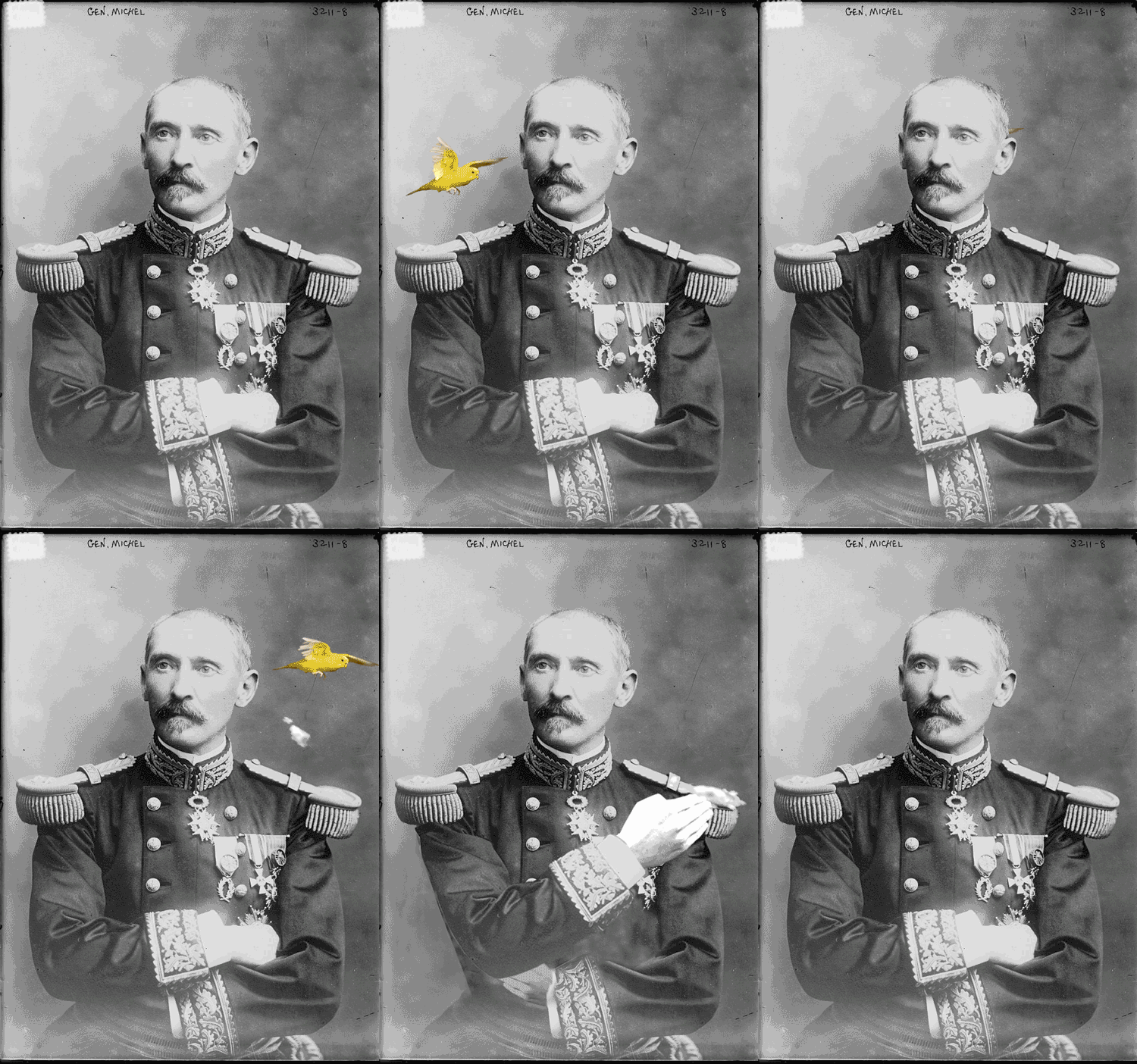
A General and a bird
I'm pressed for time tonight so this is just a brief post. Above is one of a series of animated gifs using old photos. It is from the La boite verte post Photographies anciennes animées en gif. Although this is my favorite, a couple of the other animations are nice as well.
Wednesday, April 04, 2012
Aurora on Jupiter
![]() |
| Click to enlarge |
From the Hubble Heritage image gallery, which has tons of great pictures from the Hubble Telescope.
Subscribe to:
Posts (Atom)