These are illustrations used in the 1906 French edition of H.G. Well's War of
the Worlds. They were done by the Brazilian artist Henrique Alvim Corrêa. He did early examples on spec and took them to London where he got Well's approval to go forward.
This is impressive work cleaning, painting, and fabrication parts as needed to restore an 1871 machine that makes candy drops. A large amount of knowledge went into the project. I was most surprised when he used a playing card to spread on layer of paint.
It must have taken him a long time to do the restoration. I would not have the patience to restore a single bolt. His attention to detail extends to the video, it is a very nicely filmed.
The military authorities say uniforms must be preserved at all costs, but that means manhandling patients who are in agony. Cut them off, says Sister Byrd, and she's the voice of authority here, in the Salle d'Attente, not some gold-braid-encrusted crustacean miles away from blood and pain, so cut they do, snip, snip, snip, snip, as close to the skin as they dare.
On either side of Paul as he cuts are two long rows of feet: yellow, strong, calloused, scarred where blisters have formed and burst repeatedly. Since August they've done a lot of marching, these feet, and all their marching has brought them to this one place. ― Pat Barker
It's odd to think how many iterations of life there have been on the earth. From the Cambian Explosion to today, which I'll call the Age of the Primate, life has ebbed and flowed as it morphed from one form to another. I have a fossil of a trilobite on my desk to remind me, when I get a bit down, that this little fellow too had his trials and tribulations. A life is just a speck of time, so enjoy it while you can.
A long time ago I read Rachael Carson's The Sea Around Us. It is a wonderful book in that it gives the oceans their own geography. From experience, the Gulf of Mexico is different than the Pacific, which is different from the Indian Ocean. Carson does a good job getting that across, dispelling the land-dwellers' notion that water is just water.
However, there is a weakness in the book which has to do with my trilobites and monkeys. Throughout the entire book she treated the oceans and continents as something eternal. There was land-building and erosion that took place around the margins, but the continents themselves were unchanging. As I read it I wondered, what about plate tectonics? Did she not know about the Theory of Continental Drift?
This was before the Internet, so I didn't know the answer to that question until about half-way through the book when she finally mentioned Continental Drift. She covered it in a couple of sentences, dismissing it as an obviously ridiculous theory from cuckoo-land that was best ignored. In juxtaposition to Galileo's 'and yet it moves' she offered, 'but not the continents'.
This prejudice, that places and times are something that are, or at least should be, frozen in amber is surprisingly widespread. It is obvious in modern Environmentalists, from the snail darter to ignoring the Sun and the receding Ice Age as they peer at their brief historical thermometer, but it is common elsewhere as well: canceling historical figures for living in their time, turning from cultural diffusion to cultural appropriation, and the myth of the 'good ol' days' as an aspiration.
On this blog I frequently poke fun of old-timey things. I suspect that 100 years from now there will be some future Flares poking fun of our foibles.
Walter Crane is 19th century illustrator who is most remembered today for his illustrations of nursery rhymes and children's books. He was also a committed socialist and he did numerous cartoons and other art for Socialist publications (I guess he really liked fairy tales).
As an aside, I have an old print of his Beauty and the Beast shown above. It's not creased, so it didn't come out of a book but was a later print. Along with it I have his illustration for Sinbad the Sailor which is quite striking as well. Sadly, I couldn't find it online.
Above an Aberjhani grandmother gathers cucumbers and then preserves them. When she's done she prepares a simple lunch. I'm always fascinated by the little details in these types of videos: the designs on the front of her toaster oven, the flowers painted on the side of her pot, the decorative lids she closes the jars with.
Below we have some men doing masonry as she prepares a meal of chicken stew. We end with grilled beef kebab. I wouldn't turn down an offer of a plate of that.
I fail to see why you did not understand that groceryman, he did not call
it "ground ground nuts," he called it "ground ground-nuts" which is the only
really sensible thing to call it. Peanuts grow in the GROUND and are
therefore GROUND-nuts, and after you take them out of the ground you grind
them up and you have ground ground-nuts, which is a much more accurate name
than peanut butter, you just don't understand English. ― Helene Hanff
Tune your television to any channel it doesn't receive and about 1
percent of the dancing static you see is accounted for by this ancient
remnant of the Big Bang. The next time you complain that there is nothing
on, remember that you can always watch the birth of the universe. ― Bill
Bryson
----------------------------
We like things to be black or white, tall or short, here or there. We
like to consider two sides to every story. Unfortunately, there aren't
always two sides. Sometimes there's only one; more often, there are
multitudes. Many facets on the stone. Nooks and crannies in abundance.
Things are usually not either black or white, but multicolored. ― Barry
Leiba
(Note: this was first posted on November 17, 2009. I'm reposting it for today's anniversary of the Hiroshima bombing)
A few years ago I happened to visited Hiroshima on August 7th, one day after the 63rd anniversary of the atomic bombing of the city.
When you get off the streetcar from the train station the first thing you see is the ruin of the Hiroshima Prefectural Industrial Promotion Hall. The atomic bomb detonated almost directly overhead of the building. With its few still standing walls, and its dome stripped and leaving only its framework, it is the iconic ruin of Hiroshima.
When you stand at that building, if you turn in a circle you realize your standing in a bowl surrounded by hills. Most of the rest of the buildings in that bowl were reduced to rubble by the bomb blast and resulting fires.
When they cleared the rubble they set aside several blocks of the old city as the Peace Memorial Park. You walk south along the river to get to the entrance to the monuments. At the entrance card tables are set up where there are petitions for peace that can be signed. You can buy peace t-shirts and listen to folk musicians strumming guitars and singing about peace. It is a fitting sentiment for this place.
The most visited monument is the Children's Monument for Peace. A young girl named Sadako Sasaki contracted leukemia after the bombing. As she sickened in the hospital she remembered an old Japanese saying that if one folds a thousand paper cranes one is granted a wish. She spent the rest of her short life folding paper cranes, but died before she reached one thousand. The Children's Monument for Peace was built in her memory, and in memory of all the children who died from the bombing. It is covered with paper cranes that school children have folded and sent to the park.
As touching as he Children's monument was, I most wanted to see a different monument. The monument pictured with this post. The Monument in Memory of the Korean Victims of the A-bomb.
There were tens of thousands of Koreans in the city when it was bombed. Most were forced laborers who had been brought to the city, housed in barracks and worked in the munitions plants of Hiroshima. Some 40,000 were killed, and a another 30,000 injured in the bombings of Hiroshima and Nagasaki. Most of the Koreans in Hiroshima were from Hapcheon, South Korea, and so sadly two cities ended up bearing the brunt of the attack (Atomic bomb survivors in South Korea still feel the wounds).
The Korean Monument was built in 1970 by South Koreans living in Japan and sited across the river and outside of the Peace Park. The Japanese authorities would not allow it to be placed in the Peace Park. It took until 1999 for permission to be granted to move it onto the Park's grounds.
As I stood in front of that Monument I could not help but reflect that all the paper cranes in the world would not have helped the dead honored by this memorial. That the peace petitions, while a fine sentiment, were no more substantial than Chamberlain's umbrella.
The Germans dressed prisoners up in Polish uniforms and shot them to justify their invasion that started the wider war in Europe. The Japanese used bayonets to stage their low-tech version of Hiroshima in Shangai as they spread ever deeper into China. The allies pounded cities with high explosives and incendiaries from the air. All across the globe men died in combat and civilians died behind the fronts.
A few days after Hiroshima's destruction Nagasaki was bombed. Hirohito then taped his surrender speech. That night a cadre of Japanese officers ransacked the palace seeking to destroy the recording and postpone Japan's surrender. How do paper cranes and petitions solve that sort of madness?
In the end, to me at least, this small place in the Park was less about the bomb and more about Korean farmers taken from their villages and used as forced labor. A life spent at the whim of masters. Another tragedy of the war.
My family and I were the only people at the monument when we visited it. The insciption on it reads, "Souls of the dead ride to heaven on the backs of turtles." At its base are small stones with Korean characters painted on them (pictured). The guidebook said you should leave a gift for the slain worker's ghosts. All I had were a couple of cigarettes. I supposed the ghosts might like to relax with a smoke and so I left them. It was all that I could do.
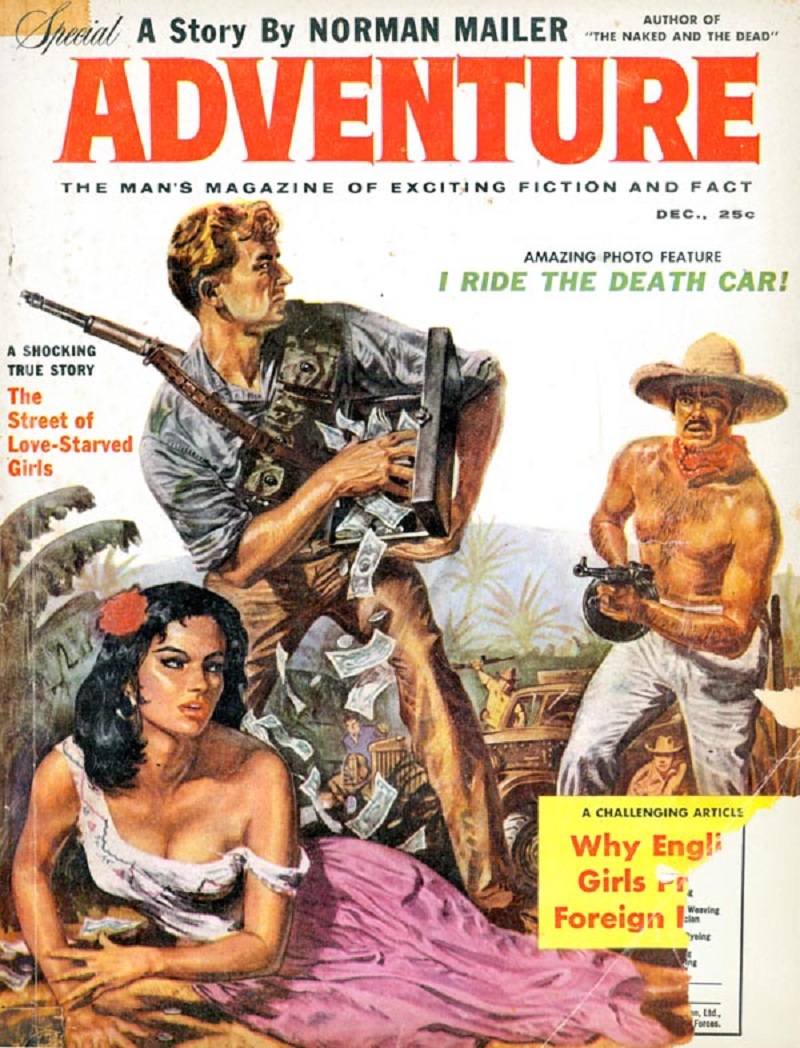
In my earlier post Popadanets -- Russian pulp propaganda about a genre of current Russian pulp fiction I ended it by making fun of the old-fashioned style of their cover art. I also noted the lack of buxom babes in their cover art, which seemed to me to be de rigueur for pulp cover art and sorely lacking in the Russian covers.
So, in the spirit of international friendship, and in the unlikely chance that mixed in with my daily traffic of spam-bots are some Russian pulp book cover artists, I've posted some American pulp art featuring buxom babes for enlightenment.
These examples, and those after the jump, are from 70-90 years ago and appear to match the art style the Russians are currently using. They were taken from Magazine Art's Adventure magazine post. There are more examples at the link.
I find these two guys to be entertaining and informative. They lived in China for several years and speak fluent Chinese. After sensing things were going south in China, they moved to the States, but they still primarily cover China. Their insights are always interesting and presented in an entertaining manner. Among other posts, they run a weekly podcase a podcast I usually watch at least in part.
As for Taiwan, after Hong Kong we should state that the 'One China Two Systems' position is clearly no longer tenable and that we don't recognize the CCP's position on that matter.
OK, this is weird. Earlier I posted about a visit to a Japanese Girls Bar. I probably should have known better than to do it, but I decided to search for other strange Japanese bars. That search led me to Japanese maid cafés and hoo-boy, they take cringe to a whole new level.
In the above video (turn on captions) a fellow takes us on a visit to a maid café. The waitresses are dressed in frilly, mini-skirted French maid outfits and talk in high pitched giggly voices. They greet him as Master and take him to a table where his maid (the owner of the place) serves him. The dining experience starts out absurd and gets more and more entertainingly ridiculous as it proceeds.
After showing him the entire menu, in a relentlessly cheerful and enthusiastic manner, she brings him the drink he ordered. She also has a flask, and she makes him recite some magical words to turn the contents of the flask pink, which she then pours into the drink tuning it pink too. It's magic! They then have to recite some more magic to infuse the drink with love so's it tastes even more delicious.
This magic business goes on with every dish she brings and finally ends up with them waving around heart-shaped plastic magic wands as they do their incantations. Along the way she also draws a cartoon bear on the eggs on top of his rice and eventually they take a picture together. For the picture he has to pose with her while wearing bunny ears. The guy's reaction through all this is hilarious. Understandably, he is completely embarrassed and yet he is still entertained by all the foolishness.
In trying to make sense out of this maid café lunacy I discovered it was rooted in Japanese anime culture. In fact, when the fellow first enters the café he says, "my otaku soul's screaming!" Otaku means: a person having an intense or obsessive interest especially in the fields of anime and manga. Appealing to that otaku crowd, the maid café is set up to be an anime world with the waitresses cosplaying as anime maids. In preparing this post I watched a recorded live stream made by two American guys and four girls who went to this same place -- their reactions were centered mainly around the anime elements of the café. They even recognized some of the anime characters the maids were imitating in their cosplay.
In the captions you'll see him use the word 'cute' repeatedly. Listening to the soundtrack he actually uses the Japanese word 'kawaii' which has a much more nuanced meaning than just cute. Kawaii refers to a specific cultural style. It refers to people or things that are "charming, vulnerable, shy and childlike". All of the elements of the café are deliberately kawaii: the color scheme, the frilly maid outfits, the high-pitched voices and giggling, the cutesy details of the food, the font styles they use, the goofy bunny ears, and the kid's games they play (shown in the video below). This is all performance theater for otaku fans.
Finally, we'll end with a video from Sue Perkins of the BBC visiting the same place. She's rather rude during the entire segment. What's she's obviously fixated on is the idea that these poor girls are forced to dress up and engage in this lunacy by the Eeeeevil patriarchy. What's funny is that much of this kawaii business was cooked up by young Japanese women (and one look at a J-pop boy band and the bunny ears the fellow above wears for his picture tells you that this kawaii stuff applies to boys as well as girls). Further, the neighborhood this café is in is the very center of otaku culture, so she has to know the context it sits in.
I picture her, in another setting, lecturing us about the wonders of diversity while all the time disdaining anything outside of her proscribed horizons. However, in fairness to Sue, I think it is part of a longer show called Japan with Sue Perkins so it may feel different when presented in the show, but in the clip we see she comes across as being insufferable. She ends the segment by informing us this is a place for shy men to interact with women. Well, it's partly that I suppose, but I think it is mainly just otaku Disneyland.
Henry Bosak is an American illustrator and painter, originally from Nebraska, but now based in Arizona. His still-lifes, rather than being the conventional bowls of fruit and what-not, are instead of mundane everyday objects. These examples, and those after the jump, are taken from his website (linked above via his name). I quite like his work. There are many more at his site.