Wednesday, November 23, 2005

Preparing for the Inevitable

I think it's really kind of bad form for commentators on any topic to announce that they predicted something when they can't point to a prediction in writing. So I won't make a point of having thought, when I first heard of Rep. Murtha's "conversion" to the anti-Iraq-War position[1], and then Senator Kerry's speech in which he said he "will not stand for the 'swift-boating'" of Murtha, I thought to myself, "This was pre-planned. They're reacting to the Republican attacks before any attacks have happened. I should write something about that now."

But, even though I predicted it, and I swear, my hand on the Enchiridion, that I was going to write about it, I didn't. So I can't take credit, and it would be untoward to make a point of it.

But I predicted it.

In any case, though, Howard Fineman writes in Newsweek:
In a long chat with an Irish colleague, he talked about his congressional hero and mentor, another blue-collar Irishman, Thomas P. (Tip) O'Neill. No liberal on defense, in 1967 O'Neill had stunned President Lyndon B. Johnson by telling him that the Vietnam War had become a lost cause. Now, Murtha mused, it was his turn to confront a president with harsh truths.

Which was precisely what the Democratic leadership wanted Murtha to do. A close ally, Democratic leader Nancy Pelosi, was anxious to open a second axis of attack on Iraq—and was aware of his growing antagonism toward the war. The two met and agreed that he would make his case in private to the party conference. After that, on his own, he would introduce a resolution calling for withdrawal of troops from Iraq "at the earliest practicable date." Pelosi and the other liberals would keep their distance, while their own Marine charged up the Hill. Framed by long rows of American flags at a press conference, he denounced the Iraq war as a "flawed policy wrapped in an illusion."

Murtha had known he would set off an explosion. He did. His arrival on the House floor was greeted with cheers from fellow Democrats, by dagger glances from Republicans.
(All emphasis mine.)

"After that, on his own"? After planning meetings with Pelosi, with the pre-planned response being that "liberals would keep their distance", and a pre-established cheering section (do you think the Democrats cheer every time Rep. Murtha comes on the floor?)

(Oh, and Fineman also includes this bit of psychic reportage: "An Ohio backbencher named Jean Schmidt, eager to demonstrate coldbloodedness,...." Wow. How do you suppose Fineman found out about that? Did someone leak him a memo from Schmidt to Hastert saying "Dear Denny, I'm eager to demonstrate coldbloodedness. Yr friend, Jean"? But I digress.)

In any case, it's clear that, far from being a moving moment of conviction (which we really knew anyway, since Murtha had been on record as saying the "war is unwinnable" in May of 2004), it turns out to have been part of a planned media play.

Which, even though I predicted it, I didn't post about. So I can't take credit for it.

But I knew it.

Shifting Sands 8 - What Might Have Been

"The issue was whether Florida's Supreme Court or the United States Supreme Court [would decide the election.] What did you expect us to do? Turn the case down because it wasn't important enough?"


I enjoy hearing Antonin Scalia's opinions concerning just about anything. He writes and speaks with a forceful clarity that has nothing whatsoever to do with the sophistry that passes for nuanced subtlety among "sophisticates" who lack both the talent and the backbone to say or write what they actually mean.

His remarks above as quoted in the New York Post are succinct but lead to an area open to vast speculation. Harry Turtledove writes in the genre of alternate history and has done some fascinating page turners about major historical events from a "what if" perspective.

Justice Scalia's remarks bring to mind a scenario suitable for examination by Turltledove. What if Gore had shown Nixon's graciousness (and foresight) when he conceded the '60 election? Would the political tenor of the past five years have changed? Would centrists within the Democratic party have been able to maintain the already fragile coalition of disparate interests that were disintegrating throughout the '90's? Would the party have been able to refrain from selling itself to the highest bidders with the lowest standards?

We shall never know with any certainty. What we do know is that the party's abject surrender of all standards of conduct to a noisome group that has never and will never account for more than twenty per cent of the electorate hastened the end rather than extended the life of a once great party.

"Governing the internet ... might be indistinguishable from destroying it."

The moment the free flow of packets over the Internet is no longer substantially guaranteed, it will cease to be trusted. Companies which are building businesses worth billions over the Internet protocols would stop if they knew a relative of the Tunisian President had to be placated for commerce to continue. Applications such email, instant messaging, searches, e-commerce, online banking, virtual medicine -- to name a few -- would be at the mercy of bureaucratic caprice, not just in the United States, but in every swamp and backwater imaginable. In the end, governing the Internet, especially in the United Nations sense, might be indistinguishable from destroying it. But one can see how that would appeal to those who yearn for bad, bad old days.
—(Wretchard)

Tuesday, November 22, 2005

The Mayor of Ar Rutbah

Every once in a while I click on over to Arts and Letters Daily. They often point to interesting stuff around the web. I did so just a few moments ago and found The Mayor of Ar Rutbah, by James A. Gavrilis, in the Nov/Dec issue of Foreign Policy.

Amid the chaos in Iraq, one company of U.S. Special Forces achieved what others have not: a functioning democracy. How? By relying on common sense, the trust of Iraqis, and recollections from Political Science 101.
It is a story that begins in April, 2003. If you are so inclined, read the whole thing.

We're ruined; and it's Oprah's fault!

Most readers in the conservative blogosphere will be familiar with Theodore Dalrymple's critiques of how the British welfare state has created a dependent underclass totally devoid of moral values. In a review of Dalrymple's recent book, Our Culture, What's Left of It: The Mandarins and the Masses, Richard Davenport-Hines argues that Dalrymple, "confronts so many bullies and demolishes so much delusive thinking in this brave, emphatic and undeniably important book; but the greatest ogre of all he will not even name."

Davenport-Hines agrees that Britain is indeed fallen, but Dalrymple, in playing to American neocons, cannot name the cause. This ogre is supposedly American popular culture. Britain was civilized into the 1970s, argues Davenport-Hines, so it was less the welfare state (built up in various stages over the last century, perhaps the most important being in the 1940s) than the spread of American television, fast food, and, more recently, political correctness that are to blame for the present moral crisis.

I tend to think that the font of delusive thinking is the desire to pinpoint blame for our universally fallen condition, to scapegoat while dressed in the respectable veneer of historiographical debate over fundamental causes. The real question is less what has gone wrong and who caused it? - things always go wrong, we are fallen - as why are people in a certain place or time without the creativity to save themselves once they come to recognize the problem?

Some are presently writing off France, as if the death of certain societies were a historical inevitability. Predicting her death is no doubt the safer bet, but in history there are no inevitabilities because humans are free. Will Britain save itself? The answer may depend on people finding the proper understanding of freedom, a freedom that is not understood in terms of the many romantic myths and lies that trap "individuals" in anthropologically false ideas of "their" personal freedom, but in terms of the recognition that we are free to act because at times we must act (lead and follow) to save ourselves. Once this recognition is sufficiently widespread a people can indeed do whatever it takes to get out of deep holes.

Reading Davenport-Hines, I was reminded of this quote that I picked up from Gil Bailie's Cornerstone Forum. I'm not a serious follower of Catholic debates on "the culture of death". But it strikes me that these words are as good as any for summing up our present moral crisis:
The culture of death is thus not the result of hedonistic excess. We lack the souls to be hedonists, which, in present circumstances, would be a moral achievement. Rather, in both its normative and exceptional guises, the culture of death is the poison fruit of excessive despair, born of a world made boring by our ‘freedom’ and a freedom made deadly by our boredom. – Michel Hanby


UPDATE:
BRITAIN'S first black Archbishop has made a powerful attack on multiculturalism, urging English people to reclaim their national identity.

The Archbishop of York, John Sentamu, said that too many people were embarrassed about being English. "Multiculturalism has seemed to imply, wrongly for me, let other cultures be allowed to express themselves but do not let the majority culture at all tell us its glories, its struggles, its joys, its pains," he said.

The failure of England to rediscover its culture afresh would lead only to greater political extremism, he said.
English urged to reclaim identity

I Need a Scholarship

And you thought Underwater Basket Weaving 101 was bad? Via An Englishman's Castle comes a link to a Whilshire College class entitled Appreciating Scottish Malt Whiskies.

Hmmmm... this needs to be taught? I thought that's what fraternities were for.

The class is open to anyone over 18 years of age and promises to impart "
knowledge of the subject, how to identify the different malts and introduce new flavours." It is not clear if home work is required, but hilariously enough this class appears to be a prerequisite for the follow up class, "Whisky and Cheese Complement Each Other" In addition, additional tutored classes in wine tasting are available.

They don't mention if job placement services are provided by the college.

The Number Spiral

Don't miss this. More fun than fractals. And while you're at it, don't forget the links page.

Credo

I hate to reproduce the whole thing, but I can't bear to excerpt it. Please follow the link to the original.


We believe in the United Nations, and Kofi Annan, the maker of international legitimacy.

We believe that the UN inspections worked.
We believe that SCUD missiles fired at U.S. troops minutes after the war began don’t change anything;
We believe that 3 liters of sarin gas used against U.S. troops doesn’t change anything;
We believe that finding evidence of mustard gas doesn’t change anything.

We believe that the war in Iraq conducted by a Republican president was unjustified because it lacked UN approval;
We believe that the "military action" in Kosovo conducted by a Democratic president was justified without UN approval.

We believe that the Iraq war was unilateral.
We believe that the participation of Albania, Australia, Azerbaijan, Bulgaria, Czech Republic, Denmark, Dominican Republic, El Salvador, Estonia, Georgia, Honduras, Hungary, Italy, Japan, Kazakhstan, South Korea, Latvia, Lithuania, Macedonia, Moldova, Mongolia, Netherlands, New Zealand, Norway, Philippines, Poland, Portugal, Romania, Slovakia, Spain, Thailand, United Kingdom, and Ukraine does not change the fact that the war was unilateral;
We believe that multilateralism can only be achieved with the participation of France and Germany;
We believe in multilateralism.

We believe that this war was motivated by greed and oil;
We believe that when France, Germany, and Russia opposed the war, they were motivated by principle, and not by sweetheart oil deals or Oil-For-Food kickbacks;
We believe that US oil prices are too high, and that the administration failed in its responsibility to do something about it.

We believe that the U.S. may only legitimately use force for humanitarian ends in one place if it does so in all places where aid might be needed;
We believe that the U.S. may not quell threats in places where the cost is relatively low unless it is willing to use force in places like North Korea, where the cost in lives would likely be very high;
We believe that a humanitarian action is only truly humanitarian if there are no strategic interests to muddle the altruism.

We believe that President Bush lied.
We believe that Prime Minister Blair lied.
We believe that when Hillary Clinton and Dick Gephardt voted for the war based on the same intelligence relied upon by Bush and Blair, they made reasonable decisions based on the intelligence available at the time.

We believe that the administration did not make the case for war;
We believe that the administration offered many different reasons but could not offer a coherent message explaining the need to go to war;
We believe that the administration made perfectly clear that the only reason we were going to war was because of the threat from WMDs.

We believe that there were no WMDs.
We believe that finding sarin gas is 14th page news;
We believe that if the sarin gas is old, then it really isn’t a WMD we were looking for;
We believe that it wasn’t really sarin gas;
We believe that sarin gas isn’t necessarily a WMD.

We believe that there was no terrorist connection to, or threat from, Iraq.
We believe that members of Abu Nidal in Iraq would not have committed terrorist acts if we had not invaded;
We believe that al Qaeda operative Abu Musab al-Zarqawi would not have committed terrorist acts if we had not invaded;
We believe that Saddam’s terrorist training camp at Salman Pak—complete with a Boeing 707 plane used for hijacking drills—did not exist or posed no real threat;
We believe that it was merely a coincidence that the pharmaceutical factory bombed by President Clinton in Sudan was using al Qaeda funds and a uniquely Iraqi formula to produce VX gas;
We believe that we are responsible for bringing terror on ourselves.

We believe that the prisoner abuse in Abu Ghraib is widespread and is probably the tip of the iceberg;
We believe that Abu Ghraib proves that the America’s occupation is no different than Saddam’s tyranny;
We believe that any attempt to suggest that there is a moral difference between a regime which systematically killed 300,000 people and tortured countless others and a regime which punished the acts of Abu Ghraib is illegitimate.

We believe that soldiers deliberately target women and children;
We believe that the soldiers abuse and kill Iraqis because they are racists;
We support our troops.

We believe that no one should question our statement that we "support our troops;"
We believe that the best thing that could happen for this country would be for Bush to lose in November;
We believe that the best way for Bush to lose in November is for the Iraq effort to go poorly, even if that means that more Iraqis and troops will die;
We believe that most of the troops are minorities and the poor;
We believe that when the word "heroes" is used to describe our troops, it should always be enclosed in scare quotes.

We believe in quagmire.
We believe that when fringe Iraqi groups attack hard targets and are soundly defeated with relatively low Coalition casualties, that this is inescapable evidence of crisis;
We believe that Iraq is Bush’s Vietnam.

We believe that Vietnam is the lens through which all wars should be viewed.
We believe that soldiers in Vietnam were baby killers;
We believe that John Kerry is a hero for his service in Vietnam.

We believe that because John Kerry is a hero, he necessarily has the national security expertise necessary to be commander-in-chief.
We believe that any attempt to question his national security expertise based on his voting record, including his decision to vote against a supplemental bill used to buy the soldiers body armor, is an unfair attack on the patriotism of a hero, who by virtue of this honorific has the expertise to be commander-in-chief.

We believe in the trinity: NPR, CNN, and the New York Times. We believe in Ted Kennedy, Tom Harkin, John Kerry, and all the DNC, and we look for President Clinton yet to come. Amen.


(Via Dr Sanity.)

Monday, November 21, 2005

Thinking Back on the French Riots

An underappreciated analyst, Britain's Melanie Phillips, has a piece quoting the French philosopher Alain Finkielkraut, on the ongoing effort to downplay the extent to which Islam was a factor in the outbreak of rioting across dozens of French cities:


'In France, they would like very much to reduce these riots to their social dimension, to see them as a revolt of youths from the suburbs against their situation, against the discrimination they suffer from, against the unemployment. The problem is that most of these youths are blacks or Arabs, with a Muslim identity. Look, in France there are also other immigrants whose situation is difficult - Chinese, Vietnamese, Portuguese - and they're not taking part in the riots. Therefore, it is clear that this is a revolt with an ethno-religious character… directed against France as a former colonial power, against France as a European country. Against France, with its Christian or Judeo-Christian tradition...

'We are witness to an Islamic radicalization that must be explained in its entirety before we get to the French case, to a culture that, instead of dealing with its problems, searches for an external guilty party. It's easier to find an external guilty party. It's tempting to tell yourself that in France you're neglected, and to say, “Gimme, gimme.” It hasn't worked like that for anyone. It can't work.’


To me it seems the degree to which Islam and Islamism figured into the rioting is still a controversial and unsettled question. But Finkielkraut's conclusion, for the French, and perhaps particularly for the French Jews, is frightening, and saddening:


‘But there's something in France - a kind of denial ... in the sociologists and social workers - and no one dares say anything else. This struggle is lost. I've been left behind.’

The Demolished Man

"They are dying for their own self-respect," he said. "It's a terrible thing to deprive someone of their self-respect. It's like your culture is nothing, your race is nothing, you're nothing."

Personally, I think it’s a worse thing to deprive someone of their own self-life. While I grant that people who go to a wedding party in a Jordon hotel are just asking for it (Insert obligatory come-back about the US mistakenly bombing a northern Iraqi wedding party here) you have to admit that it’s better to be alive, even if you have to deal with VOA satellite transmissions telling you your race is nothing – so worthless, in fact, that it deserves a democracy like Iowans and Britons and Japanese. Oh, we could just nuke your cities and take your oil, but we hate you so much we’re going to stay here and bleed and force your warring factions to hold subcommittee meetings on the constitutional process. It's bored our people to tears; now it's your turn.


Lileks destroys Vonnegut.

Carnival of Pre-War Intelligence

This is great! OSM and Glenn Reynolds have put together a Carnival of Pre-War Intelligence. No, not the Kerry "History will show that none of the leading Democrats had substantial intelligence" kind (h/t Gateway Pundit).

I did not write anything on the subject but I do have an opinion just the same:

We did indeed find two types of WMD in Iraq: the Insurgency and the Purple Fingers.

And the Purple Fingers are proving to be the most powerful weapon in Iraq's arsenal.

How to lose a democracy

The Australian: Muslim fanatics terrorise a nation [ 21nov05 ]: "Islamist murders and threats have transformed the once-tolerant Netherlands into a place of armed bodyguards and fear, writes Anthony Browne."

I listen to so many Americans who are complaining that the Patriot Act is removing our civil rights, and that if these rights are watered down at all, we will lose the very freedoms we are fighting for. Well, I think they are looking in the wrong direction.

One of our most basic freedoms is our freedom of speech. Political Correctness has already done us harm as far as free speech goes, because PC actually attempts to control our thinking. But the punishment for an un-politically correct statement is merely censure or mockery.

The punishment for speaking out against Islamist fanatics or even criticizing Islam may be death.

The heart of any democracy is public discourse and dissent. If we lose the ability to speak our minds and attempt to pursuade others of our individual points of view, we lose our democracy.

What is happening in the Netherlands, a place where freedom and tolerance were the envy of many throughout the West, is far worse than a librarian telling an FBI investigator what book one may have shown an interest in. It is worse than the recent car-burnings in France. It is the death of free speech. The death of democracy.

We see signs of it elsewhere in CAIR's protestations and the business community caving to their pressure. We see signs in the banning of piggy banks from Britain's financial institutions. We see signs in the politically correct approach the New York Times takes on any story involving muslims or Islam.

The battle against terrorism is only one level of this conflict between the tolerant and the intolerant. We have not yet begun to fight the other, larger, battle.

I will end, as the linked article does, with the same horrifying words:

"There is self-censorship."

Speaks for Itself

The generosity index, which calculates the amount people give to charity in each state as a fraction of their total income, has been computed. You can see why the Democrats expect to take Colorado next time.


Posted for Buddy Larsen [HT Michelle Malkin]

Congressional Omerta

From The American Thinker

Americans justly pride themselves on having the most open government in the world. Aside from our intelligence services and certain aspects of the Justice Department, the business of governance is supposed to be conducted in sunlight. Anyone in the world with knowledge of the English language, access to a computer and the patience to learn a rather simple search system can visit the House of Representatives and the Senate and the Congressional Record for as detailed a view of the process of governance as has ever been available to a country's citizens in the history of the world.

Americans are also very attentive to Lord Acton's dictum concerning the propensity of power to corrupt. Through their elected representatives they have established various controls from time to time to assure impartial investigation and prosecution of malfeasance by elected or appointed officials. One such attempt was the Office of the Independent Counsel, established in 1978 in reaction to President Nixon's firing of Archibald Cox in order to forestall the investigation into Watergate. The statute authorizing the Office of Independent Counsel required that each counsel report to Congress the findings of the investigation of the incident(s) that gave rise to the appointment.

The OIC had a somewhat checkered history and the statute authorizing its existence was allowed to expire on September 11, 2001. At the time of its expiry there was one investigation remaining to be completed. That investigation initially concerned allegations that President Clinton's then Secretary of Housing and Urban Development, Henry Cisneros, had made false statements to FBI agents during a background check. Mr. Cisneros plead guilty to a misdemeanor charge, paid a $10,000 fine and was one of those pardoned by President Clinton just before his exit from the White House.

It would seem that Independent Counsel David Barrett who was appointed in May of 1995 should have been able to write and publish his report sometime in the year 2000 from the facts presented by the Minority Report of the Committee on Government Reform. The report presents Counsel Barrett's failure to publish his report as if it were some sort of misbehavior on his part. It appears to allege that he is wasting money and that the Democratic Minority Report has actually found a major boondoggle worthy of close scrutiny.

It is odd that the Democratic Minority Report mentions not one word concerning the actual reasons that David Barrett's operation continues to this day. One might imagine that at least one Democrat might have noted Tony Snow's piece back in April when Senators Kerry, Dorgan and Durbin tried to kill funding so that Barrett's report would never see light. They might also have taken note of the Wall Street Journal editorial of October 7 or Byron York's NRO piece of October 25 or his subsequent piece on November 18. Finally, they might even have noted the meticulously buried item in their favorite paper, the Washington Post in an article on October 1.

The Post forgot to edit out one sentence that solves the entire mystery of 'the report which couldn't be buried'.

Barrett has expanded the probe to look into allegations that a regional Internal Revenue Service audit into Cisneros's payments to the mistress was transferred to Washington and then stifled.


What in the world does the Barrett report contain that requires three US Senators and the entire Democratic membership Committee on Government Reform (now that's chutzpah)to bury? Why did the Conference Committee overseeing IC Barrett agree to keep the most critical part of the report buried after the DC Court of Appeals finally halted the flood of motions by William & Connolly that sought to push the reports release into the 22nd Century?

Americans love a good mystery almost as much as they love sunshine. Independent Counsel Barrett has fought for disclosure to the very end. The order by a panel of the DC Court of Appeals that the "sealed" Section V of Barrett's final report be made available to nine named members of Congress for distribution by them to other members and staff is tantamount to tearing out the last chapter in a mystery novel.

The American public will hear of the published but restricted contents of Section V via anonymous leak and innuendo and the redacted portions will be subject to surmise based upon political advantage. The order by the Court of Appeals is a compromise that will satisfy no one.

Senator Chuck Grassley and the Hon. James Sensenbrenner should be encouraged to be more forceful on this issue. Directing the IRS to impede an investigation of the Executive is a matter requiring sunlight's disinfectant properties.

Sen. Chuck Grassley
135 Hart Senate Bldg.
Washington, DC
20510-1501
202.224.3744

Congressman F. James Sensenbrenner Jr.
2449 Rayburn House Office Building
Washington, D.C. 20515-4905
Telephone: (202) 225-5101

I Knew They Were Nuts

ShrinkWrapped has begun a new series with the easy to remember title of "Narcissism, Disintegration, Suicidality & the Fall of the West" which continues the investigation of the "root causes" of the self destructive thought and behavior exhibited by those sitting in the reserved seat section of life's short bus.

As usual, ShrinkWrapped is exhaustive in his analysis without ever being exhausting to the reader.

UPDATE

David Thomson notes:
On a similar note, Melanie Phillips links to the Ha’aretz interview with the noted French philosopher Alain Finkielkraut:

"‘But there's something in France - a kind of denial whose origin lies in the bobo, in the sociologists and social workers - and no one dares say anything else. This struggle is lost. I've been left behind.’"

Sunday, November 20, 2005

We're winning ... in Iraq at least

Results. Another goal was to advance freedom and democracy in the Middle East--not just to help the people there but to change the mind-set of the region that produced the attacks of September 11. Before 2003, the dictators and authoritarian rulers of the region focused their peoples' inevitable discontent on the United States and Israel. Now the progress toward democracy in Iraq is leading Middle Easterners to concentrate on the question of how to build decent governments and decent societies. We can see the results--the Cedar Revolution in Lebanon, the first seriously contested elections in Egypt, Libya's giving up WMD s, the Jordanian protests against Abu Musab Zarqawi's recent suicide attacks, and even a bit of reform in Saudi Arabia. In Syria, the Washington Post' s David Ignatius reports, "People talk politics here with a passion I haven't heard since the 1980s in Eastern Europe. They're writing manifestos, dreaming of new political parties, trying to rehabilitate old ones from the 1950s."


Michael Barone

Updated 2005-Nov-20 10:21:26: Via Powerline, See also today's Washington Times ---

AMMAN, Jordan (AP) -- Family members of Jordanian-born Abu Musab al-Zarqawi renounced the terrorist leader Sunday after his al-Qaida in Iraq group claimed responsibility for the Nov. 9 suicide attacks on three Amman hotels that killed 59 people.

The family of al-Zarqawi, whose real name is Ahmed Fadheel Nazzal al-Khalayleh, reiterated their strong allegiance to Jordan's King Abdullah II in half-page advertisements in the kingdom's three main newspapers. Al-Zarqawi threatened to kill the king in an audiotape released Friday.

"A Jordanian doesn't stab himself with his own spear," said the statement by 57 members of the al-Khalayleh family, including al-Zarqawi's brother and cousin. "We sever links with him until doomsday."

The statement is a serious blow to al-Zarqawi, who no longer will enjoy the protection of his tribe and whose family members may seek to kill him.

"As we pledge to maintain homage to your throne and to our precious Jordan ... we denounce in the clearest terms all the terrorist actions claimed by the so-called Ahmed Fadheel Nazzal al-Khalayleh, who calls himself Abu Musab al-Zarqawi," the family members said.

"We announce, and all the people are our witnesses, that we - the sons of the al-Khalayleh tribe - are innocent of him and all that emanates from him, whether action, assertion or decision."

The statement said anyone who carried out such violence in the kingdom does not enjoy its protection.


Further update (speculative), added 2005-Nov-20 12:22:46: It occurs to me, having watched the Sunday morning talking heads, that we're not only winning the war in Iraq, but that the political calculations on the part of the Democratic Party in fact include in their calculations the fact that we're winning. Consider:
  • in the last week, we've seen Rep Murtha's "sense of the House" resolution demanding immediate withdrawal (except that it's only "immediate withdrawal" in Murtha's own words when he's talking to the press, but it's not an immediate withdrawal when challenged, and only an immediate drawdown if it's not a demand that the forces be increased, or a demand that the forces be mainted at current strength while it increases the risk of drawing them down.) This appeared, coincidentally, at the same time that the commander of US forces in Iraq gave the Department of Defense a plan for drawdown of the forces on a brigade-by-brigade basis. This plan exactly corresponds to the stated plans since time immemorial (in legacy media terms, more than three weeks ago.)
  • We have also seen Senator Kerry demanding an immediate drawdown of 20,000 troops, coincidentally at the same time as the Department of Defense was annoucing plans to draw down forces by about 21,000 directly following the December election.
  • Senator Biden (on Fox News Sunday this morning), while declaiming sonorously that the Administration either has no plan or that the plan is a failure (it was a little hard to tell which) demanded a change to a plan in which we draw down forces following the establishment of an Iraqi military capable of keeping peace in Iraq and fighting the insurgency, and the establishment of a government in which all the major tribes and ethnic groups have a stake. (It doesn't have to be a "liberal democracy", however. That's apparently too much to ask of Arabs.)
In other words, it appears that the actual stated demands of the Democratic opposition are to withdraw forces when it's safe, maintain them while they are needed, comply with already-existing drawdown schedules, and not leave until we've established a military capable of defending Iraq and a representative government supported by the majority of Iraqis across all ethnic groups.

A plan which is, as far as I can tell, completely indistinguishable in any stated goal or approach from the plan that has been in place and widely discussed by the Administration.

If the Democratic party leadership thought we were not winning, would they be demanding that we proceed exactly according to the stated plans?

User's Guide to Intelligence Leaks

It's been a big couple of weeks for news of leaks of intelligence. There is, of course, the continuing saga of the Valerie Plame Identity. There was the recent succession of leaks of secret CIA air flights, secret CIA prisons, and so on. I usually like to have three examples, but I'll leave it as an exercise for the interested reader to find them; I promise that it would only take a few back issues of the Washington Post or the New York Times to find them.


With that in mind, however, let's think about what can and can't be inferred from these leaks. Remember that, in general, classified information is classified for a reason: we know what we know about Them and how we got it, and we don't want Them to know what we know, especially if that might let Them figure out how we know it. (Technically, "how we got it" is called "sources and methods".) Everyone who works with classified materials knows these things; in fact, one is required to take regular courses and briefings on what classification means, why classification is important, and what unexpected methods might be used to try and get classified information. (I recall in my youth a lot of talk about sloe-eyed Gallic women.) In modern times, the potential importance of classified information is codified in the Espionage Act (18 U.S.C. § 792 et seq.) and the Intelligence Identities Protection Act (50 U.S.C § 421), which establish extremely serious penalties for revealing classified information.


So ... then why are there leaks of this sensitive information? There are many reasons, but as a first approximation, all intelligence leaks should be treated as satisfying three conditions, which shall be henceforth known as Seneca's Law of Leaks:


  1. All leaks come from someone with considerable bureaucratic power, or under the protection of someone with bureaucratic power. (Why? Because without bureaucratic power, the risk is too great.)

  2. The information in the leak is not complete, and may very well not be true. In fact, it is very likely to be nearly or completely untrue, for the simple reason that if it were well-informed and true, it would actually cause substantial harm, and expose the leaker to real risk.

    However, the likelihood that the material will cause real damage is directly proportional to the bureaucratic power of the leaker.


  3. The information is leaked in order to serve the political or bureaucratic purposes of the leaker. It is never leaked with pure and altruistic motives. On the other hand, it is never leaked by someone who obtained the information by active espionage, because the people who commit the espionage don't want it known that they know what they found.


Note that these rules are non-partisan: they apply equally to John Kennedy's revelations about the "ICBM Gap" and the leak by a Republican senator of the fact that NSA was intercepting Usama bin Laden's satphone communications.

An interesting correlary to point 2 is that the information is very likely to be from someone with bureaucratic power, to that person's political advantage, and exactly contradicting the true intelligence, because the risk of revelation is now zero, while the risk of being contradicted is also very small — because attempting to contradict the leak will reveal sources and methods. Any time the person revealing this information is easily identifiable, the likelihood of this is very much increased. (In this context, consider, for example, the "Missle Gap" of the 1960 Presidential campaign. The information Kennedy presented wasn't true, and — since he was a member of the Armed Services Committee, which would see threat assessments — he very likely knew it wasn't true. Nixon, however, could say it wasn't true, but couldn't say how he knew or what the truth was.)

Economics Quiz

(From James Hamilton via Jane Galt):
Sometimes I like to base exam questions for my students on recent news. Here's an exam question to see how thoroughly students understand the economic issues associated with today's allegations about oil companies and the Cheney energy task force.

EXAM ESSAY QUESTION (answer on separate paper)

Senator Frank Lautenberg (D-NJ) today issued the following press release:

In the four years since the secret Cheney task force met, we have seen gas prices double and oil company profits skyrocket. What went on at these secret White House meetings that may be motivating oil company executives to deny their participation? Now it appears that some Big Oil CEOs might have lied to Congress to cover up their involvement with the White House task force. What are they trying to hide from the American people?

Your assignment is to describe in detail the possible economic mechanisms whereby the actions of this task force might have contributed to a doubling in the world price of oil. Be sure to address in your essay the following issues.

1.) The Cheney task force resulted in the Bush energy plan released in May 2001. Discuss in detail three elements of this plan that led to an increase in oil prices. Be sure to explain how this happened despite the fact that the legislation proposed in that plan was not passed by the Senate and, if passed, would have increased energy supplies.

2.) Even if one ignores the Bush energy plan itself, explain how secret consultations by the task force could have resulted in higher oil prices. Recall that the five executives who were called before the Senate last week represented BP, Exxon-Mobil, Shell, Chevron, and ConocoPhillips. Including all their global operations, these five companies between them produced 10.1 million barrels of oil per day in 2004 (data from Petroleum Review with a tip of the hat to The Oil Drum), which would represent 12% of global production of 83 mbd. Describe the precise actions these companies could have taken that could have led to a doubling of oil prices. If possible, bolster your argument with a numerical example using plausible elasticities and actual production figures.

3.) Develop further Lautenberg's theme that the statements made by those called before the Senate were knowingly false. In particular, refute the claim by ConocoPhillips CEO James Mulva that in 2001 he had been the chief executive of Phillips and that Cheney met with someone from Conoco, which at that time had been a separate company.

4.) Perhaps the most important accusation made by Senator Lautenberg is that the statements by the oil company executives before the Senate committee were misleading. Describe some of the economic harm that can result when someone in a position of power makes statements that could result in a misunderstanding of the facts by the American public.
I'd say "read the whole thing" except that is the whole thing. But it's a fascinating exam. I'd love to see some answers.

(Note to commenters: I'm 2000 years old and I've had a hard week, I'm entitled to be a little irascible. Comments that bring up the Iraq War, claim that Cheney was trying to help his oil buddies without answering any of the questions in some substantive manner, or are simply unutterably stupid, will be deleted without mercy or remorse.)

The Unbearable Lightness of Being...

...Western, or "Why There Is No Force On Earth That Can Resist Us At This Moment In History..."

(For better or worse.)


Via Warren Bell of NRO's The Corner.

Saturday, November 19, 2005

Saturday Geekpost, Part II--Flock

Right after I posted that last post I happened to come across something immensely cool. Since it's a slow night I'll take the opportunity to hog all the bandwidth.

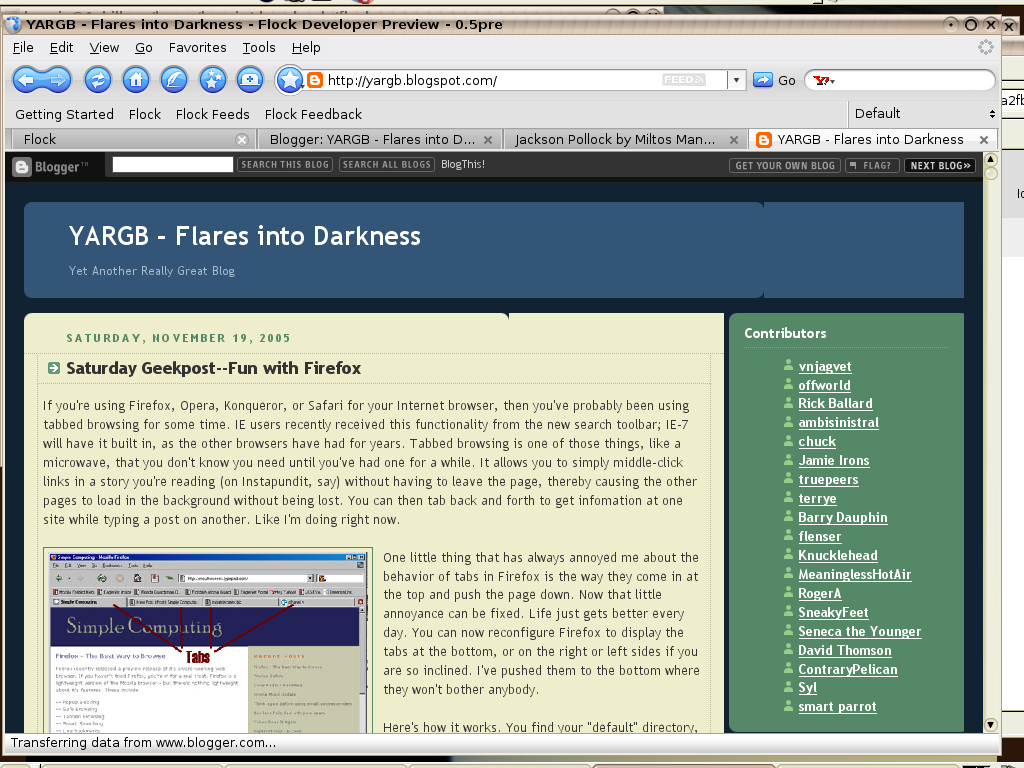
There's a new web browser called "Flock". You can download it here, but you should be warned that it's still beta software, i.e., not ready for prime time yet. Still it's so cool I had to mention it. Here's a screen shot.


Notice the tabs at the top.

Why do we care? Flock is a "social" browser. First, see that star at the top? Click that and the currently opened page will be put into your del.icio.us account, a kind of social bookmark service which allows you to access your bookmarks from any computer, work, home, laptop, or on the road, and allows other people to check out some of your bookmarks. See mine at http://del.icio.us/meaninglesshotair.

Second, if you click the fourth button over, the one that looks like a quill pen, you get a small separate window that allows you to create a blog post that goes directly onto YARGBY! You can be looking at one site while blogging about it in a separate window. I'm using it right now to write this post.

There are, as always, more features. I'm just getting started with it tonight. Read more about it here.