Monday, November 20, 2006

Bill Roggio Reports

Bill Roggio is working his way around Africa and the ME again with some excellent reporting. He provides a good quote from a piece by Michael Fumento -
During [the sniper team's] deployment, [team leader SSgt. Ken] Cooke's handful of snipers (the exact number is under wraps) with those 120 kills have accounted for about a fifth of the total known kills of the 1/506th. Meanwhile enemy snipers, though generally the most skilled of the enemy fighters and armed primarily with good 7.62 millimeter Soviet Dragunov sniper rifles, have killed 1 member of the battalion. The battalion plus its support units have lost a total of 8 men while killing about 600 – a stunning ratio of 75:1. Think about that the next time you hear of the prowess of the enemy.
Getting the information out on this kind of kill ratio will make watching the civil war a bit easier to take. Ramadi seems to be a very attractive kill zone for the moment. Maybe the 506th could hold a competition with the Sunni sheiks?

It couldn't hurt.

Krauthammer's Iraqiphobia

Or maybe Malikiphobia.
Are the Arabs intrinsically incapable of democracy, as the "realists" imply? True, there are political, historical, even religious reasons why Arabs are less prepared for democracy than, say, East Asians and Latin Americans who successfully democratized over the last several decades. But the problem here is Iraq's particular political culture, raped and ruined by 30 years of Saddam's totalitarianism.
That's certainly true but part of Saddam's notoriety as an above average muslim thug comes from the fact that some Iraqi's did attempt insurrection and his reaction was not much different than the Syrians or the Algerians or the Iranians or the Jordanians or the Saudis or the Egyptians or the Turks or the Paks or the Afghans or the Somalis or the Sudanese or the Libyans or the Lebanese ad infinitum, ad nauseum.
But unless the Iraqis can put together a government of unitary purpose and resolute action, the simple objective of this war — to leave behind a self-sustaining democratic government — is not attainable.
Can't argue with that.

They never knew what hit em

Noel Sheppard of the American Thinker does a very interesting piece on the old bait and switch:

As a result, to make this “assassination” work, step two was to get a previously adoring press quickly to alter its view of the Congressman, and comply with the need for a hit job. And, comply they did.

First out of the gates was NBC Nightly News, which on Thursday evening, just hours after the historic vote, fabulously threw Murtha under the bus. After playing the now infamous video of the Congressman discussing a bribe with an FBI agent – a video whose public display was totally verboten before the election – correspondent Chip Reid reported:

Murtha was investigated by the FBI in the Abscam bribery scandal 26 years ago, though he was never charged, and recently expressed frustration over a proposed Democratic package of ethics reforms.

Rep. MURTHA: (From MSNBC’s “Hardball”) And it is total crap that we have to deal with an issue like this when we got a war going on.

Reid concluded this segment by getting a quote from political analyst Norman Ornstein:

You can’t have the theme that you’re going to clean up the culture of corruption and then hand pick somebody who is a product of that culture.

Next up to kick the carcass of one suddenly despised by his caucus was the New York Times which published a scathing editorial on Friday that could have been found at either the Washington Times or the National Review:

The well-known shortcomings of Mr. Murtha were broadcast for all to see — from his quid-pro-quo addiction to moneyed lobbyists to the grainy government tape of his involvement in the Abscam scandal a generation ago. […]

Mr. Murtha would have been a farcical presence in a leadership promising the cleanest Congress in history.

All We Are Saying is Give War a Chance

With step two complete, it was next essential for the media to begin laying the groundwork for changing the public’s view concerning Iraq. The network morning news programs were willing accomplices as NBC’s Matt Lauer set up a segment on Friday’s Today Show:

Americans let Congress know loud and clear they’re not happy with the war in Iraq, but what would happen if the US just packed up and left?

Correspondent Richard Engel amazingly responded:

Well, I think what happened in southern Iraq yesterday is a good example of the kind of security situation that would develop. In those provinces in the south where those Americans were kidnapped, British and Italian forces have been pulling back and handing over authority to the Iraqi security forces. But instead of having a stable environment, it was handed over to militiamen and highway robbers, and a—probably a similar pattern would be repeated across the country.


The whole thing is worth reading. Have the anti warriors been had? Snookered? Lied to? Used? One can hope.
H/T AJ .

True to Form

Levin and Syria are on the same page, they both want a timetable for surrender, I mean troop withdrawal.

Rangel calls for bringing back the draft. In all the tons of campaign propaganda I got from Democrats in the lead up to the midterms there was no mention of a draft. Makes you wonder.

Last but not least AJ has an interesting post about a story of Iraqis fighting AlQaida:

While the Democrats push for America’s complete surrender to Al Qaeda in Iraq, thankfully the Iraqis themselves are stilling clawing their way to a democratic future. More indications are being seen that Al Qaeda’s brutality against Iraqis is starting to pay off - for the Coalition. Sunni’s are openly standing up against the Al Qaeda outsiders -0 and winning:

A power struggle is taking place in the Sunni triangle, with tribal leaders and coalition forces aligning against a common enemy …

While the world’s attention has been focused on Baghdad’s slide into sectarian warfare, something remarkable has been happening in Ramadi, a city of 400,000 inhabitants that al-Qaeda and its Iraqi allies have controlled since mid-2004 and would like to make the capital of their cherished Islamic caliphate.

A power struggle has erupted: al-Qaeda’s reign of terror is being challenged. Sheikh Sittar and many of his fellow tribal leaders have cast their lot with the once-reviled US military. They are persuading hundreds of their followers to sign up for the previously defunct Iraqi police. American troops are moving into a city that was, until recently, a virtual no-go area. A battle is raging for the allegiance of Ramadi’s battered and terrified citizens and the outcome could have far-reaching consequences.


I made a comment to that post that I will add here. The outlaws of the Wild West ruled the place until ordinary people stood up to them. The same could be true of Iraq.

In ‘88, Pelosi Voted to Impeach Hastings — Will She Support Him Now?


"One of the newcomers to the House was the future Speaker Nancy Pelosi, who had been in office a little more than a year. She voted to impeach Hastings.

Rep. Steny Hoyer, the future Majority Leader, also voted to impeach. And so did the lawmakers who will soon chair powerful House committees. Rep. Conyers, now in line to become chairman of the House Judiciary Committee, voted to impeach. Rep. Charles Rangel, soon to chair the Ways and Means Committee, voted to impeach. Rep. Barney Frank, in line to head the Financial Services Committee, voted to impeach. Rep. Henry Waxman, next chair of the Government Reform Committee, voted to impeach. Rep. John Dingell, in line to chair the Energy and Commerce Committee, voted to impeach. Rep. George Miller, soon to head the Education and the Workforce Committee, voted to impeach. Rep. David Obey, in line to chair the Appropriations Committee, voted to impeach. Rep. Ike Skelton, next chair of the Armed Services Committee, voted to impeach. Rep. John Spratt, next in line for the Budget Committee, voted to impeach. Rep. Howard Berman, next head of the Ethics Committee, voted to impeach. Rep. Tom Lantos, in line to chair the International Relations Committee, voted to impeach. And Rep. Louise Slaughter, next chair of the Rules Committee, voted to impeach.

So did other well-known Democratic lawmakers like Rep. John Lewis, Rep. (and later Sen.) Barbara Boxer, Rep. (and later Sen.) Charles Schumer, Rep. (and later Sen.) Richard Durbin, Rep. Ed Markey, Rep. Ron Dellums, Rep. Julian Dixon, and Rep. Richard Gephardt."

Sunday, November 19, 2006

CARPE DIEM: Tax Facts

CARPE DIEM: Tax Facts: "From the most recent report from the Congressional Budget Office:

1. Corporate income tax revenues almost doubled over the last two years, from $189 billion in 2004 to $354 billion in FY 2006.

2. Corporate income tax receipts rose by 27.2% from FY 2005 to FY 2006.

3. Individual income tax revenues increased by 12.6% in 2006 to more than $1 trillion, the highest level in US history.

4. The budget deficit, as a percent of GDP, fell to 1.9% in FY 2006, the lowest level in 4 years, and well below the average of 2.3% since 1965. "

Unstable? | Free exchange | Economist.com

Unstable? | Free exchange | Economist.com: "LAST month, unemployment hit 4.1% in America, the lowest level the nation has seen in thirty years. Yet at the same time, Democrats are vowing to protect American jobs from foriegn competition by limiting trade, gobalisation, and especially outsourcing. If gobalisation is sending jobs abroad, how is it that unemployment is so low?"

While we weren't looking....

Bomb Iran - Los Angeles Times

Bomb Iran - Los Angeles Times: "After the Bolshevik takeover of Russia in 1917, a single member of Britain's Cabinet, Winston Churchill, appealed for robust military intervention to crush the new regime. His colleagues weighed the costs — the loss of soldiers, international derision, revenge by Lenin — and rejected the idea.

The costs were avoided, and instead the world was subjected to the greatest man-made calamities ever. Communism itself was to claim perhaps 100 million lives, and it also gave rise to fascism and Nazism, leading to World War II. Ahmadinejad wants to be the new Lenin. Force is the only thing that can stop him."

This settles it

If you want to know what the Democratic Party is going to do, just listen to what they swear the Republican Party is about to do. It worked for voter fraud, it works for vote suppression efforts, and now, we see their prediction that the draft would come back.

Rep. Rangel will seek to reinstate draft - Boston.com: "WASHINGTON --Americans would have to sign up for a new military draft after turning 18 if the incoming chairman of the House Ways and Means Committee has his way.

Rep. Charles Rangel, D-N.Y., said Sunday he sees his idea as a way to deter politicians from launching wars and to bolster U.S. troop levels insufficient to cover potential future action in Iran, North Korea and Iraq.

'There's no question in my mind that this president and this administration would never have invaded Iraq, especially on the flimsy evidence that was presented to the Congress, if indeed we had a draft and members of Congress and the administration thought that their kids from their communities would be placed in harm's way,' Rangel said."
It will be amusing --- in a sort of cynical disgusted way --- to see how the legacy media tries to spin this as George Bush's fault.

The American Thinker

The American Thinker: "George W. Bush qualified for that training by virtue of having a college degree, being in excellent health, and being willing to commit several years of his life to a role for which there were constant shortages. He did not jump to the front of any line: for what he was qualified to do, there was no line! Yes, there was a line for non-degreed enlistees wanting to be in the ANG, but in the officer positions required of pilot trainees, the ANG was begging for applicants. No doubt most of the recent Yale grads were out helping the poor.

Mr. Schorr is well aware of these facts, but slyly keeps re-playing the canard that Mr. Bush somehow exhibited cowardice and took advantage of family connections when he volunteered to undergo several years of full-time, dangerous as hell, flight training. I would wager that Mr. Schorr has never done anything half so brave – I know I haven’t – and it is about time he and NPR apologized for the knowing slander he is allowed to utter on your radio network nearly every week."

Climate Science: Roger Pielke Sr. Research Group Weblog » Iceberg Spotted from New Zealand Shore

Climate Science: Roger Pielke Sr. Research Group Weblog » Iceberg Spotted from New Zealand Shore: "This observation is interesting in light of the below average sea surface temperatures that are currently observed in the Southern Hemisphere high latitudes (see). In the November 17 2006 analysis, the cold anomalies extend north to the South Island of New Zealand.

The news article makes the standard comment on whether or not this event is related to global warming. The more appropriate climate science question, however, is whether the geographic distribution of icebergs in both hemispheres have changed over the last several decades, and, if so, why? In the case of this event, it appears that colder than average ocean conditions in this region are part of the explanation.

The question to the media is why hasn’t this rare (but cold) climate event (and last year’s sightings in New Zealand) been reported more widely?"

Smaller Government

Is there really a desire among the electorate for smaller government? This is not a facetious question. I have come to wonder if this is something that most Americans really do not care about.

I remember that Bush did not really want the 9/11 Commission or a new department of Homeland Security for that matter but there was public pressure for both. The result of course was a large expansion of the federal government. But at the time of its creation the Homeland Security Department was originally opposed by Bush who was criticized for that opposition:

The Gallup polling reported yesterday found that even though Democrats originated the proposal for a permanent homeland security department and President Bush initially opposed the concept, he was later successful in convincing a majority of Americans that it was a White House idea.

Three-fourths of Republicans polled say the new department will be at least somewhat effective and approve of it. Little more than half of all Democrats said they think it will be somewhat effective. One in 10 Democrats said they expect that the department "will not be effective at all."

There has been some criticism by conservatives of the drug prescription plan, but there is still pressure from the public to do more to help people pay for health care:

In an extensive ABCNEWS/Washington Post poll , Americans by a 2-1 margin, 62-32 percent, prefer a universal health insurance program over the current employer-based system. That support, however, is conditional: It falls to fewer than four in 10 if it means a limited choice of doctors, or waiting lists for non-emergency treatments.


Such a program would mean a much larger role for government and yet there certainly does not seem to be a groundswell of resistance to the idea, in fact more and more people seem to be warming to the idea.

I also noticed that among immigration hardliners there was never an attempt to honestly portray the costs in terms of added resources in manpower and money to ridding the country of all illegal aliens. The idea was that since this is a necessary function of government the costs is irrelevant.

But doesn't everyone feel that way? If it matters to me, it is important and the costs should be borne, the people hired, the bills passed.

In truth I think that most people would prefer the good old standard tax the rich policy to stringent budget cuts and while Americans are most certainly capitalists and not socialists they do feel that it is more important that government be effective rather than limited in size and scope. I think the libertarians are wrong on this, in fact I think they are naive.

The Volokh Conspiracy - Those Who Favor Income Redistribution Are Less Happy and Less Generous.--

The Volokh Conspiracy - Those Who Favor Income Redistribution Are Less Happy and Less Generous.--

Saturday, November 18, 2006

Saturday Movie Review: The Road Warrior


I got all I need here.

You don't have a future. I could offer you that.


Before Nicolas Roeg came to Australia in 1969, other British and American directors occasionally came to Australia to film. There are, for instance, On The Beach (1959) and The Sundowners (1960). Both were produced, at least in part, at various locations in Australia. Post-production (e.g., film and sound editing, music scoring, etc.) though was done on other continents. The movie Roeg was directing, Walkabout, was no different in this respect, but there was one necessary difference which began, in a small way, to introduce the inhabitants of the land down under to the moviegoers of the rest of the world. That difference is that one of the principal characters is a male aboriginal Australian on rite-of-passage walkabout. Roeg cast a 17-year-old ceremonial dancer named David Gulpilil (Gumpilil in the Walkabout credits) to play the role.

I don't know that I've ever seen a movie released prior to 1975 which was made (as opposed to being partially or wholly filmed/produced) in Australia and it wasn't until 1979 that I began seeing movies that had been post-produced there during the years 1975 to 1978. It began with a double-bill, at the local repertory theater, of movies directed by Aussie-born Peter Weir. David Gulpilil has a part in The Last Wave, released in Australia in 1977. This is the movie that brought Weir to the world's attention, perhaps because Richard Chamberlain stars, but more likely because Colleen McCullough's novel, The Thorn Birds, was a best-seller in 1977. [The mini-series, none of which was filmed in Australia, aired in 1983.] Picnic at Hanging Rock, tagged as "Australia's First International Hit" (it played at many international film festivals after its 1975 release,) was the other movie on the bill that evening.

One year later, in 1980, a number of movies made in Australia during the previous three years got art house and better releases in the United States and since then movies made in Australia have appeared on general admission screens worldwide on a regular basis. Peter Weir went on to direct Gallipoli and The Year of Living Dangerously before coming to America where he's directed Witness, Dead Poets Society, Fearless, The Truman Show and Master and Commander: The Far Side of the World among others. Among my twenty favorite domestic releases of 1980 are Aussie director Fred Schepisi's The Chant of Jimmie Blacksmith, Aussie director Gillian Armstrong's My Brilliant Career and Aussie director Bruce Beresford's Breaker Morant, which opened in mid-May in Australia and in the last week in December in the United States. [It got its better release because United Artists withdrew Heaven's Gate to try to salvage it.] Schepisi later directed Roxanne, A Cry in the Dark and Six Degrees of Separation. Armstrong later directed High Tide, The Last Days of Chez Nous and Little Women. Beresford later directed Tender Mercies and Driving Miss Daisy.

And then there are the actors who were born or raised in Australia: Mel Gibson, Judy Davis, Sam Neill, Bryan Brown, Jack Thompson, Paul Hogan, Kerry Fox, Geoffrey Rush, Noah Taylor, Nicole Kidman, Hugo Weaving, Russell Crowe, Toni Collette, Rachell Griffiths, Cate Blanchett, Guy Pearce, Simon Baker, Heath Ledger and Hugh Jackman in particular. A short list of known Australian-born actors prior to 1980: Errol Flynn, Dame Judith Anderson and Leo McKern. And whatever happened to David Gulpilil? He turned up, in the outback, in the most successful (at least in terms of U.S. box office) Australian movie, Crocodile Dundee, and a few years ago he played the tracker in a movie about Australia's "Stolen Generations", Rabbit-Proof Fence. In other words, he's had a long, but limited, career.

Two Australian movies have topped my yearly list of favorites. Breaker Morant, my favorite 1980 release, is an adaptation of a 1978 stage play about a real 1902 court martial which took place during the final phase of the Second Boer War. Three Australians were tried for, among other things, shooting Boer prisoners. The movie swept the Australian Film Institute Awards in 1980. The only nominees who didn't win were the three actors who lost to the two actors who did. The screenplay was nominated for an Oscar. It's a new kind of war, George. It's a new war for a new century. The issues involved in deciding how to wage war and in how to secure peace when one side is using guerilla tactics are of even more moment today than they were in 1980. It is a movie I cannot recommend highly enough to those who like crisp writing, brauva acting and inducements to think in their movie entertainment. The other movie that tops one of my lists has little of any of that and, of course, is, in my view, the slightly better movie.


Two days ago, I saw a vehicle that would haul that tanker. You want to get out of here? You talk to me.


It's the sequel to a movie that grossed more than $100 million worldwide, but was little seen in the United States in 1979. I was a bit surprised that I had no memory of having even heard of Mad Max when I lined up to see The Road Warrior on opening night in Berkeley, at the same repertory theater, in May of 1982, but then in 1979 the American distribution rights to Mad Max, a low-budget revenge movie with great road stunts and superb editing, were purchased by a studio which was taken over by another three months later. The new owners didn't think much of it. They had the dialogue dubbed by Americans. Yes, that's right. Even many years later some other voice was coming out of Mel Gibson's mouth when Mad Max played in the United States. It was dumped into cheap theaters here and there and many of those who saw it, critics included, thought it good, but most of its potential audience weren't aware they'd missed it until a few years later. Warner Brothers, who did the distribution for The Road Warrior worldwide, called it Mad Max 2 everywhere but in the USA.
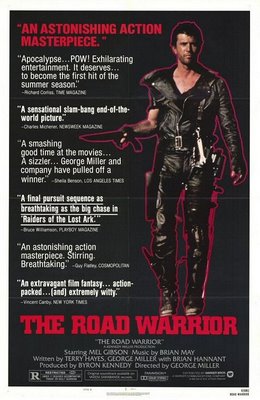
In addition to having a lot more money to work with on a second "Mad Max" movie, the director-producer team of George Miller and the late Byron Kennedy had been reading their Joseph "The Hero with a Thousand Faces" Campbell. This time around they placed their hero alone and on the roads of a wasteland. Max is in his trial phase and if and how he will find a way to reintegrate into human society is the subject of the story. There are no subplots to speak of. The future is post-apocalyptic. There is narration to set the stage and to sum up and in between there is violence, violence and more violence, terse dialogue, fantastic road stunts, colorful characters, even better editing except for one glaring error late in the movie, and an iconic performance by Mel Gibson, a wonderfully complex actor, as the hero, Max. Casual, brutal, graphic violence in the service of an engaging story has never been much of a hinderance to my ability to enjoy a movie. On the whole, I find it more distracting that the wounded in classic code movies aren't seen to bleed.


...and the Road Warrior. He Lives now, only in my memories.


They made a third Mad Max movie, Mad Max Beyond Thunderdome, a couple of years later, but like many sequels it was too self-referential and audience-expansion and future-sequels minded and it pales in comparison to the other two movies. They'd decided to make a fourth and in 2003 the pre-production was rather far along when the United States took out Saddam Hussein and Mel Gibson, from what I can tell, decided that that created too many potential security problems given where (Namibia) they'd decided to film. Mad Max: Fury Road died and, to date, has not been resurrected.

Another movie on my 1982 favorites list, Smash Palace, was directed by Aussie director Roger Donaldson. He filmed it in New Zealand in 1980. In 1990, Jane Champion, resident Australian born in New Zealand, went there to film parts of An Angel at My Table and a couple of years later went again with Holly Hunter, Harvey Keitel, Sam Neill and Anna Paquin in tow. The result was The Piano. A year later a Kiwi director named Peter Jackson had his first international hit with Heavenly Creatures, a movie about an infamous 1952 New Zealand murder case. A 17-year-old British actress named Kate Winslet got what turned out to be her big break when she was cast to play one of the teenage murderesses. When, at the end of the last century, a live-action adaptation of J.R.R. Tolkien's The Lord of the Rings trilogy was greenlighted, everyone not already there came to New Zealand to make it and when, in 2003, the third movie had its world premiere, that premiere was in Wellington. Its worldwide theatrical gross came to $2,916,544,743.00 or thereabouts. The two big box office movies from last December, King Kong and The Chronicles of Narnia: The Lion, the Witch and the Wardrobe were made, in whole or in part, in New Zealand.

And now that we've seen what the Kiwis have to offer? Hollywood?


...In the roar of an engine, he lost everything. And became a shell of a man, a burnt out, desolate man, a man haunted by the demons of his past, a man who wandered out into the wasteland. And it was here, in this blighted place, that he learned to live again.


While we wait...and wait...and wait...moviegoers are embracing, or not, Borat: Cultural Learnings of America for Make Benefit Glorious Nation of Kazakhstan. Kazakhstan? What other fictional future does this call to mind?

Why is the Deliverator so equipped? Because people rely on him. He is a roll model. This is America. People do whatever the fuck they feel like doing, you got a problem with that? Because they have a right to. And because they have guns and no one can fucking stop them. As a result, this country has one of the worst economies in the world. When it gets down to it—talking trade balances here—once we've brain-drained all our technology into other countries, once things have evened out, they're making cars in Bolivia and microwave ovens in Tadzhikiistan and selling them here—once our edge in natural resources has been made irrelevant by giant Hong Kong ships and dirigibles that can ship North Dakota all the way to New Zealand for a nickel—once the Invisible Hand has taken all those historical inequities and smeared them out into a broad global layer of what a Pakistani brickmaker would consider to be prosperity—y'know what? There's only four things we do better than anyone else

music
movies
microcode (software)
high-speed pizza delivery


—Neal Stephenson, Snow Crash

Make that three things.

Going for a blast into the real past

Going for a blast into the real past: "If his experiment with splitting photons actually works, says University of Washington physicist John Cramer, the next step will be to test for quantum 'retrocausality.'

That's science talk for saying he hopes to find evidence of a photon going backward in time."

I am not alone

Beth at My Vast Ring Conspiracy says it so well:

Frankly, I am sick and goddamned tired of conservatives–or as Squiggler calls them, the “neo-right”–invoking the name of Ronald Reagan when they attack other Republicans and any time they take a stand. It’s kinda like Godwin’s Law, in a sense–you can’t just throw out a name and assert moral authority, you have to back it up with facts and reality. Or alternatively, you could (I do) call it blasphemy. None of these “neo-right” types have anything to do with Reagan, in either deed or words. Reagan wasn’t an angry man, he was certainly no pessimist, and he did NOT violate his own 11th Commandment. These people are Buchanan Conservatives, if anything; not Reagan Republicans. Similarly, they like to say Bush is a “Rockefeller Republican;” believing, like leftists, that naming someone makes things so. (Of course, there’s plenty written about the similarities between ideological extremes.) Keep calling Iraq a “quagmire,” and it is one. Keep calling Bush a “Rockefeller Republican,” and he is one. Right.

A.J. Strata calls us Bush Conservatives, and that’s about right. We’re also Reagan Conservatives–or at least as Bush Conservatives, the reincarnation of Reagan Conservatives. I suppose it’s because of the medium itself that the blogosphere is so heavily concentrated with loud-mouthed, short-sighted extremist types. All too often–daily, if I’m not extremely selective with the blogs I read–I just want to separate myself altogether from the Stupid Blogosphere and turn off the lights at MVRWC. It’s good to see that more of “us” are speaking up.

I’m still very, very angry at the Buchanan Conservatives/neo-right/cannibals/whatever you wanna call ‘em. It is THEY who I blame more than anyone for the GOP/conservative loss in the election. I suppose it’s irrational to blame them first, but they are the ones with whom I have the most contact, if you will, or at least the most in common (in that we are bloggers). They worked for over two years, slandering everyone on their own side whenever there was a point of disagreement. How the hell did they think the media wouldn’t lap that up? Dissension within the conservative ranks? A gift to the liberal media! And as a result, rather than putting real pressure on those who needed it, they simply allowed the left’s sound-bite slogans, “culture of corruption” and “pork-loving Republicans” to penetrate the usually-disengaged voters’ minds. How often did the media talk about the DEMOCRATS having a culture of corruption? How often did the media talk about the well-known fiscal irresponsibility of the Democrats? Hmmm…never? Not even on “Faux” News. Voters saw the Democrats as the answer to corruption and overspending? Seriously, how the hell do these cannibalistic conservatives think that happened? The media didn’t just cook that up themselves, you know.


We're gonna have a Revolution
oh yeah.

I have been seeing more and more posts like this. Some are not quite so strident perhaps but the message is the same: Shut up you do not speak for me.

- Prometheus: What is Wrong with Politically-Motivated Research? Archives

- Prometheus: What is Wrong with Politically-Motivated Research? Archives: "In 2004 I characterized (in PDF) the 'politicization of science by scientists' as 'the use of science by scientists as a means of negotiating for desired political outcomes.' Dr. Crutzen's description of his work clearly fits this definition.

I characterized the problem with such a strategy as follws, 'many scientists encourage the mapping of established interests from across the political spectrum onto science and then use science as a proxy for political battle over these interests.'

Why does this matter? 'when politics is played out through science with the acquiescence and even facilitation of scientists, the results can serve to foster political gridlock to the detriment of science and policy alike because science alone is incapable of forcing a political consensus.'

Starting with a desired political outcome and then generating the science to support that outcome is not the most effective way for science to support policy, even coming from a Nobel laureate.
"

Friedman

OpinionJournal - Extra: "The essence of political freedom is the absence of coercion of one man by his fellow men. The fundamental danger to political freedom is the concentration of power. The existence of a large measure of power in the hands of a relatively few individuals enables them to use it to coerce their fellow men. Preservation of freedom requires either the elimination of power where that is possible, or its dispersal where it cannot be eliminated."

Google Fusion