Get ready for an awkward weekend with Sebaya Project.
The above video covers the first mass tank attack during the battle of Cambrai in WWI. It focuses on one tank, named Deborah, that was involved in the attack and met its end on the field of battle. I suppose you could call it the first combined arms operation. However, like the first of anything it didn't work as well as hoped; there were coordination and technical issues that caused the attack to fall short of its goals.
 |
| Click any image to enlarge |
These are paintings of carts, stalls and trucks that serve food from the side of streets. Hotdog carts, taco trucks, and all manner of small enterprises that serve treats and meals.
As an aside, my son, Ambi Jr., at one point in his varied career decided he was going to operate a food truck. He bought a truck and spent some time adding all of the facilities inside it. He opened it and a week later the covid lockdowns started. Needless to say, that put a dent in his business. However, all was not lost, he kept working his regular job and his partner survived the lockdown on take-out business from the truck.


 |
| Click image to enlarge |
Guard well your spare moments. They are like uncut diamonds. Discard them and their value will never be known. Improve them and they will become the brightest gems in a useful life. ― Ralph Waldo Emerson
 |
| Click any image to enlarge |
Aside from the times we turn them into tables by randomly piling objects on them, chairs are made for sitting. And sit in them we do. These are paintings of occupied chairs as well as empty ones. So, as you sit in your chair in front of your computer, or relax in a chair with your phone, scroll through and enjoy the pictures.


Once again, we head to the sub-continent to visit an industry. This time a foundry casting a pump body. As usual, safety standards seem to be lacking. The two guys wearing sandals as they carry a cauldron of molten metal across a debris littered floor is particularly harrowing.
 |
| Click any image to enlarge |
Jacques François Joseph Carabain (1834-1933) was a Dutch/Belgian painter known for his paintings of street scenes. However, while many of his paintings featured markets it was the architecture and not the people were the focus of his paintings. He stopped painting 26 years before his death. Because of that, and because of some motifs repeated in many of his works, I suspect he painted mainly for commercial purposes.


 |
| Jacques Carabain |
A couple on a circumnavigation pass through the Panama Canal on their catamaran to get to the Pacific Ocean. Aboard they have their parents and a few hired locals to help handle the lines. They also have a pilot to help them navigate the canal. It is an interesting up-close look, from the deck of a small boat, of the passage through the locks and waterways of the canal.

|
| Click any image to enlarge |
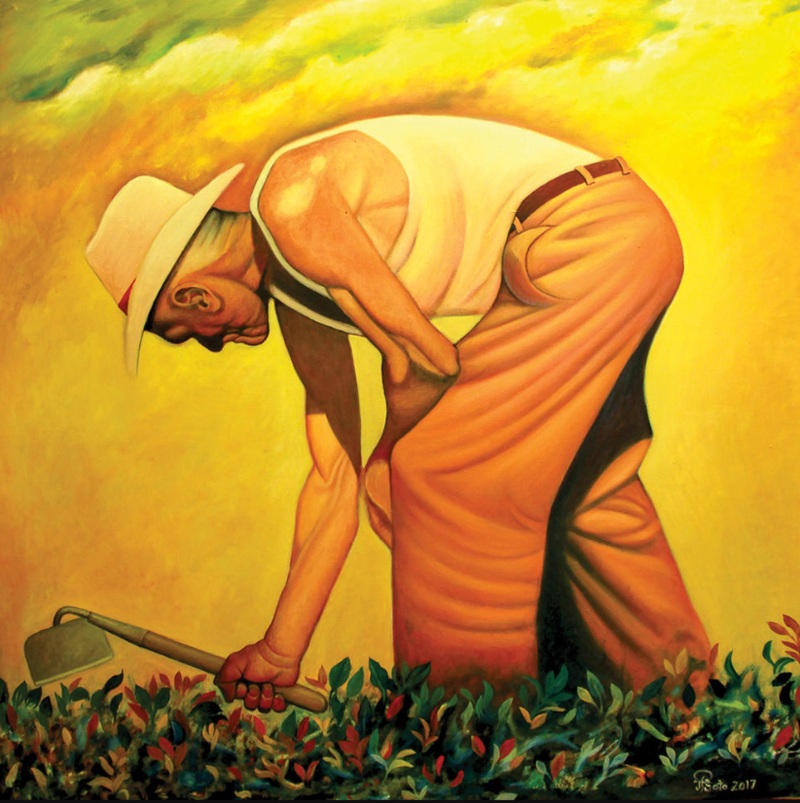
These paintings focus not on bucolic images of farms, but rather on the farmers who work the farm. There were very few images of current farmers, I guess they are out of favor in the modern art world, so we see farmers laboring in older times.


The story is that in 1850s, in western Oklahoma, there were Choctaw Indians and white settlers in the area who started having problems with thieves. It started with the theft of food, moved onto cattle rustling, and eventually escalated to women and children gone missing. This enraged the Choctaws who raised a war party to track and kill the thieves.
They rode for a day before coming upon a forest clearing with a horrible stench coming from it. When they entered the clearing, they were horrified to discover it covered with the half-eaten bodies of their missing women and children. Standing over the bodies, they saw three gigantic hairy, humanoid creatures dining on the remains. Infuriated, the Choctaws attacked and a battle ensued. All the Bigfeet were killed with only the loss the Choctaw leader, Joshua LeFlore, who had his head tore off in the scuffle. They buried the bodies of the women and children and burned the Bigfeet carcasses. What became of LeFlore's headless body is lost to the mists of history.
Sounds totally plausible to me, especially since it was first revealed in Lyle Blackburn's highly reputable book Sinister Swamps: Monsters and Mysteries from the Mire.
However, I do have a few questions. Why is there no contemporaneous record of this event. One would think that an outbreak of giant carnivorous monkeys would generate considerable interest -- reports to the territorial authorities, newspaper accounts, and years of retellings of the story around general store pickle barrels, but all of that is curiously missing. I wonder why people lost interest in the matter from almost the first day.
Secondly, it took only a day for the Choctaws to track and locate the murderous simian beasts. What does that say about contemporary Bigfeet investigators? They've spent decades, and used all manner of high-tech equipment, and can find nary a clue (tuffs of hair, Bigfeet scatt, etc.) much less one of the big goobers, dead or alive. They certainly need to up their game a bit.
 |
| Click any image to enlarge |
Virginia Frances Sterrett (1900-1931) was a 20th century book illustrator whose work was in the realm of fantasy. Due to her contracting tuberculosis, she died young and only completed three commissions: Old French Fairy Tales, Tanglewood Tales, and Arabian Nights. Regardless of the brevity of her career, she was highly influential in the genre.
Her works featured large areas of color punctuated by flourishes of elaborate, and colorful, details. You can see echoes of her style in fantasy art to this day.


Get ready for a cessating weekend with LUX the band.
This is a video of a Tokyo restaurant that has been in operation for 162 years. For dinner they only serve food from the Edo period. The tables have an area, which is covered for lunch. During dinner it is opened, and charcoal is placed in it so dinners can grill their own skewers. It's a pleasant looking place.
For a Westerner it would be confusing as all hell to order food in the place, but Japanese food is quite tasty. You would just have to expect mildly aghast looks as you committed one dinning gaffe after another as you ate.
 |
| President Donald J. Trump |
I do solemnly swear (or affirm) that I will faithfully execute the Office of President of the United States, and will to the best of my ability, preserve, protect and defend the Constitution of the United States.
|
| Click any image to enlarge |
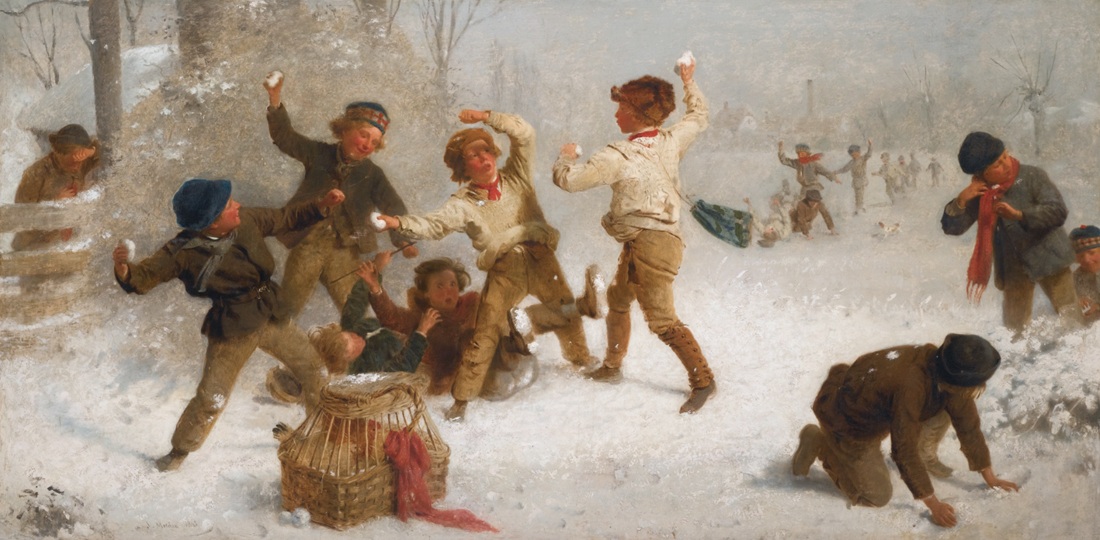
This post is for my northern visitors. Apparently, when it is cold enough outside to have that disgusting form of water known as snow littering the ground, they'll go out and bean each other with balls made from the snow. Sounds completely daft to me, but I guess we have to respect the traditions of primitive tribes. So, enjoy these paintings of the snowball fighting ceremony so popular in the frigid lands.


