Showing posts with label Alistair's Reviews. Show all posts

Monday, June 09, 2008

SIFF Day One

Posted by Alistair.

-----------------------------------------------------------


Fyodor Dostoevsky once said that there are only two types of books: those in which someone goes on a journey and those in which a man comes to town. The same line could undoubtedly be applied to narratives of all kinds, particularly the films I saw Monday at the Seattle International Film Festival. All of them involved a man coming to town, which is—as Dostoevsky so cleverly implies—the same thing as a man ending the journey he began from another town.

The first of these was Boy A, a beautiful, sad, poignant, and artfully made film. The film was directed by John Crowley from a script penned by Mark O'Rowe and was the second film both have worked on (their previous effirt was 2003's Intermission, which stars Colin Farrell, Cillian Murphy, and other Irish favorites). Although I have not seen Intermission, Boy A makes it abundantly clear that both men are quite naturally talented, as is the entire cast of actors, which makes the familiar argument that when looking for acting talent you should begin in Britain.


The film follows a recently paroled youth in his early twenties and his effort to fit into normal society. As we begin to know him in his everyday routine and his interactions with those around him, we are slowly shown, via flashback, the events leading up to his stint in jail. He was an unpopular and awkward boy, whose parents were indifferent and abusive. He was beaten up at school. He went friendless until he met Philip Craig (who purposefully causes a traffic accident in their first encounter). As the friendship between the two boys grows, it becomes increasingly clear that Philip (played with sadistic aplomb in a good bit of child acting by Taylor Doherty) is most likely the root cause of (the protagonist) Jack Burridge's troubles. As Jack (the brilliant Andrew Garfield) adjusts and begins to fit in with his new life he is haunted by his old life where he was ill-adjusted. And he faces the moral dilemna of honestly adjusting his old life to his new acquaintances and the very real harm that such an address could put him in.

This film was not perfect. Though the writing, directing, and acting were all stellar—particularly Garfield's Burridge, who wins you over with his good-heartedness before breaking your own heart—the film lacked in a grand philosophic message. Although Jack is a soul who deserves forgiveness, the film does not argue that all sinners are (although it flirts with the idea) exempt from simply being evil (as the chilling sociopathic child Philip Craig demonstrates). It takes on the subject of redemption—one of the greatest literary themes, as Dostoevsky himself proved—and whether it is possible; and although it argues that it should be possible it doesn't do enough to settle the matter one way or another. The film makes the mistake—one of its few—of having Jack commit an event that is, or at least it is meant to be, the exact negation of the horrible act that led him into prison in the first place. This is a mistake not only because it is a bit hackneyed, but also because it weakens the very essence of Jack's redemption. Redemption is not an act, but an existential transformation, from someone who is weak to someone who is strong. Jack proves that he has fulfilled this transformation in his goodly treatment of the people in his life and his standing, at every minute, for compassion. This is, if anything, the philosophical message of the film. It is a fairy tale for all of us who were lonely, unhappy, and misunderstood as children (junior high?), capable of ignominious acts in our weakness (even if it was just lashing out at our parents), who somehow became happy, functioning members of adult society. But where did that childhood go? And how did we get from boy a to man b? These are questions whose answers are unknown to both the filmmakers and me.


The second film I saw, The Children of Huang Shi, was much less memorable or enjoyable, though it ambitiously set out to be both. Here is a film that attempts epic status as well as the kind of emotional resonance of a man who is won over into humanitarianism despite himself (cf. the great Schindler's List and the also great Red Beard). Its failure at pulling off the first follows from its failure to pull off the second. It has a lot of things going for it that good epics have. It has a great, relatively unexplored back-drop, Japanese occupied China in the 1930s, which allows almost limitless potential for any number of country-spanning adventures, occasionally punctuated by Japanese soldiers and communist on nationalist squabbling. And director Roger Spottiswoode gives a valiant attempt at producing such an epic, with great photography of beautifully huge landscapes, excellent set-pieces and costumes, and an all-star-ish cast (at least by SIFF standards) which includes Jonathan Rhys Meyers, Chow Yun-Fat, and Michelle Yeoh. The problems come when the film asks us to invest emotionally in its characters when it clearly has no interest in doing so itself. They exclusively exist to advance the plot.

So let us turn to the plot. A British journalist (Rhys Meyers) comes to China to investigate what's going on, after witnessing the horrors inflicted by the Japanese military in Nanking he is shuttled away to safety in a boy's orphanage. At first he plans to leave immediately, viewing the boys as animalistic brats, but eventually he is convinced of their humanity and of his duty to them. After the war with Japan makes it unsafe to remain where they are, he leads the boys on a perilous journey to the western edge of China, where no one will interfere with their lives.


As mentioned, all the characters exist solely to forward this plot and offer up no convincing portraits of real human beings. This is particularly true of the orphans, who often exist solely to make a single point (that one shows how the Chinese have a strong tradition of farming, this one shows how the children are interested in English and the West, that one shows how the children are hurt by the war, etc.). What's worse, the story and its talking points are told and not shown (so that one character will say something like "that's Ching, he's been really hurt by this war. His family were government officials and they were killed right in front of him.") Then Ching (which, as you might have guessed, is probably not the name of the actual character I am thinking of) will fade into the background until his anger at the Japanese becomes useful. All of the characters are easily and early cast as either good guys or bad guys, and therefore the revelations about their natures ("I'm an opium addict!" "My parents are pacifists, but I want to fight!") seem as forced as twists in a soap opera and make absolutely no difference one way or another in the outcome of how the characters are viewed. They therefore exist merely as a way to kill time and stretch the plot out to "epic" proportions.

Which is precisely why the movie failed as an epic, because I didn't care about or believe in the characters, I wasn't at all impressed by how momentous their journey across China was. Rhys Meyers was likable enough, but I didn't buy his devotion to the kids, partially due to the fact that the kids were shown for their cuteness and not for their humanity (contrast this with Schindler's Jews), and partially due to Rhys Meyers's inability to sell it as an actor. Couple this with Radha Mitchell's portrayal of Rhys Meyers's requisite love interest, which was cold, unconvincing, and annoying, and the completely needless characters of Yun-Fat and Yeoh and you have a movie filled with incomplete, simplistic, and unbelievable people. This is mostly the screenwriter's onus, but good acting and directing should be able to make the limitations of a weak character non-existent (cf. Robert Downey Jr. in Iron Man). As it stands, Spottiswoode was too busy directing the landscape to be bothered with the actors, who were in too far over there heads to pull the thing off. That isn't to say that this was a film completely without merits. As I said, the setting (both in time and place) was quite interesting, and it contained awesome locations, beautifully photographed. But its flaws are too great to recommend it.

The third and final film I saw on Monday was Still Life (Sanxia haoren), a film from China shot on and around the Yangtze river before the area was flooded by the completion of the Three Gorge dam in 2006, which has been in festival circulation as long as it has existed. It is a beautiful and quiet film, whose subject—the clash between traditional and modern China—and plot—two plots actually, one about a man searching for his wife the other about a woman searching for her husband—take a backseat to its misty images. I am still in awe of a shot that captures a man and woman standing together in a brick building with a gaping hole through which the remnants of an abandoned and half destroyed downtown are visible. As the two stand there, one of the buildings is demolished and gently crumbles from its place amidst the gray-brown rain-soaked sky and lush green hills.


The movie's characters inhabit a beautiful, haunted world made all the more amazing for the fact that it will soon cease to exist. This is part of the film's plot as well as its reality and it lends everything an air of tragic poetry. The film begins with a man arriving in Fengjie from the upriver region of Shanxi in search of his wife. He has an address she left him sixteen years ago when she ran away. He gives this address to a cabbie on a motorcycle who, after some bargaining, agrees to take him to the address. He finds when he arrives that the motorcycle cabbie has tricked him, that the street where his wife lived has been flooded by the river in the damming of one of the first two gorges. He travels back to a town filled with the rubble of destroyed buildings spray-painted with what will be the water level after the final gorge is dammed. He asks around and finds that his wife's brother still lives in town.

He visits his brother-in-law at his place of work, on a ferry, and asks him where his sister is. He is told that he seems like a nice man but that he should return home. This thinly veiled threat is underscored by the men who (hilariously) pour out of the ship's bellows and into its cabin, one after another, to hungrily slurp down noodles and menacingly eye the protagonist. This scene reveals a few things about Fengjie's inhabitants. They are scrappy; they work hard and eat, when they can, with great vigor; they accept situations as they are, trusting the instincts of their fellows, even if it comes to fighting for those instincts, and distrusting strangers; and there are lots of them, all around.


The man slowly settles into this life, deciding to live in Fengjie and wait on the off chance that his wife will show up with his sixteen-year-old daughter. He gets work doing what needs doing, which in this soon-to-be-submerged city means tearing down buildings. And as he gazes out on the Yangtze the movie looks away, turning instead to a woman searching for her husband. She belongs to a different class than the first man and her husband has some lofty position in some favored industry. She inhabits a different Fengjie as she is shepherded around to fancy dining and dancing by a kindly, but twitchy man who knows her husband. But despite their differences, it is clear that the two characters share a hurt spirit that cannot easily be mended. Their worlds bump into each other in funny ways, as when a friend of the husband (the first husband) is hired to commit a crime by another man (the second husband). But their worlds are not so far off as one might think and strange juxtapositions give Fengjie its haunted and beautiful nature. In one scene a couple dances the waltz in evening attire on the exposed beams of a ruined skyscraper, perched over a beach strewn with debris.

At the end of climactic moments, the camera will move away from the actors to focus on the objects that are cluttered everywhere. The name of the objects will appear on the screen to reveal one meaning of the title's double entender (the other meaning presumably refers to the stillness with which the protagonists have suffered). I liked this movie a lot, for the glimpse of a live ghost town, for its depiction of rural China, and for the poetry with which it is accomplished. I did not, however, love it. After awhile one gets the feeling that the still objects (cigarette, mints, tea) are just as alive for the camera as the film's characters, which is to say, not very alive. I loved Fengjie as a mythical pre-Atlantis, but I loved its citizens even more, and I wanted to see them less as backdrop for the story of a lost world and China in transition, and more as the subjects in whom a doomed home and changing homeland created dramatic effect to which I could relate. Sadly this is not what we get.


The movie's final shot is once again the space the characters have just inhabited, but this time the scale of the picture is large. The camera shows two buildings, between them is stretched a rope, across which a man walks, carefully balancing so as not to fall. I took it as a metaphor for the path China's people must now walk, remembering their past, honoring their traditional rural roots, while moving into the future. Careful not to let nostalgia or overenthusiasm at what will be pull them down (symbolic for the fates of the spouses if not the heroes). I wish I could say that Still Life passes this test, but it is a movie stuck in time.

Friday, February 15, 2008

Thursday Movie Review: There Will Be Blood

by Alistair
------------------------------------------------------

There Will Be Oscars, There Will Be Westerns


Although many have pointed to 2007 as the best year for films in quite some time, few have paid attention to what themes, if any, unite this year’s films. And as far as an overarching theme goes, you could do a lot worse than to point to the Western. In addition to the four or five critically acclaimed films that directly evoke the genre’s major characteristics, there are a handful of films like Into the Wild and Rescue Dawn that embody much of what we love about the cowboy philosophy. Not to mention the slew of crime films the year produced, whose anti-heroes embody the same sort of violent mysticism as the dust caked protagonists of westerns. Enough so, at any rate, to keep the two genres relatively close in my mind. So why the resurgence of the cowboy, be he a half-crazed Vietnam POW, a sad and wizened Texas lawman, or otherwise? Many may point to the relative success of 2005’s Brokeback Mountain—an undeniably sad and beautiful film because it so admirably showed the deep humanity of any number of denim-clad, dry-faced old men who (those of us from the West and Midwest are well aware) people the backgrounds of our lives and often go unconsidered. But although that film was set in the West and had some light to shine on the stoic cowboy as an American figure, it did not consider many of the things that make up 2007’s pearls in the genre.

These themes, which include violence, the order that sets in during a period of uncivilized lawlessness, the transition from one frontier to another, the formation of modern America, honor among sinners, and the creation and destruction of mythical figures, owe their most recent and best incarnation to the brilliant HBO series Deadwood. A series whose creator David Milch has been thoroughly obsessed with these issues, attacking them from several directions, and bringing them to the forefront as strong artistic fodder; a trend many have picked up on. And of the many who released strong, thoughtful films that seriously engaged the western tradition while transforming it into something new, I found There Will Be Blood to be the film that follows closest in Deadwood’s hallowed footsteps.


Part of the similarity undeniably lies in Daniel Day-Lewis’s performance, which will almost undoubtedly earn him an Oscar . After seeing Gangs of New York I have frequently asked anyone who would listen “How good would Deadwood be if Daniel Day-Lewis played Swearengen (Deadwood’s pragmatic and ruthless crime boss)?” There is an undeniable similarity between Daniel Plainview, Day-Lewis’s character in Blood, and Ian McShane’s Al Swearengen, both in how the characters are conceived and how the actors portray them. Both men speak within a brilliant homespun oratorical style that hints at the violence just barely beneath the surface. Both men are smarter than those that surround them and know how to manipulate them to get what they want (although, like the former trait, Swearengen excels more at this with a god-like omnipotence). Both men are, at root, self-made businessmen that oversee their empires with do-it-yourself attitudes (Swearengen by slitting throats, and Plainview by bribing and threatening officials). And both actors make very similar choices in portraying their respective characters, expertly bringing out nervous laughter in the audience and making them squirm in their seats (sometimes in the same moment). After all, both men grew and trained in the London stage scene at roughly the same time. But while Swearengen is probably a better conceived and written character, Plainview is more of a joy to watch. And the difference comes almost exclusively from Day-Lewis’s performance.

Daniel Plainview is from the start a captivating and fearful mercenary who inspires the same mixture of nervousness and excitement as a three-shot espresso. He begins the film as a young entrepreneur who buys up small properties in the hopes of mining them for gold and silver. One day he slips while climbing down one of his mine/wells and breaks his leg. He crawls his way back up the ladder, and drags himself across the desert and into town by his hands. He has with him some rocks to be assayed and there is nothing yet to tell us who this man is, but already the grim deterministic look on Day-Lewis’s face sets the audience a-twittering in giddy fear. After a successful diagnosis—indeed, he has found gold and silver fever—he returns with some men to mine it. They get more than they bargained for when they hit upon an oil spring.


From these unlikely beginnings Plainview is launched into the burgeoning world of oil barons. He discovers a town rich in oil, has several run-ins with the local preacher that end (for both men at varying points) in unsettling comic humiliation, tries to raise a son to follow in his footsteps, and shows us the fierce “competition” that plagues his soul. Day-Lewis shines brilliantly (and further establishes himself as one of today’s cinema’s greatest actors) because of his level of commitment. He is willing to push his character’s anger so far, let his contempt and greed breathe so openly, squeeze every scene for oil-black comedy, and war so heavily against himself (his major fight is between his deep need for family and his mistrust and dislike of anyone but himself) that the character pushes past cartoonish exaggeration and begins to feel like the basis on which the stereotype was formed.

Since the story unfolds in the early days of the twentieth century neither of the film's leads—Day-Lewis as Plainview and Paul Dano as the deliciously treacherous evangelical preacher—have an idea of the respective caricatures their stations in life later become: the greed driven baron or the corrupt preacher. In this lack of knowledge comes a sense of freedom: since they are creating the stereotypes they are not beholden to anyone. They can act or not act as they damn well see fit. This is a move of pure genius on the part of the film’s creator, writer-director Paul Thomas Anderson. By granting his characters this sort of existential freedom from subtlety, Anderson can focus on how these stereotypes were created and how they helped transform the old west into the American landscape of today.


Besides engaging in themes and larger-than-life men that will no doubt inspire comparisons to Citizen Kane and The Treasure of the Sierra Madre , Anderson delivers some really great dialogue and beautifully shot scenes. My favorite speeches are the two that introduce the film’s two main characters: Plainview trying to sell some farm-folk on selling him their land, and Dano’s Eli Sunday curing a woman’s arthritic fingers of Satan. My favorite shots are those that involve oil, both as a primordial, filthy muck that men wade in, and as a beautiful fountain that shoots out of the ground with anger, lights aflame, and burns all night.

Many have praised this movie for its major themes and its poetry (whichever Oscar the Coens don’t get, writing or directing, Anderson will probably snag—my bet is on directing) while criticizing its end as a mistake. As too dramatic or absurd even for a film this like a comic book history of the United States. In my estimation these critics have misunderstood this film and its maker, who steers away from ambiguity and towards big climactic endings whenever he can (remember Walberg’s speech to his reflection at the end of Boogey Nights or how effectively the frogs in Magnolia caused every character’s story to resolve just how you were rooting for it to resolve?) Besides this criticism of the last scene seems to ignore the final line, which is delivered with such aplomb by Day-Lewis as to qualify as one of the most fitting punch-lines I’ve ever heard. This line, besides making me laugh well into the credits, also serves as one of those rare moments in film in which a movie’s coda causes you to re-examine its whole structure. In this case we are given new insight into Plainview’s ascent to the top, which– as Day-Lewis’s reading of the final line suggests—may have been more of an attempt at destroying himself than at becoming a success. There Will Be Blood is a truly great film, its acting is top notch, its themes universal and large ones, its writer-director a true talent finally blossoming to his fullest potential, its scenery sparse yet poetic, its score (a foolish snub by the academy of Radiohead guitarist Jonny Greenwood) great, and its every fiber neo-western. We can almost be guaranteed, as Awards season approaches, that in 2008 and 2009 there will be even more westerns.

Thursday, January 10, 2008

Thursday Movie Review: Atonement

by Alistair

-----------------------------------------------------------------------


There is a scene about two thirds into Atonement that ranks as one of the most spectacular and awesome feats that cinema has ever offered. It is a vision of the nearly vanquished British army, now stuck on a French beach, having retreated all the way to the sea and awaiting its encroaching doom in the early days of World War II. The Brits have found a deserted carnival on the beach and—since they have nothing else to do while they wait to die—several of them have begun to play on it. This scene is revealed in a single brilliant tracking shot that weaves between the soldiers rushing into formation and those cooking under parasols before passing by a man who methodically shoots his horses. The camera then turns and encircles a group of forlorn men who stare out to sea while singing a melancholic dirge, it follows the path of a merry-go-round crowded with boisterous, drunken soldiers, and, finally, pulls back to reveal a Ferris wheel in the background framed against a beautiful setting sun and a smoke-filled sky. At one point we see a single soldier grab on to one of the Ferris wheel’s carriages. As the carriage rises he dangles by just one arm; we keep expecting him to fall off, but as the carriage reaches its apex and begins its descent he remains, still clinging. For some reason this struck me as a microcosm of the whole, a scene as beautiful as it is hellish, a beautifully choreographed and perfectly captured nightmare.


While the Dunkirk scene is astonishingly breathtaking it is hardly novel. Since at least the days of Catch-22 authors have mixed the horrors of war with chaotic surrealism to produce this sort of hauntingly beautiful effect. It is a trick that has been pulled quite a few times. Nor is it anything new to film, as Spielberg created something very similar (also set on a beach in France) just after the first battle in Saving Private Ryan. Nor is this even the first time we’ve seen something like this in a recent film, as the horrendously scripted Children of Men secured itself a spot as a decent film by using a couple of inspired single take tracking shots through wartime action. But what Atonement loses in originality it makes up for in professionalism. And up until this scene—which is the film’s high point—that is exactly what Atonement is: a good solid professional film. Not the year’s best, nothing groundbreaking, not the work of a true master, but a very well-executed movie sure to pick up a couple of Oscars.

Unfortunately the film then proceeds to falter (although its Oscar chances are still alive and well). It moves its scope, as it inevitably must, away from the compelling narrative of a soldier and his love to the titular act.


While the crime which requires atonement—the very skillfully set-up subject of the film’s first act—is a veritable joy to watch, the act of atonement that follows it is very weak by comparison. Surely the act of atonement is one of the deepest and most complex facets of our humanity, consequently providing practically limitless philosophical potential, and, when this act is engaged correctly, it produces the unequaled best in our literature. Consider Crime and Punishment and The Stranger for example. It is, however, very difficult to do well and this particular go-round seems satisfied merely to acknowledge that the act exists, without making any profound comments about it.
This is of course fine by me, and if the film had ended with the story of how Briony Tallis, the character indirectly responsible for the above-mentioned soldier-in-love’s fate as a soldier, atoned, then it would be a very strong movie, stopping just short of brilliant. The trouble is the film decides that it wants to make a deep comment about atonement after all, without having a clue as to what real atonement is or what it really wants to say about it.


Right before we reach what would under normal circumstances be the film’s climax, we are snapped out of the story and placed on the set of a television show in the present day. Briony Tallis is being interviewed about her new book, Atonement, and she reveals to the interviewer that some of the events depicted in her book (those we have just finished watching) did not actually occur. No doubt the makers of the film congratulate themselves for their betrayal of narrative expectation. No doubt this works in the novel. But it fails miserably here. The reason is simple: the expected outcome of a narrative serves a purpose, it satisfies the audience. It is a gift that should only be forfeited if something greater is to be gained in its stead. Betraying our narrative expectations in No Country for Old Men succeeded because that film is concerned with free will, fate, and determinism. By challenging what they bring you to expect, the Coen brothers are able to deepen their film’s philosophy by adding to it a few layers. This is far from the case with Atonement, a film that eschews the satisfaction that comes with a completed story in order to make a sloppy, semi-incoherent point about atonement. And in doing so it breaks one of narrative’s golden rules, in a meek attempt to justify itself: show don’t tell! You have to be an absolute master with a deep understanding of why these rules are in place before you can hope to disregard them. And for all of their professionalism, the makers of Atonement are not even close to being masters.


I have purposefully omitted the plot of Atonement because watching it unfold was one of the greatest pleasures last year’s cinema had to offer. Although it is mostly unoriginal and somewhat predictable, it is so well paced and so craftily revealed that you won’t care at all. The first two-thirds of this movie prove that it’s the singer that matters and not the tune. Unfortunately the film’s end, which resembles the kind of arrhythmic and cacophonous free jazz of a cat crossing a piano, reminds us that once you start a tune, it's important to keep singing.

Monday, July 23, 2007

Movie Mini-Review: The Decalogue, Part I

Posted by Alistair.
-----------------------------------------------------------------------------

Krzysztof Kieslowski's Decalogue is a series of ten one-hour films inspired by the Ten Commandments. In the first film—loosely inspired by the commandment "I am the Lord your God, you shall have no other gods before me"—a young linguistics professor teaches his son about the world. The professor (Henryk Baranowski) gives his son Pawel (Wojciech Klata) complicated physics problems, takes him to his class, and generally teaches his son about the hidden joys of the intellectual world. I have known several father and son duos just like the one depicted in the movie and Kieslowski gets it exactly right. He perfectly captures the mild discomfort the father faces when forced to deal with the world outside of his classroom. Likewise, Pawel is shown with the exact mix of aloof sadness and naivety that characterizes intelligent children. Although they may have their flaws, the characters really and deeply love each other and Kieslowski shows this love in all of its simple and powerful beauty. This is the best part about this movie, and if it had ended after the first thirty minutes in which the characters are introduced it would be more than worthy of its reputation.

Unfortunately it does not. It goes on to discuss God and how religion cannot be replaced by science. Maybe this stuff was novel at one point, but now it has become remarkably cliched. Particularly when we get the message from people who completely lack an understanding of the computer. Although I have only seen the first part of the Decalogue, it has so far failed to live up to its immense reputation. I hope the next nine parts improve upon the story put forth here. But the first episode of the Decalogue shows a brilliant understanding of family and a lack of spiritual or religious clue. Its a shame religion is the subject of this series and not fathers and sons.

Saturday, July 14, 2007

Saturday Movie Review: The Lives of Others

Posted by Alistair.
-----------------------------------------------------------------------------------

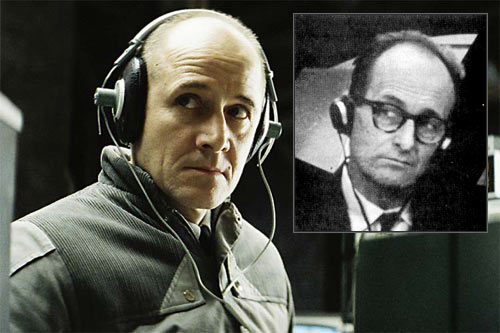
I was coerced into seeing The Lives of Others (Das Leben der Anderen) on the rumor that it was even better than Downfall (Der Untergang). It is not. Downfall did what few pieces of art aspire to, let alone accomplish. It took a man, universally despised and feared, and made him a human being. In doing so it opened up our own humanity for us to see; reflecting to us how we can be wonderful as well as despicable. Casting Adolph Hitler and the high-ranking Nazi officials that surrounded him in a sympathetic light is probably the hardest task that any writer can perform. Doing it with the understated and sadly realistic panache that Downfall pulls off is sheer brilliance. So I was not too surprised that the rumor turned out to be false. I was, however, surprised by how close it was to truth. The Lives of Others is a remarkably good film. And it, alongside Downfall, marks the coming of a brilliant new age for German cinema.


The Lives of Others has a lot going for it. It won the Academy Award for best Foreign Language film (one of the few categories of Oscar that occasionally goes to the movie that deserves it). And unlike Downfall, it tells us a story we have heard only in snippets—the story of the East German secret police. A lot of moviegoers will be horrified by the insane Orwellian logic by which the East German government ruled (the movie, after all, mostly takes place in 1984). I was far more horrified by its servants' intelligence and efficiency. The film begins with a secret policeman showing students in the academy the skills of his trade, how to correctly interrogate a suspect. With cold, dead eyes, the teacher—the film’s protagonist, agent Gerd Wiesler (the brilliant Ulrich Mühe)—plays for his class a tape of a successful interrogation and explains that a suspect may only give you the information you need after forty hours of solid interrogation. When a student asks if keeping someone awake for this long is not inhumane, he calmly marks an x next to the student’s name and explains that an innocent person will get irate after being questioned for so long, while a guilty man will become complacent and may cry. While you are busy reeling over the insanity of this, the movie progresses forward. Wiesler points out that the suspect has the exact same story forty hours into the interrogation as he had at its commencement—the same story word for word. Such a rehearsed story is the sign of a lie—an honest man can tell you the same event from several different angles, but a guilty one can only give the lines that he has rehearsed. This is, of course, true. And the cold logic of it hit me far harder than the brutality of sleepless torture. We immediately realize that the suspect has something to hide, and that Wiesler is more than capable of getting him to reveal it. A threat to the suspect’s wife and children are all it takes to crush the tired and broken suspect. Agent Wiesler calmly writes down the name the suspect gives him.

This scene sets the whole tone of the film. It depicts an insane world of drab streets, fearful citizens, and government bureaucrats more deadly than sharks. But a world that is populated by real people. Some of them are loyal believers in East Germany and socialism, some of these are hardworking and dedicate themselves to their system with a zealous belief in its good, and some of these—a very few—are even good men. The movie is about two such men, the playwright Georg Dreyman (Sebastian Koch)—the only East German writer who believes in East Germany and is good enough to be read in the West—and agent Wiesler, who is assigned to spy on him.


The plot of the movie is too good and is revealed too well to be restated here. Suffice it to say that the government’s motives in spying on Dreyman are less than the perfect betterment of the state. When Wiesler learns of the true reason he has been made to monitor another man’s life, his faith in the East German system is shaken. When he hears, from bugs in every room of Dreyman’s apartment, what a decent person his target is, his idealistic notions are shattered. As the story moves along at the pace of a Hitchcock thriller, Wiesler finds it harder and harder not to help the man he is supposed to be ruining. And as he begins to be swayed to the side of decency, we witness the same humanistic message that Spielberg gave us in Schindler’s List: human beings are good and worth fighting for.

Of course, The Lives of Others does not reach the grandiosity that was put forth in Schindler’s List, but its subtlety is its greatest strength. Excepting the fiendishly evil Minister Hempf, whose idea it is to spy on Dreyman, everything about this movie smacks of a realistic portrayal. The far more nuanced Grubitz—head minister of culture (“the state’s sword and shield”) and Wiesler’s direct boss—is far more convincing, and thus terrifying. He at first comes off as an idiotic bureaucrat, but we soon see how cleverly evil he is. When he begrudgingly eats lunch with low-level secret policemen, instead of the high level officials he is used to (“Socialism has got to start somewhere,” Wiesler tells him), he overhears one of them making a joke about the party’s leader. When the officer realizes he has been spotted he freezes in his tracks, but Grubitz eggs him on, urging the joke to its punch line. When it is delivered he laughs heartily and then demands the man’s name and rank. After a few seconds of fearful silence, Grubitz reveals that he is only joking. We are reminded of Joe Pesci’s character in Goodfellas, who makes Ray Liota laugh and then threatens his life only to reveal that he is joking. As that film progresses, Scorsese reveals to us how serious he really was. As does The Lives of Others’ brilliant writer and director, Florian Henckel von Donnersmarck, who shows this same man, years later, working in the secret police’s lowest occupation—steaming open the letters of citizens. Although this man is not the focus of the scene, as von Donnersmarck retains his beautiful subtlety, we are chillingly reminded whom the joke is really on.


Grubitz is the perfect villain, able to laugh and joke, to fraternize with all the governmental bigwigs, while carefully monitoring everyone for weaknesses. He reads from a student’s paper which explains the five types of artists in East Germany and how to break each one. The student got a "B" (“You can’t praise them too much,” Grubitz tells Wiesler), yet Grubitz realizes the brilliance of his work. He explains that Dreyman is artist type 4, an “anthrocentric” who is best destroyed by utterly isolated captivity for eight months. “After which,” Grubitz says, amused, “he will no longer have the ability to write.” Knowing the kind of good, delicate soul that Dreyman possesses, we are sure that Grubitz is right. And we are sure what type he himself is.

The Lives of Others slips up at points. Its depiction of Hempf may be a little overdramatic, as may be its Deus Ex Machina-like conclusion of the Dreyman investigation. But the film does not end there. It goes on to tell the story of what happens to its characters after the Iron Curtain crumbles. How people return to their lives, and how the tired, injured creature called compassion lives on. The movie’s ending is once again subtle, but it brought tears to my eyes.


The Lives of Others has a better story than Downfall. It has more hope and redemption for its characters, and tells us a story that we do not yet know by heart. It captures in its magical 137 minutes what Downfall captured as well: the real and actual lives of people, pushed to their limits, in the face of a system of utter brutality and insanity. It shows us that it is the corrupt systems, leviathans which exist beyond the lives and powers of their human components, that are the true evils in this world and those things which cannot be stopped (I got the distinct impression that every single character in the movie, be he artist or bureaucrat, could be replaced by someone else and that the system would run just as smoothly). Like Downfall it never strays too far into the realm of the unrealistic and all of its characters—like the Nazis in Downfall—are horrifically understandable and, at times, even sympathetic. It is a slightly worse film, because it does not seek to achieve the impossible task that Downfall set for itself and is of far less historical and political interest. It is, however, a great movie and of the utmost interest to anyone who believes in the good of humanity and in letting other people live their lives.

Tuesday, June 26, 2007

Tuesday Movie Review: M*A*S*H

Posted by Alistair.
-----------------------------------------------------------------------------------


Last Friday the American Film Institute (AFI) released a new list of the 100 best American movies as decided by 1,500 people in and around the film business. This list remained relatively faithful to the original list that the AFI released 10 years ago. Toy Story replaced Fantasia and the epic Lord of the Rings, Fellowship of the Ring replaced the even more epic Dr. Zhivago, but changes were the exception and not the rule. For the most part, movies that were deemed list-worthy last time made their way onto the new list. Among these was Robert Altman’s 1970 film M*A*S*H, which was rated America’s 52nd best film on the original list but slipped to 58th best on this new list. High praise is not uncommon for this film, which won an Oscar for best screenplay upon its release, spawned a hit TV series, and is frequently cited by critics and movie goers as one of the best movies ever made.

As best as I can guess, the case for M*A*S*H goes something like the following: men are drafted into a war they don’t want to fight, a pointless war that reinforces the corrupt ideals and hypocritical morals that have turned their society ugly. Instead of following the system’s rules, these men behave like heroes—deconstructing the system from within. With Dadaist fervor they challenge everything their commanding officers insist on. If a “good” soldier should believe in Christ, then Hawkeye, Trapper John, and Duke will belittle the religious, replace the Bible with pornography, and generally disrupt the tyranny of religion. If a “good” American should be sexless and monogamous, then these boys will be anything but that. And if the American’s highest calling is football, well then, this lot of anti-heroes will beat the blonde, corn-fed bastard at his own game. Oh yes, there is also a plethora of jokes and breasts. It’s like Animal House with a message. Or a hysterical version of Catch-22.

Except that everything about this movie is wrong. Its jokes are largely unfunny and dated. It is spiteful of women, especially those like Nurse Houlihan who are good at their jobs and unattracted to the film’s male leads. These women must suffer brutal and unfunny sexual humiliation at every turn. This film exhibits everything that is wrong with 60s idealism while retaining nothing about it that’s right. There were, nearly all will grant, many things wrong with the morality of America in the 1950s. A lot of this involved distrust and hatred for blacks, gays, and women. M*A*S*H, with a misanthrope’s limited vision, wishes to topple the wrongs of the past. Its solution is that of a moron: since some thoughts in the past have turned out to be less than ideal we must do away with all the ideas held in the past. In the past people treated each other with respect. Not in Altman’s utopia. Everything has been redone, and all moral standards have been adjusted to serve the film’s protagonists (all except a belittling distrust and hatred of blacks, gays, and women).


The characters, having been sexually stifled in the droll atmosphere of America, let loose in the steamy, exotic Korean jungle. The sexual revolution arrives and love is free. As long as it is given freely by the film’s shallow, two-dimensional women. If it is not…well, every revolution demands sacrifice, and Nurse Houlihan pays the price to the entire camp. First when she dares to have sex with a Christian man (the nerve!) and later when the men want to determine whether she is a natural blonde. In the first instance her sex is broadcast on the radio, while in the second the entire camp gathers while the heroes expose her as she showers. Unlike the lovable idiots of Animal House, who fail again and again to score with the opposite sex, the jeering idiots of M*A*S*H, who use sexual humiliation as a weapon, have always turned my blood cold. If it was Altman’s goal to celebrate and capture the mentality that leads to rape, then I believe he succeeded.

What bothers me most about this movie is how much it fails. It would not have been terribly difficult to make us dislike a haughty religious man or a prudish uptight woman. Lord knows, both kinds of people have committed grave sins and done some horrible things. But that's not what M*A*S*H does. Robert Duvall’s character is deemed evil because he tries to teach a Korean kid who hangs out on the base about the Bible. Now, forcing your own religion on another is a pretty heinous albeit common thing, but Duvall doesn’t do this. He plays the scene with a bumbling compassion, a loser merely failing to impart what he himself loves. In another scene, Duvall yells at a nurse for selecting the wrong instrument while a patient dies. This is the closest we come to seeing his supposedly monstrous character. But the audience sees no such thing, we see rather a dedicated doctor lashing out in frustration. Duvall is guilty of cheating on his wife with Nurse Houlihan, as all the camp’s personnel are guilty of infidelity. When Hawkeye points this out to him, and disrespects Nurse Houlihan with insensitive words, he is attacked. It is the one moment in the movie at which I felt like cheering. After the fight, Duvall is dragged off to an insane asylum, and Altman has his petty victory over his own character. Those deemed sane by our normal standards have revealed their true stripes, only they haven’t really because the script is not good enough to show us how this could happen. It can barely even conjure up words of disdain for the class Duvall is supposed to represent.


Just as the film fails to make its villains unsympathetic, it utterly neglects to present its characters as likable. We are told, by the heroes themselves, that they are dedicated hard working surgeons who will stand up for everything that’s right. This moral dedication is exhibited in the operating room, in the form of making jokes while being up to the elbows in blood. No amount of blood or carnage can take the spring out of their step, or out of their libidos for that matter, as the men continue to flirt and sexually harass the nurses even at the grimmest moments of their patients' lives. There is a single moment in which the heroes act nobly. They insist on performing surgery on an ill local woman despite the chagrin of their commanding officer. Unfortunately they go on to spoil their good deed seconds later, by drugging the officer in question, stripping him naked, placing him amongst Korean whores, and blackmailing him with the photos.

The film finally loses faith in all of its own preaching and decides to limp out with a twenty minute slapstick football game. Nurse Houlihan dresses as a dirty, stupid cheerleader and acts the part. M*A*S*H lacks the strength of its own convictions. Its bad guys aren’t bad; its good guys aren’t good. It pretends to be a film about war, but is too confused to put a coherent message across or even support its own characters and ideas in the end. Some of the jokes are funny and it puts forth a good case for not putting people in the army who do not want to be there and don’t know what they are doing. Perhaps it took bravery to make an anti-war movie at the time (though even this is doubtful, as this movie came out after much of the peace movement had already happened and it lacked the chutzpah to actually talk about Vietnam itself). Other than that it fails catastrophically. Its script is weak, its story nonexistent, and although the acting is good, most of it contradicts what the script itself is attempting to tell us about the characters. It is, perhaps, the most overrated movie in existence. It is utterly undeserving of its praise by AFI or anyone else.


Robert Altman is a talented director who destroys all of his projects with his petty and contemptible loathing of other people. All of the characters in his films are brilliant exemplars of all that is rotten in the human spirit, but he has no clue as to what about the human spirit might be redeemable. For this reason M*A*S*H makes a lousy Animal House. And an even worse Catch-22.

Update: Picture of Loretta Swit replaced with one of Sally Kellerman. Thanks to JD Watson for pointing out this mistake.

Saturday, September 02, 2006

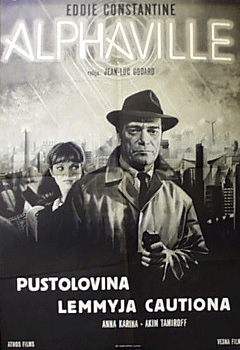
Saturday Movie Review: Alphaville

Posted by Alistair.
---------------------------
From the little I know of the director, it seems that Jean-Luc "Cinema" Godard's films work, when they do, when the director succeeds in precariously balancing American pop-culture with French existential and metaphysical philosophy. In Alphaville, the prolific director's tenth film in five years, Godard errs in both directions: by focusing too heavily on the philosophical and the pop, Godard replaces what could have been a classic film with one that is merely good.

The movie's title comes from its location. Alphaville is the name of a squalid dystopia ruled by a fascist computer, Alpha-60 (brilliantly voiced by a man without a voice box). In Alphaville logic rules everything, words like conscience and love are forbidden, and weeping is a crime punishable by death. The streets and interiors simultaneously capture the grime of the Forties noir and the impersonal, metallic, cold of the late Fifties, early Sixties sci-fi future. Godard deserves much respect for crafting a world that is familiar yet so uniquely alien out of nothing more than Paris in the mid Sixties (the film's exclusive shooting location).

The world of the future is not as bleak as it initially seems. Alphaville isn't the only city left in the galaxy, there exist the "Outer-Lands" populated by such cities as Tokyorama, Nuevo-York, and Florence. Although none of these cities are ever seen it is hinted that they still hold on to the old ways of love, self-expression, and everything else illogical. Out of Nuevo-York comes secret agent Lemmy Caution (Eddie Constantine). A brash American detective of the Sam Spade pedigree, Caution is intent on finding and liquidating Professor Leonard Nosferatu (once professor Von Braun) a man who fled the Outer-Lands to create and run Alpha-60 in typical evil scientist fashion. Along the way Caution meets and falls for Von Braun's daughter Natacha (Godard regular and wife, Anna Karina), a woman who has been in Alphaville so long she has forgotten the word love....


Alphaville has every detail down pat. There are abundant pop-culture refferences and in-jokes from the evil professor's name to lab technicians named Heckle and Jeckle (after the cartoon ravens) and a secret agent with the unlikely nomen cloture Dick Tracy. All the actors carry themselves perfectly—Constantine holds himself like a Bogart Proust love child, simultaneously tough and poetically tender, while Karina pulls off seeming confused and seductive in such a way that the traits complement each other, her confusion becoming a seduction and her seduction a confusion. Caution looks like noir itself while running down a hallway with a drawn gun in a beautifully chosen hat and trench coat. Shots like this are cross-cut with shots of neon signs that advertise E=mc², and other physics slogans, as well as endless hallways with futuristic doors, and neon signs denoting the city's north and south zones. Through these details Godard is able to create his unique vision of a world that is equal parts past and future. And since the super-computer Alpha-60 insists that past and future are one and the same, Godard has succeeded in creating a hellish imaginary world in both form and content.


The film's philosophy is equally perfect in its details. With brilliantly enigmatic quotes from the computer such as: "Once we know the number one, we believe that we know the number two, because one plus one equals two. We forget that first we must know the meaning of plus." There are some amazing exchanges between Alpha-60 and Mr. Caution, such as when the computer asks the man what the privilege of the dead is and the man replies "To die no more." Or when the computer tells him, "I shall calculate so that failure is impossible". To which the reply is, "I shall fight so that failure is possible". These lines come in between images of men being shot by machine guns into swimming pools for behaving illogically, ruminations on art and poetry, and the struggle by Natacha to overcome logic with feeling.

And while all of these details are presented in crisp, perfect fashion, the big picture becomes blurred. Godard focuses so heavily on capturing good dialogue, referencing the pop-culture of his youth, and telling us which metaphysics of time he calls his own that he utterly forgets the film's plot. No—perhaps "forgets" isn't the right word—it is more as if the plot is shunned. And while shunning a film's plot (or at the very least severely relegating it) is a brave move and worthy of some respect, it must only be done when it is replaced by something even better. Unfortunately for Godard, his vague theories of time, and laughably naive ideas about the badness of math and logic and goodness of poetry and art, do not do the trick.

This film ends—as do most Sixties movies about evil super-computers that rule the world—with the computer destroyed (it uses all its power trying to decipher a riddle about love [groan]), Alphaville and all its brainwashed denizens dying off, and the two heroes speeding away in a car while Natacha forgets all the logic she learned and begins to feel love. That she has absolutely no reason to love Lemmy Caution is, in the face of everything else going on, hardly noticeable. I was unpleasantly surprised by this film's general naivety and dated ideas regarding the subject of love; a subject I have always found the French New Wave to warmly embrace and understand without sacrificing the emotion's more subtle and complex points. Here love seems both cold and misunderstood. I am not trying to fault this film too heavily. It is, of course, a science fiction film of the 1960's and one of the best and smartest ones at that. It fails, however, to transcend the boundaries of its genre—although it plays with them quite masterfully—and never becomes, as 2001 later would, something more than a science-fiction film made at the height of the froth of Sixties ideology and confusion.

Sunday, August 27, 2006

Saturday Movie Review: Little Miss Sunshine

Posted by Alistair
------------------------

Little Miss Sunshine—a film that has been in American theaters for exactly a month but is only now starting to get the attention it deserves—is at once incredibly subtle and excessively larger than life. It is crafted around the very simple story of a dysfunctional family embarking on a road trip so that their youngest member, Olive (Abigail Breslin), can compete in a children's beauty pageant. The plot, as with all good journey stories, is not all that important. What really drives this film to its comedic and dramatic peaks—both of which are reached often and with indefatigable charm—is the characters that inhabit it.

We are presented with characters that are both insanely over the top and heartbreakingly human. Kudos must be given to writer Michael Arndt and directors Jonathan Dayton and Valerie Faris, all three of whom love and understand the unique humanity present in each of their characters.

There is the father Richard (Greg Kinnear), a man incapable of success who has developed a laughable self-empowerment system based on the bifurcation of the world between winners and losers. Sheryl (Toni Collette), the family matriarch who tries to be a pillar of family togetherness while nearly crumbling herself under the weight of financial problems and a secret smoking habit. Frank (Steve Carrell), Sheryl's scholarly brother, a once famous scholar, who has, at the film's open, fallen from grace and undergone a suicide attempt. Grandpa (Allen Arkin), a man who has led a long and varied life only to develop a heroin addiction and heavy regrets in his twilight years. Dwight (Paul Dano), Olive's brother who reads Nietzsche and has taken a vow of silence until he is accepted into the air force. And of course Olive, a girl with little personality other than the desire to be a beauty pageant winner. She is, without a doubt, the film's weakest character.

All of these characters... initially come off as obnoxious but funny caricatures of themselves. As the film progresses, however, and the family members begin to open up to each other, the thin mercurial humanity present in each begins to show itself. The father is quite hard on his daughter and the rest of the family—going so far at times to insinuate their placement on the negative side of his black and white, losers vs. winners, binary worldview. He is redeemed however when he interacts with those who fit his strict definition of "winners". These scenes, including the film's howlingly funny and painfully heartwarming climax (where Olive performs her "talent"), are among its best. When the father battles it out with the world's winners he triumphs by retaining his own personal idiosyncrasies and moral sensibilities, characteristics that he may himself loath but that the audience is sure to adore.

Indeed, in the end, all of the characters are redeemed on similar grounds. All of the characters struggle with the constant pain of being different, and finally realize that's what draws them together. Although that ending sounds typically Hollywood and absurdly clichéd it is anything but. The film deserves the utmost respect for never compromising its integrity and giving the family the kind of victory that winners readily achieve. On the contrary, their victory is incredibly small and only important to them, but it is important to them.

While the film suffers from not enough explanation of, or investment in, its female characters, as well as some confusion about the characters it does touch upon, it carries itself off with just the right amount of humor and exploration of the human spirit. Its ending is both believable and uplifting, something almost unheard of in modern entertainment.

This movie will make you laugh both at the absurdity of its bits and at the very fact that something so painful could be so funny. And while it ultimately boils down to little more than a treatise on winners vs. losers and who really belongs to which group (a point subtlety brought out in the horrific images of real child beauty queens during the film's climax), it is a film of hilarious, dramatic, and human depths, the likes of which haven't been portrayed on the screen in such brilliant light since Sideways.

Saturday, July 22, 2006

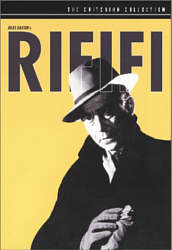
Saturday Movie Review: Rififi

Posted by Alistair.
-------------------------------------------

In a lot of ways Du Rififi chez les Hommes—or Rififi as it is more commonly known—is the perfect movie. It is the product of many good people working at their best to create a whole far greater than the sum of its parts. It is shot with beautiful cinematography that captures the urban sprawl of Parisian streets and the smoky glamour of the criminal underworld in equal measure. It is brilliantly acted. All the movie's characters are given a depth that makes them simultaneously feel as large as the inhabitants of Greek myths and as ordinary as people you see in the street. Jean Servais is particularly amazing as the lead, giving a performance here that proves he was as capable as Bogart as a noir anti-hero. The screenplay is perfectly paced and replete with subtly brilliant lines—like when gangster Jo le Suedois's wife tells him that he is one of millions who suffered an unhappy childhood, and it is the others, and not he, who are truly tough guys. And the movie's plot is strong and full of twists while never becoming too much to handle. But for all of its brilliance in these departments, what really sets this film strongly on this side of the classic film line is its direction.

Blacklisted American director Jules Dassin (who apparently only made the film for the money) creates something so revolutionary with such understatement that it is still difficult to identify what sets it apart from the rest of its breed. It isn't just the movie's brilliant pacing, in which not a second is wasted, and no element is introduced that does not pay off with interest by the film's end. Nor is it Dassin's mastery of all the ingredients I mentioned above—script, location, cinematography, character development, plotting, and acting. It is clear that Dassin is a master working at the peak of his game, but that alone isn't what makes this movie what it is. Perhaps it is Dassin's unique circumstance, his need for a job coupled with his entrance into the culture of a new country. Perhaps this is the place where the American work ethic meets French ennui. Where Bogart meets Camus.

Whatever it is, something in this film makes it undeniably brilliant. It manages to retain a staying power that keeps it as fresh and exciting today as when it was first released. It is without doubt a film that helped spawn both the genres of heist film and the French New Wave. It remains smarter and more human than anything in the former category and cooler, quicker, and more exciting than anything in the latter, while simultaneously giving homage to the Forties' noirs on both sides of the Atlantic that preceded it. It is one of those classic works that immediately becomes the rule by which everything that follows will be measured. And it does it all so smoothly that you hardly notice what has happened until it's all over.

The film's plot follows a thief named Tony le Stephanois who was recently released from prison (Servais). After finding no solace in gambling or confronting his former girlfriend who helped put him away, he reluctantly agrees to rob a jewelry store with his old friend Jo le Suedois (Austrian born Carl Mohner). The two work to assemble a crack team, and to discover the secret of bypassing the latest alarm system with which the jewelry store is equipped.

Although the plot is pretty standard, Dassin works overtime to make it shine. He crafts a careful theme that hinges around a thief's code and his debt to the innocent. And he makes even the seemingly superfluous bits count—like the inclusion of an umbrella in the heist, which is both funny and thrilling. The heist itself is one of cinema's classic scenes and it is to Dassin's utmost credit that he shoots it in almost real time, taking 32 minutes while hardly using a sound, and that each second is utterly captivating.

If the film can be faulted for anything it would have to be for its lack of a vastly important theme. The idea that something can be done perfectly, but fail due to the inhumanity of others (you'll have to see it to find out!), while interesting is hardly as deep or as broad-reaching as any of literature's great works. The film may also suffer from a little too much focus on revenge for being ratted out. (A motif that a bitter Dassin may have included in retaliation for his having been blacklisted.) These minor complaints aside, this is an unbelievable film. It has immediately clawed its way to the top of my favorite movie list. It is a brilliantly formulated noir, exquisitely crafted, with a tough but human core. If you have never seen Rififi I suggest you work to change that.

Saturday, May 13, 2006

Saturday Movie Review: The Passenger

Posted by Alistair.
-----------------------------------------


The Passenger (aka Professione: reporter, 1975), which came out on DVD two weeks ago after being re-released in theaters in late 2005, is a rare find in the movie world. It's a critically-praised film made by a famed director, with universally known and incredibly talented actors—all of whom are performing at or near the peaks of their respective careers—and yet it is and has been virtually unheard of. It's natural to ask with a movie like this why that is. Is there good reason we've never heard of it? Thankfully The Passenger is a lost gem, not a discarded one.

This isn't initially obvious. From the first shot of a sand-swept street in Africa, as Jack Nicholson is slowly brought into visibility and then, even more slowly, into the foreground, it is clear that this film requires a good amount of patience. The cinematic problems seem to multiply from there. Director Michelangelo Antonioni often seems as preoccupied with the movie's scenery as with its plot. There are less than thirty minutes of dialogue in the entire movie. And there is a constant sense of having missed some crucial detail as to who anybody on the screen is, or what drives them. But what initially appear to be drawbacks soon unfold into the film's very strengths. Antonioni focuses on imagery precisely because he knows the imagery that matters, and given the abundance of lush locations he's provided us—from the barren, harshly beautiful deserts of Africa to the dusty, colorful streets and rooftops of Western Europe—there's hardly a moment where something beautiful doesn't pass before our eyes (including the film's leads, the mischievous-as-ever Nicholson, and the sultry French belle Maria Schneider). Although the dialogue may be minimal to a fault, nearly every line holds a gentle touch of the poetic. What is at first shocking is then wholly satisfying when we realize that the ambiguity within the characters is not a flaw, but the very point.


Because of Antonioni's idiosyncratic technique and commitment to building slowly, you may be well into the film's second act before you realize you are watching a continental thriller, replete with guns, chases, politics, and a love interest; sort of an art-film rendition of The Bourne Supremacy. Nicholson plays a reporter writing a piece on civil unrest in Africa. Bored with his job and feeling trapped, Nicholson takes the only out he can, switching identities with the only other American in town after inadvertently discovering that man's corpse. Upon rifling through the man's belongings, Nicholson learns that the man was a gunrunner affiliated with a radical militia having backers in Europe. He then stumbles head first into the other man's life, but finds himself trapped and forced to enlist the help of a French tourist, Schneider (who may or may not work for the militia), in order to escape from both the police and his increasingly suspicious wife.

Upon hearing of her husband's death, the reporter's wife (played by Jenny Runacre) is told that her husband was "An excellent reporter—a very detached man, but a brilliant observer". And it is through eyes like these that the world of The Passenger is shown to us. We catch the film's characters, walking down labyrinthine European streets from afar, indistinguished figures among several others. The camera will often follow a particular scene only to be thwarted by a closed door, a dead end, a place we are not allowed to intrude. Several of the film's most poignant moments are glimpsed from the outside, through a window or some other obscuring object.


For all its similarities to bestselling spy novels, this movie is of an entirely different character. The moment at which Nicholson decides to do away with his old self is practically an aside, as are all of the daring chase scenes, the near captures, and the wife's insistence that something about her husband's death does not add up. We don't see the seduction that occurs between Schneider and Nicholson, or the love that somehow develops, only the effects of these causes. We are treated rather to the existential views of pointlessness (borrowed heavily from Camus and from Godard's masterpiece Breathless), expressed by Nicholson and Schneider in their more tender moments together, and the warmly terrifying notion that anything we experience in life does not really matter, at least not more than anything else. After all, life is nothing but a series of events that we cannot control; quite the contrary: they control us. And we're all of us just passengers along for the ride.