Firmin Baes (1874-1943) was a Belgian artist who, although he also worked in oils, is primarily known for his pastel on canvas works. He was from a family of artists and began his career painting interior and exterior designs on buildings with his father. He soon moved onto paintings where he had considerable success. It is his work with pastels on canvas that he is most remembered for,
A fellow named Ebroin runs the YouTube channel Ebroin's Miniatures. He builds dioramas and there are quite a few videos at his channel. The one above is of a small boat tied up to a pier. I must say I like the overly dramatic music used in the soundtrack -- it is rather majestic.
Glass is an interesting subject for a painter. Being transparent, its form is primarily revealed by the light reflecting from it, or the distortion of the light passing through it. Add water to the glass and you have two transparent layers reflecting and light distorting areas to add complexion to the composition.
The above video shows a family in Yunnan, China harvesting, processing and cooking with sugar from the sugarcane. It is obviously a staged cooking show, but it is nicely filmed and put together. If you are a diabetic, you may have a rise in your glucose levels just from watching it, but they do whip-up some tasty looking food and treats.
Detail showing the Persian and Western influences (click any image to enlarge)
Hossein Behzad
(1894-1964) was an Iranian painter who started his career painting in the
style of old Persian miniature paintings. He hoped to revive the style and was
part of the Neo-Safavid movement. In the 1930s he moved to Paris for some time
and studied Western and Eastern painting methods. He was to fold those
influences into his work.
The Neo-Safavids met some skepticism at first because at the time Western
collectors were interested in antique miniature Persian paintings, and the
Neo-Safavids were often conflated with the fakers who were creating forgeries
for the collector market. However, over time their work was accepted as a
genuine and distinct art style.
This is a video of a walk through downtown La Paz, Bolivia. It starts out on a touristy looking street with shops selling colorful local fabrics, guitars, crafts, and the like. There are also a lot of shops dedicated to hiking. I suppose one of the draws of Bolivia is hiking in the mountains. As my regular readers will guess, my passion for conveyor belt sidewalks will preclude me from taking part in that activity until they install some conveyor belt nature trails.
He moves through the streets and eventually ends up in a public square. He filmed it during the Christmas season, and so there a lot of elaborate Christmas displays in the square. It is a lively looking place, with some nice old buildings mixed in.
Canoes are small open topped vessels propelled by oars that are used in narrow waters. Dugouts, kayaks and the Amerindian's birchbark canoe are all examples of canoes. They were used in transportation, trading and exploration. Much of the upper Midwest, with its plentiful rivers and large lakes, were explored via canoes. Today, they are widely used for recreational purposes.
This is a video about a 4,000-year-old Sumerian joke: a dog walked into a tavern and said, 'I can't see a thing. I'll open this one.' In this day and age, it is not exactly a knee-slapper. However, we don't know the context, or it may have been wordplay. In fact, it may not even had been a joke (it is from a tablet fragment). Still, it is an interesting video.
Starblazer was an English comic book series that published science fiction stories and eventually fantasy stories as well. It was published between 1979 and 1991 for a run of 281 issues. Along with the fiction stories it wrote about astronauts, space missions and planets. At the link you can view all of the covers as well as flip through and read the stories and articles.
The above video covers the first mass tank attack during the battle of Cambrai in WWI. It focuses on one tank, named Deborah, that was involved in the attack and met its end on the field of battle. I suppose you could call it the first combined arms operation. However, like the first of anything it didn't work as well as hoped; there were coordination and technical issues that caused the attack to fall short of its goals.
These are paintings of carts, stalls and trucks that serve food from the side of streets. Hotdog carts, taco trucks, and all manner of small enterprises that serve treats and meals.
As an aside, my son, Ambi Jr., at one point in his varied career decided he was going to operate a food truck. He bought a truck and spent some time adding all of the facilities inside it. He opened it and a week later the covid lockdowns started. Needless to say, that put a dent in his business. However, all was not lost, he kept working his regular job and his partner survived the lockdown on take-out business from the truck.
Guard well your spare moments. They are like uncut diamonds. Discard them and their value will never be known. Improve them and they will become the brightest gems in a useful life. ― Ralph Waldo Emerson
Aside from the times we turn them into tables by randomly piling objects on them, chairs are made for sitting. And sit in them we do. These are paintings of occupied chairs as well as empty ones. So, as you sit in your chair in front of your computer, or relax in a chair with your phone, scroll through and enjoy the pictures.
Once again, we head to the sub-continent to visit an industry. This time a foundry casting a pump body. As usual, safety standards seem to be lacking. The two guys wearing sandals as they carry a cauldron of molten metal across a debris littered floor is particularly harrowing.
Jacques François Joseph Carabain (1834-1933) was a Dutch/Belgian painter known for his paintings of street scenes. However, while many of his paintings featured markets it was the architecture and not the people were the focus of his paintings. He stopped painting 26 years before his death. Because of that, and because of some motifs repeated in many of his works, I suspect he painted mainly for commercial purposes.
A couple on a circumnavigation pass through the Panama Canal on their catamaran to get to the Pacific Ocean. Aboard they have their parents and a few hired locals to help handle the lines. They also have a pilot to help them navigate the canal. It is an interesting up-close look, from the deck of a small boat, of the passage through the locks and waterways of the canal.
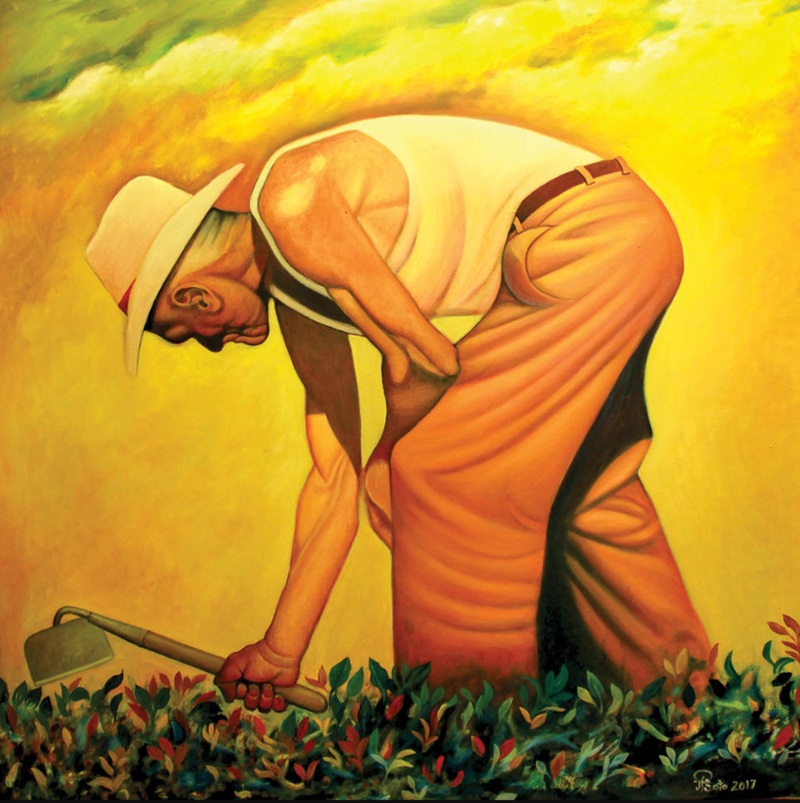
These paintings focus not on bucolic images of farms, but rather on the
farmers who work the farm. There were very few images of current farmers, I
guess they are out of favor in the modern art world, so we see farmers
laboring in older times.
The story is that in 1850s, in western Oklahoma, there were Choctaw Indians and white settlers in the area who started having problems with thieves. It started with the theft of food, moved onto cattle rustling, and eventually escalated to women and children gone missing. This enraged the Choctaws who raised a war party to track and kill the thieves.
They rode for a day before coming upon a forest clearing with a horrible stench coming from it. When they entered the clearing, they were horrified to discover it covered with the half-eaten bodies of their missing women and children. Standing over the bodies, they saw three gigantic hairy, humanoid creatures dining on the remains. Infuriated, the Choctaws attacked and a battle ensued. All the Bigfeet were killed with only the loss the Choctaw leader, Joshua LeFlore, who had his head tore off in the scuffle. They buried the bodies of the women and children and burned the Bigfeet carcasses. What became of LeFlore's headless body is lost to the mists of history.
However, I do have a few questions. Why is there no contemporaneous record of this event. One would think that an outbreak of giant carnivorous monkeys would generate considerable interest -- reports to the territorial authorities, newspaper accounts, and years of retellings of the story around general store pickle barrels, but all of that is curiously missing. I wonder why people lost interest in the matter from almost the first day.
Secondly, it took only a day for the Choctaws to track and locate the murderous simian beasts. What does that say about contemporary Bigfeet investigators? They've spent decades, and used all manner of high-tech equipment, and can find nary a clue (tuffs of hair, Bigfeet scatt, etc.) much less one of the big goobers, dead or alive. They certainly need to up their game a bit.