Time and circumstance have not allowed me to pay attention to a certain pressing matter. I did, however, discover one way to distinguish osprey from ospring from a great distance.
When osprey decide it is time to take wing they simply take a little hop into the air, beat their wings a time or three, and off they go. When ospring decide to leave the nest they point their beak earthward and dive... hurtling downwardfor a few moments and finally swoop out of the dive, make a beat or two of their wings, and fly off.
I wonder how long it takes them to learn those wonderful circling maneuvers?
Tuesday, May 23, 2006


Monday, May 22, 2006
The Anchoress Says what I feel

How do you accept a good? This question is posed by The Anchoress in a post that I recommend every conservative read:
I was surprised, and what surprised me was the sense I had that Bush’s heart was broken. That he had done everything he could to keep faith with the nation, and that he could not believe that in a time of such terrible need, all some people could think of was, “how do we use this politically, how do we break Bush with this?” It can’t have helped that some of the hysteria was coming from the right as well as the left. Things changed after that, didn’t they? The press and the left doubled up their attacks, the far-right went very smug, and President Bush never has seemed to have regrouped his spirit.
A month later, I wasn’t surprised (although some - mostly the hard-right “I’m a Conservative before I’m anything and he’d better serve me” types - clearly were) when he nominated Harriett Miers to the SCOTUS. In fact, I’d predicted it. Up until that moment, every person President Bush had nominated to pretty much any position had won accolades from the beamish far-right, but Miers did not. She wasn’t one of their guys or gals. She wasn’t Luttig, she wasn’t Rogers-Brown. Harriet Miers? Damn that Bush! The denouncements came fast and furious and suddenly “the base” with which George W. Bush had not broken faith…broke faith with him. Suddenly they were as willing to call him a moron and an idiot as any KozKid.
Imagine that. Imagine being the guy who has given his base one splendid nominee after another, in all manner of posts, make a nomination he thinks appropriate only to find that “base” coming out with both guns, defaming his nominee and directing all manner of insult at himself. President Bush is nothing if not loyal; his loyalty is often his downfall. When he asked for a little trust (which he had surely earned) a little loyalty and a little faith, from “the base,” he got kicked in the groin, over and over again, for daring to think differently, for falling out of lockstep with his policy-wonk “betters.”
That had to be bitter, for him. At that point Bush, unchanged in essentials, might have wondered if his conservative “base” had become a bit over-confident and loose-hipped, so cock-sure of their majority (not that congress used it) so certain of their own brilliance that they were beginning to believe they didn’t need him; that he wasn’t conservative enough, after all, and that the next president was going to be the solid, “uncompassionate” conservative they’d really wanted all along. The president who had delivered one gift after another to his base asked them to trust him, and his base sneered.
Read it all.
Politics and Commencement
Via Gateway an interesting story on the socalled commencement speech of Lacy Clay D-MO at the University of Missouri last weekend. Apparently his Bushbashing anti war talk did not go over well with the student body. Why do these guys think these kids want to listen to this crap?
Blair Speaks
Via Lorie Byrd Tony Blair will be in Washington DC later this week to discuss Iraq and his support for the use of military force by the Coalition forces to remove Saddam Hussein from power.
Hell Is Where You Find It
And Baron Bodissey of Gates of Vienna posts another piece by Fjordman that strongly suggests that Loki has managed to free himself and has adopted the nihilistic dystopianism beloved by the New York Yimes to bring Ragnarok to pass so that the Swedes can find their very own in a socialist Niflheim.
Not exactly what Marx and the New York Times promised but it is all that they are capable of providing.
PS - There are some very good links in the comments at Gates on this piece concerning the marriage of Marx and Mohammed as blessed by Gramsci.
Not exactly what Marx and the New York Times promised but it is all that they are capable of providing.
PS - There are some very good links in the comments at Gates on this piece concerning the marriage of Marx and Mohammed as blessed by Gramsci.
Sunday, May 21, 2006
Shifting Sands - Following the Money
If one were to believe polls paid for by the adjunct propaganda organs of the Democratic Party one would think the Republican Party in serious trouble. In fact, if one reads the political commentators paid to fill all the vacant column inches every week one might have reason to believe that "something new" or "something serious" was happening. According to the 'dollar polls' that may provide a better lens on the political situation, there is something happening. Democrats are definitely putting money up at a rate far better than they have in the past. The loss of the unions 'help' has apparently been acknowledged and the propaganda effort on the part of the party organs has encouraged a level of giving at a rate double that of the 2002 cycle (first quarter results). That's quite an achievement and Howard Dean and Rahm Emmanuel deserve kudos from their party for their efforts thus far.
On the Republican side contributions are up a paltry 24% but one might give some slight consideration that a 24% increase in contributions is perhaps a signal that the Republican apocalypse may still lay in the future rather than having already occurred. Some small cold comfort might also be obtained by reflection upon the better than 2 to 1 edge that Republicans continue to hold in contributions. Down sharply from the 3 to 1 edge that they held in '02 at the same point, to be sure, but not because of any decrease in contributions on the part of Republicans.
The '06 elections may be of more interest than first appearance indicated but the reason lies with affirmative actions taken by the Democrats (including emphasis upon phantasmal 'deep' dissension within the Republican ranks) rather than upon the reality expressed by increased Republican contributions. Money does talk - and what it's saying is that the Bush/Rove penchant for keeping the powder dry until the right moment is still operative.

On the Republican side contributions are up a paltry 24% but one might give some slight consideration that a 24% increase in contributions is perhaps a signal that the Republican apocalypse may still lay in the future rather than having already occurred. Some small cold comfort might also be obtained by reflection upon the better than 2 to 1 edge that Republicans continue to hold in contributions. Down sharply from the 3 to 1 edge that they held in '02 at the same point, to be sure, but not because of any decrease in contributions on the part of Republicans.
The '06 elections may be of more interest than first appearance indicated but the reason lies with affirmative actions taken by the Democrats (including emphasis upon phantasmal 'deep' dissension within the Republican ranks) rather than upon the reality expressed by increased Republican contributions. Money does talk - and what it's saying is that the Bush/Rove penchant for keeping the powder dry until the right moment is still operative.

Saturday, May 20, 2006
Ray Nagin Winning Reelection
And here is Paul at Wizbang's amazing preelection analysis predicting it. No way I would have guessed that, no way. Hats off to Paul, the force be with him.
Majority Party
Are the Republicans capable of being the majority party? Are their views too narrow and self serving? I did not think so when I voted for George Bush, but some of the rhetoric I have heard during the course of the immigration debate has made me wonder.
Fred Barnes lays out the stakes in the upcoming election:
PRESIDENT BUSH AND REPUBLICANS are staring political disaster in the face on immigration. The problem isn't that they might enact a bill allowing illegal immigrants living in America to earn their way to citizenship, inviting foreign workers to come here, and beefing up security on the 2,000-mile border with Mexico. No, it would be a disaster for Republicans if they didn't pass such a bill.
Rarely has the American public been so involved in a national issue as they are today in immigration reform. Everybody has an opinion. Everybody agrees there's a crisis when, as is the case today, hundreds of thousands of illegal immigrants are streaming across our southern border and millions more are already living in this country. The public expects action from the people who run Washington--that's Bush and Republicans. But action is not what they will get if the enforcement-only House refuses to compromise. What they will get in that case is an impasse. And that means the crisis endures.
The American people are not on the side of the House Republicans who favor toughened enforcement and nothing more. On the contrary, a national consensus has formed around what the president calls "comprehensive" immigration reform--that is, impenetrable border security plus earned citizenship and a temporary worker program. But there's a wrinkle in the Senate. Democrats are certain to filibuster legislation consisting solely of enforcement. So it can't pass. However, their constituency groups, particularly immigrant groups, won't permit Democrats to block a comprehensive bill. So it, and only it, can
pass in the Senate.
Once the Senate approves an all-inclusive bill, House Republicans will have a decision to make. Will they accept a broader bill, even if it contains what they consider to be amnesty for illegals, or will they insist on the enforcement-only approach they took in the measure they passed in the House last December?
But if they persist in holding out, immigration reform may die.There's a wrinkle in the House, too. Immigration reform may be killed altogether unless a majority of Republicans backs a broader bill. Why? Because House Republican leaders don't want to be put in the politically awkward position of relying on Democrats to approve a comprehensive bill--
Governing requires compromise, and it also requires seeing beyond one's narrow perspective. I am beginning to wonder if Republicans are capable of that. In the last few weeks I have heard conservative Republicans come up with conspiracy theories concerning Bush's plans to all but cede the southwest to Mexico which are every bit as insane as are the theories concerning government involvement in 9/11. They both refelct a lunatic fringe which when combined make up a disquieting number of people.
Governance is not about being the opposition, it is about leading and creating a consensus and developing compromise solutions. When Republicans like Peggy Noonan start talking about masterminding their own defeat for some larger victory down the road, are they really saying they don't have what it takes to get the job done? When the comment sections of conservative blogs are full of invective for any Republican, including the president, who would even consider a compromise are the Republicans once again proving to the world that they are the stupid party?
Fred Barnes lays out the stakes in the upcoming election:
PRESIDENT BUSH AND REPUBLICANS are staring political disaster in the face on immigration. The problem isn't that they might enact a bill allowing illegal immigrants living in America to earn their way to citizenship, inviting foreign workers to come here, and beefing up security on the 2,000-mile border with Mexico. No, it would be a disaster for Republicans if they didn't pass such a bill.
Rarely has the American public been so involved in a national issue as they are today in immigration reform. Everybody has an opinion. Everybody agrees there's a crisis when, as is the case today, hundreds of thousands of illegal immigrants are streaming across our southern border and millions more are already living in this country. The public expects action from the people who run Washington--that's Bush and Republicans. But action is not what they will get if the enforcement-only House refuses to compromise. What they will get in that case is an impasse. And that means the crisis endures.
The American people are not on the side of the House Republicans who favor toughened enforcement and nothing more. On the contrary, a national consensus has formed around what the president calls "comprehensive" immigration reform--that is, impenetrable border security plus earned citizenship and a temporary worker program. But there's a wrinkle in the Senate. Democrats are certain to filibuster legislation consisting solely of enforcement. So it can't pass. However, their constituency groups, particularly immigrant groups, won't permit Democrats to block a comprehensive bill. So it, and only it, can
pass in the Senate.
Once the Senate approves an all-inclusive bill, House Republicans will have a decision to make. Will they accept a broader bill, even if it contains what they consider to be amnesty for illegals, or will they insist on the enforcement-only approach they took in the measure they passed in the House last December?
But if they persist in holding out, immigration reform may die.There's a wrinkle in the House, too. Immigration reform may be killed altogether unless a majority of Republicans backs a broader bill. Why? Because House Republican leaders don't want to be put in the politically awkward position of relying on Democrats to approve a comprehensive bill--
Governing requires compromise, and it also requires seeing beyond one's narrow perspective. I am beginning to wonder if Republicans are capable of that. In the last few weeks I have heard conservative Republicans come up with conspiracy theories concerning Bush's plans to all but cede the southwest to Mexico which are every bit as insane as are the theories concerning government involvement in 9/11. They both refelct a lunatic fringe which when combined make up a disquieting number of people.
Governance is not about being the opposition, it is about leading and creating a consensus and developing compromise solutions. When Republicans like Peggy Noonan start talking about masterminding their own defeat for some larger victory down the road, are they really saying they don't have what it takes to get the job done? When the comment sections of conservative blogs are full of invective for any Republican, including the president, who would even consider a compromise are the Republicans once again proving to the world that they are the stupid party?
Saturday Movie Review: Yasujiro Ozu in toto
Posted by Loner.
-------------------------------------------------
Because we lost, young kids shake their behinds and dance to their hot jazz. But if we'd won...the blue-eyed ones would be wearing wigs and chewing gum while plucking tunes on the samisen.
It's lucky we lost.
You think so? Yeah...could be.
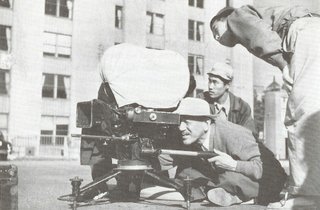
On V-J day, August 15, 1945, the 42-year-old Japanese director Yasujiro Ozu was in Singapore. He'd made 39 movies in 25 years prior to being sent there to aid the war effort two years earlier. While there he spent much, if not all, of his time watching confiscated American movies. He was interned when the British returned in September and repatriated in February 1946. When he began directing again a year later it was immediately apparent that what he'd seen had done nothing to change a style most apparently influenced by the silents of Ernst Lubitsch and polished and refined to a simplicity that in his final movie is breathtaking.

It is a style in which the camera is usually stationary and positioned to capture the point-of-view of a person sitting on the floor. Most of the edits are straight cuts. There are no special lenses. There is no cross-cutting. There are no flashbacks. There are no dream sequences. There are no ghosts. There are no Samurai. From 1935 on there is sound and from 1958 on there is color. In that final movie the camera never moves within a shot and there is not one edit that isn't a straight cut.

For Ozu, like Hitchcock, a movie was largely done when the shooting script was finished. He generally had a collaborator and for the final thirteen movies that collaborator was Kogo Noda. The scripts are all about character. What plot there is is in the service of the characters and the characters were generally created with specific actors in mind. When it came to shooting the script, Ozu told the actors exactly how he wanted everything done (though not generally why) and they did it and did it and did it until he was satisfied. What are his movies about? Donald Richie suggests in his Introduction to Ozu, that Ozu "had but one major subject, the Japanese family, and but one major theme, its dissolution." This is more or less true, but it is absolutely true of the first, Banshun (Late Spring), and the last, Sanma No Aji (An Autumn Afternoon), of the final thirteen.
I have a prospect. Interested?
What for?
For marriage, man!
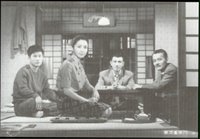
In the two movies a widower has to part, through marriage, with his only daughter. In An Autumn Afternoon the action begins with a series of establishing shots of some sort of factory. Eventually the cut is to a man sitting at a desk. The man is the widower, Shuhei Hirayama.
[He is played by Chishi Ryu. Ryu also played the widower 13 years earlier in Late Spring and he played parts big and small in all but a couple of the 54 movies directed by Ozu between 1927 and 1962.]
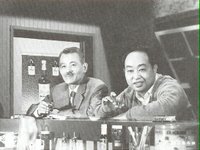
A younger woman enters the same office. Mr. Hirayama notes that another woman has been absent for a couple of days. She may be getting married. He suggests that that means the absent woman will be leaving. Maybe. He asks how old the absent woman is. 23 or 24. He inquires as to what the young woman's husband does. She's not married and she's supporting her father. He comments that soon it will be her turn to marry and he wishes her luck. She leaves. Cut to the hallway outside the office where she walks into the background and passes a man (slight bow by both) who knocks on the office door, is acknowledged and enters.
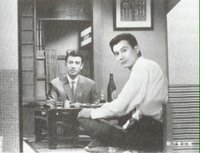
The man is a school friend and after some pleasantries they move into another part of the office where they sit facing one another. The friend asks how old his daughter is. She's 24. "I have a prospect. Interested?" The widower, as you read, doesn't know what he's talking about and when he does dismisses the suggestion as premature. The friend disagrees, but makes little headway and the widower mentions that another school friend called and would like them to join him that night. The friend says he has a crucial baseball game to go to. The widower encourages him to skip the game and come along. He resists. Cut to a shot of stadium lights and score music. More stadium lights. A public address announcer says it's the bottom of the fourth with so-and-so coming to bat. Cut to a black and white television set on which so-and-so is coming to bat and a television play-by-play announcer is doing his shtick. Hold for the first pitch. A called strike. Cut to four men sitting at a bar and watching the television. Cut to a hallway leading to the room in which sit the four men. Cut to another shot (presumably from the same hallway) into a private room in which three men are sitting on the floor and sharing a meal and drinks. The widower is on the right and his friend from the prior scene is on the left. The other school friend is center with his back to the camera.

Another school friend has encountered a long forgotten teacher who they nicknamed "The Gourd." "The Gourd" will prove crucial in convincing the widower that it is time his daughter marry and will also be a link in a chain that will bring him to a bar proprietor who will remind him, but not his oldest, of his dead wife. His oldest son is married and lives in a modern apartment. He isn't making enough money to buy everything he and his wife would like to have. There is another son, the youngest, who still lives at home and depends for his meals and such on his sister.
A formal Affair? A funeral?
Yes, more or less.
After many scenes in which the characters move the action forward, that initial prospect is acted upon and the coda begins. Just as it happened thirteen years earlier in Late Spring we see a car, but there are differences. There is more than one car. There are chauffeurs polishing them and the first thing we learn when we cut to the interior of the family home is that there aren't enough of them. The younger son is taking care of it. There are no small children about. The widower and the older son talk and the talk is of children. The widower asks if they are using birth control and the son says they are because they can't afford a child. The father suggests that fifty is too late to be raising children. The daughter is ready.
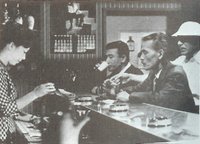
If Ozu did not change, Japan did and it is in this that Ozu is, I think, the most invaluable of all moviemakers because Ozu shows us the changes without anywhere near the editorial comment that a less austere filmmaker would have included. Just as, for the most part, the characters usually maintain that culturally characteristic outward diffidence so too does the director. While Ozu was writing the script for An Autumn Afternoon his mother, with whom he lived most of his life, died unexpectedly and a little under two years later he died, on his sixtieth birthday, of cancer. An Autumn Afternoon is my favorite of the Ozu movies I've seen because every time I see it I can imagine this remarkable man showing me Japan as she was in 1976 and in 1986 and in 1996 and as she is in 2006 were we still blessed with his presence.
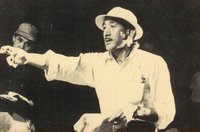
In 1949 (Late Spring), there is still much that is ceremonial and traditional dress is common. In 1962, it is rare in the men and mostly nostalgic in the women. In 1949, the relationships have a formality to them. By 1962, this is largely lacking. The daughter is ready. In 1962 there is little awkwardness and a daughter's appreciation isn't expressed; it's understood. The shots of the empty home when the family depart show us what is outside the windows and confirms that the modern is everywhere. Most of the establishing shots elsewhere have shown us thoroughly modern, functional and uninspired architecture. The family home and the better restaurant are the only exceptions and both, it turns out, are surrounded. As in 1949 neither the wedding nor the groom are in the movie. The widower drinks with other characters in the aftermath and he is sitting alone and lonesome when we last see him. Before then in An Autumn Afternoon what I think is the first English as English is uttered in an Ozu movie when the younger son says "Okay" to his sister-in-law as she and the older son prepare to depart.
An Autumn Afternoon is not yet out on DVD in North America. Late Spring and Tokyo Monogatari (Tokyo Story) are and I recommend them above everything that is available and hope and expect that An Autumn Afternoon will come out soon. It is on video.
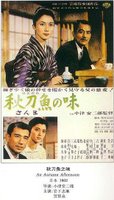
I began this knowing I could not convey all I wanted to regarding Yasujiro Ozu and the movies he gave us so I especially hope you'll read the Chishi Ryu reminiscence linked above and I'll close with this from Donald Richie's Ozu:

...and a picture of his grave in Kamakura. If an actor in an Ozu movie is shown to be drinking sake, beer, whisky, etc. that actor is drinking sake, beer, whisky, etc. and in An Autumn Afternoon a staggering amount is consumed. There will be a bit more on Ozu and drinking in my forthcoming bookend review of another 1949 release, Nora inu (Stray Dog), by another Japanese director you've hopefully heard of, Akira Kurosawa.
-------------------------------------------------
Because we lost, young kids shake their behinds and dance to their hot jazz. But if we'd won...the blue-eyed ones would be wearing wigs and chewing gum while plucking tunes on the samisen.
It's lucky we lost.
You think so? Yeah...could be.

On V-J day, August 15, 1945, the 42-year-old Japanese director Yasujiro Ozu was in Singapore. He'd made 39 movies in 25 years prior to being sent there to aid the war effort two years earlier. While there he spent much, if not all, of his time watching confiscated American movies. He was interned when the British returned in September and repatriated in February 1946. When he began directing again a year later it was immediately apparent that what he'd seen had done nothing to change a style most apparently influenced by the silents of Ernst Lubitsch and polished and refined to a simplicity that in his final movie is breathtaking.

It is a style in which the camera is usually stationary and positioned to capture the point-of-view of a person sitting on the floor. Most of the edits are straight cuts. There are no special lenses. There is no cross-cutting. There are no flashbacks. There are no dream sequences. There are no ghosts. There are no Samurai. From 1935 on there is sound and from 1958 on there is color. In that final movie the camera never moves within a shot and there is not one edit that isn't a straight cut.
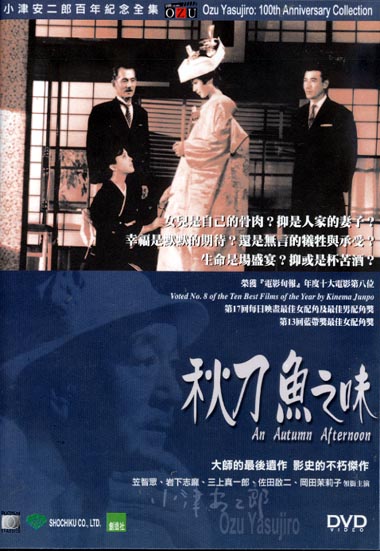
For Ozu, like Hitchcock, a movie was largely done when the shooting script was finished. He generally had a collaborator and for the final thirteen movies that collaborator was Kogo Noda. The scripts are all about character. What plot there is is in the service of the characters and the characters were generally created with specific actors in mind. When it came to shooting the script, Ozu told the actors exactly how he wanted everything done (though not generally why) and they did it and did it and did it until he was satisfied. What are his movies about? Donald Richie suggests in his Introduction to Ozu, that Ozu "had but one major subject, the Japanese family, and but one major theme, its dissolution." This is more or less true, but it is absolutely true of the first, Banshun (Late Spring), and the last, Sanma No Aji (An Autumn Afternoon), of the final thirteen.
I have a prospect. Interested?
What for?
For marriage, man!
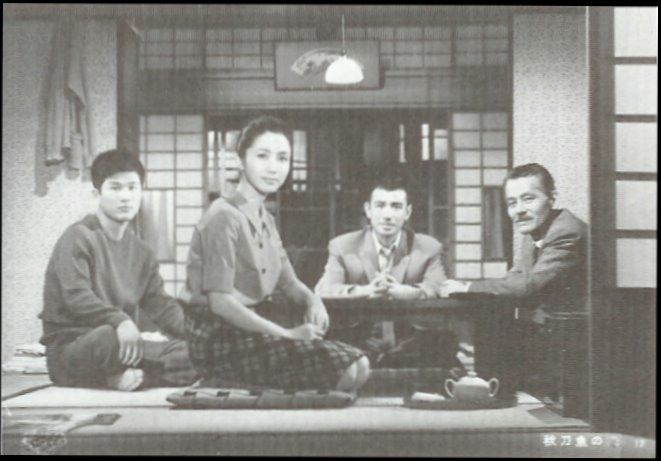
In the two movies a widower has to part, through marriage, with his only daughter. In An Autumn Afternoon the action begins with a series of establishing shots of some sort of factory. Eventually the cut is to a man sitting at a desk. The man is the widower, Shuhei Hirayama.
[He is played by Chishi Ryu. Ryu also played the widower 13 years earlier in Late Spring and he played parts big and small in all but a couple of the 54 movies directed by Ozu between 1927 and 1962.]

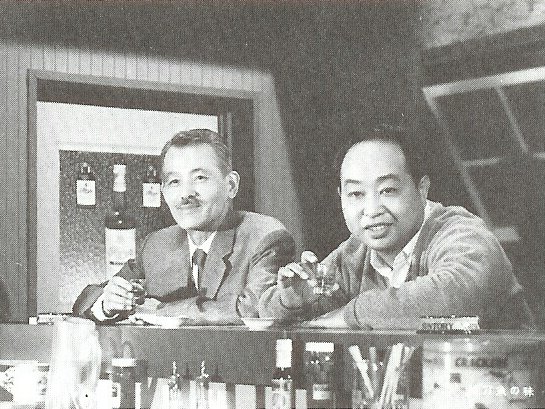
A younger woman enters the same office. Mr. Hirayama notes that another woman has been absent for a couple of days. She may be getting married. He suggests that that means the absent woman will be leaving. Maybe. He asks how old the absent woman is. 23 or 24. He inquires as to what the young woman's husband does. She's not married and she's supporting her father. He comments that soon it will be her turn to marry and he wishes her luck. She leaves. Cut to the hallway outside the office where she walks into the background and passes a man (slight bow by both) who knocks on the office door, is acknowledged and enters.

The man is a school friend and after some pleasantries they move into another part of the office where they sit facing one another. The friend asks how old his daughter is. She's 24. "I have a prospect. Interested?" The widower, as you read, doesn't know what he's talking about and when he does dismisses the suggestion as premature. The friend disagrees, but makes little headway and the widower mentions that another school friend called and would like them to join him that night. The friend says he has a crucial baseball game to go to. The widower encourages him to skip the game and come along. He resists. Cut to a shot of stadium lights and score music. More stadium lights. A public address announcer says it's the bottom of the fourth with so-and-so coming to bat. Cut to a black and white television set on which so-and-so is coming to bat and a television play-by-play announcer is doing his shtick. Hold for the first pitch. A called strike. Cut to four men sitting at a bar and watching the television. Cut to a hallway leading to the room in which sit the four men. Cut to another shot (presumably from the same hallway) into a private room in which three men are sitting on the floor and sharing a meal and drinks. The widower is on the right and his friend from the prior scene is on the left. The other school friend is center with his back to the camera.

Another school friend has encountered a long forgotten teacher who they nicknamed "The Gourd." "The Gourd" will prove crucial in convincing the widower that it is time his daughter marry and will also be a link in a chain that will bring him to a bar proprietor who will remind him, but not his oldest, of his dead wife. His oldest son is married and lives in a modern apartment. He isn't making enough money to buy everything he and his wife would like to have. There is another son, the youngest, who still lives at home and depends for his meals and such on his sister.
A formal Affair? A funeral?
Yes, more or less.
After many scenes in which the characters move the action forward, that initial prospect is acted upon and the coda begins. Just as it happened thirteen years earlier in Late Spring we see a car, but there are differences. There is more than one car. There are chauffeurs polishing them and the first thing we learn when we cut to the interior of the family home is that there aren't enough of them. The younger son is taking care of it. There are no small children about. The widower and the older son talk and the talk is of children. The widower asks if they are using birth control and the son says they are because they can't afford a child. The father suggests that fifty is too late to be raising children. The daughter is ready.
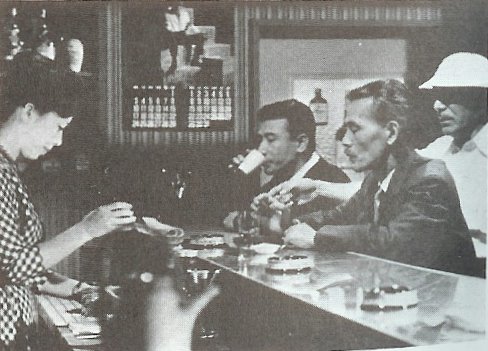
If Ozu did not change, Japan did and it is in this that Ozu is, I think, the most invaluable of all moviemakers because Ozu shows us the changes without anywhere near the editorial comment that a less austere filmmaker would have included. Just as, for the most part, the characters usually maintain that culturally characteristic outward diffidence so too does the director. While Ozu was writing the script for An Autumn Afternoon his mother, with whom he lived most of his life, died unexpectedly and a little under two years later he died, on his sixtieth birthday, of cancer. An Autumn Afternoon is my favorite of the Ozu movies I've seen because every time I see it I can imagine this remarkable man showing me Japan as she was in 1976 and in 1986 and in 1996 and as she is in 2006 were we still blessed with his presence.

In 1949 (Late Spring), there is still much that is ceremonial and traditional dress is common. In 1962, it is rare in the men and mostly nostalgic in the women. In 1949, the relationships have a formality to them. By 1962, this is largely lacking. The daughter is ready. In 1962 there is little awkwardness and a daughter's appreciation isn't expressed; it's understood. The shots of the empty home when the family depart show us what is outside the windows and confirms that the modern is everywhere. Most of the establishing shots elsewhere have shown us thoroughly modern, functional and uninspired architecture. The family home and the better restaurant are the only exceptions and both, it turns out, are surrounded. As in 1949 neither the wedding nor the groom are in the movie. The widower drinks with other characters in the aftermath and he is sitting alone and lonesome when we last see him. Before then in An Autumn Afternoon what I think is the first English as English is uttered in an Ozu movie when the younger son says "Okay" to his sister-in-law as she and the older son prepare to depart.
An Autumn Afternoon is not yet out on DVD in North America. Late Spring and Tokyo Monogatari (Tokyo Story) are and I recommend them above everything that is available and hope and expect that An Autumn Afternoon will come out soon. It is on video.
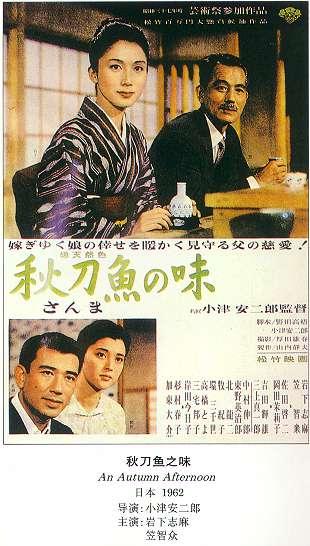
I began this knowing I could not convey all I wanted to regarding Yasujiro Ozu and the movies he gave us so I especially hope you'll read the Chishi Ryu reminiscence linked above and I'll close with this from Donald Richie's Ozu:
The director Kimisaburo Yoshimura, in Singapore at the time, remembers Ozu looking at.... The film that impressed Ozu most was Welles's Citizen Kane. "If you give Chaplin 62 points, this film gets about 85." He looked at it again and again. It was apparently the technique of the film that most interested him, and according to Yoshimura he kept shaking his head in wonder over this effect or that. Thereafter, whenever asked his favorite foreign film, he always said Citizen Kane, though it is impossible to imagine a picture more antithetical to his own.

...and a picture of his grave in Kamakura. If an actor in an Ozu movie is shown to be drinking sake, beer, whisky, etc. that actor is drinking sake, beer, whisky, etc. and in An Autumn Afternoon a staggering amount is consumed. There will be a bit more on Ozu and drinking in my forthcoming bookend review of another 1949 release, Nora inu (Stray Dog), by another Japanese director you've hopefully heard of, Akira Kurosawa.
On Fiction and Religion: A Comparison of Orthodoxies
In the late 80's when Satanic Verses was published, there was a furor somewhat akin to what we are now hearing about the Da Vinci Code. Many orthodox Muslims expressed the same sort of outrage expressed by many orthodox Christians today. And when one compares the two books, there are similarities. Satanic Verses questions some of Islam's most basic beliefs about Muhammed, its most important figure other than Allah. Likewise, DaVinci questions Christianity's most cherished beliefs about Christ, who it believes was the Son of God, divine yet also human but without sin.
But there was a distinct difference to the reactions of the respective orthodox leaders as well. Then, the outrage caused Muslim leaders to call not just for the supression of the offending book, but for the death of its author Salmon Rushdie as well. To date, although the Vatican and many conservative Protestant leaders have vehemently criticized Da Vinci, Dan Brown's life has not been threatened by even the most outraged Christian leadership.
Doesn't this tell us something relevant to today's struggles with the Islamic Jihadists and their supporters? Doesn't it also say something about Christians?
But there was a distinct difference to the reactions of the respective orthodox leaders as well. Then, the outrage caused Muslim leaders to call not just for the supression of the offending book, but for the death of its author Salmon Rushdie as well. To date, although the Vatican and many conservative Protestant leaders have vehemently criticized Da Vinci, Dan Brown's life has not been threatened by even the most outraged Christian leadership.
Doesn't this tell us something relevant to today's struggles with the Islamic Jihadists and their supporters? Doesn't it also say something about Christians?
HOPE
It does spring eternal. the Iraqis have formed their government .
Needless to say most of the article is about the violence in Iraq and not the history that has been made, but history has been made nonetheless. The city of Baghdad will have to be safer than LA before we stop hearing about the violence but there is hope.
Now they have to deal with Sadr.
Needless to say most of the article is about the violence in Iraq and not the history that has been made, but history has been made nonetheless. The city of Baghdad will have to be safer than LA before we stop hearing about the violence but there is hope.
Now they have to deal with Sadr.
Friday, May 19, 2006
Jews and Christians in Iran to wear distinctive insignia
Pastorius has another scary post up. Canada's National Post is reporting [UPDATE: This story has now been removed from the National Post website, casting doubt as to its accuracy - see update below, and the NP follow-up story, here]:
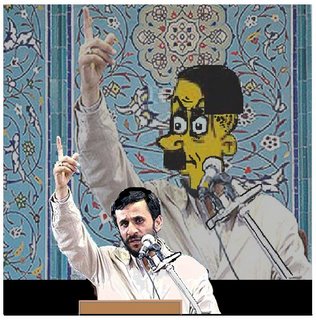 (Photoshop Credit: BL)
 UPDATE: Dag has more from an unattributed source:
Human rights groups are raising alarms over a new law passed by the Iranian parliament that would require the country's Jews and Christians to wear coloured badges to identify them and other religious minorities as non-Muslims.Pastorius neatly asks:
"This is reminiscent of the Holocaust," said Rabbi Marvin Hier, the dean of the Simon Wiesenthal Center in Los Angeles. "Iran is moving closer and closer to the ideology of the Nazis."
Iranian expatriates living in Canada yesterday confirmed reports that the Iranian parliament, called the Islamic Majlis, passed a law this week setting a dress code for all Iranians, requiring them to wear almost identical "standard Islamic garments."
The law, which must still be approved by Iran's "Supreme Guide" Ali Khamenehi before being put into effect, also establishes special insignia to be worn by non-Muslims.
Iran's roughly 25,000 Jews would have to sew a yellow strip of cloth on the front of their clothes, while Christians would wear red badges and Zoroastrians would be forced to wear blue cloth.
"There's no reason to believe they won't pass this," said Rabbi Hier. "It will certainly pass unless there's some sort of international outcry over this."
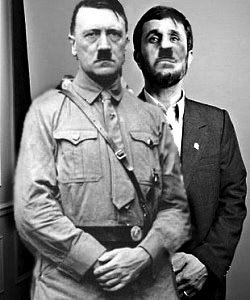
The current rulers of Iran came of age in the Iran-Iraq war. Ahmadinejad's job was to brainwash children to run into mine fields to explode the mines and become martyrs. The kids were given keys to hang around their necks to open the gates of heaven. This is why I find all comparisons to Hitler scary. Hitler was obsessed with redeeming the great sacrifices of his youthful compatriots in World War I. In his mind, World War II and the Holocaust was an effort to make good the previous sacrifices for the fatherland. Unless Ahmadinejad is a completely unfeeling psychopath, how do you figure he is coming to terms with his very evil job in the first war? As Dag said last night, the psychology to fear is that of the gambler throwing good money after bad.
Ok, so Ahmadinejad is a Holocaust denier, who, at the same time, uses all the methods and rhetoric of Hitler.
Still having trouble figuring it out?
 (Photoshop Credit: BL)
 UPDATE: Dag has more from an unattributed source:
independent reporter Meir Javedanfar, an Israeli Middle East expert who was born and raised in Tehran, says the report is false.I would also add that the Nazis themselves received their idea of forcing Jews to wear the yellow star from the Dhimmi codes of the Middle East.
"It's absolutely factually incorrect," he told The New 940 Montreal.
"Nowhere in the law is there any talk of Jews and Christians having to wear different colours. I've checked it with sources both inside Iran and outside."
"The Iranian people would never stand for it. The Iranian government wouldn't be stupid enough to do it."
Political commentator and 940 Montreal host Beryl Waysman says the report is true, that the law was passed two years ago.
"Jews should wear yellow strips, Christians red strips, because according to the Iranian mullahs, if a Mulsim shakes hands with a non-Muslim he becomes unclean."
Seattle Post-Intelligencer Publishes 9/11 Conspiracy Theory
The Seattle P.I. has published an op-ed: 9/11 Commission report is a lie by Richard Curtis, Ph.D., an adjunct professor of philosophy at Seattle University and a member of Scholars for 9/11 Truth; www.st911.org.
Among other things, the op-ed claims:
Among other things, the op-ed claims:
in the months after 9/11 all of the surviving New York City Fire Department personnel who were on the scene were interviewed. Those oral histories were recorded and withheld from the public until Aug. 15, 2005. Only after losing in court three times did the city of New York finally release them. All 503 are now posted on The New York Times Web site. Why did the city fight so hard to keep them from the public?And I thought it outrageous when the Vancouver Public Library allowed some Arab chap to sell 9/11 conspiracy DVDs at a talk given my Hans von Sponeck, former UN Assistant Secretary General & UN Humanitarian Coordinator for Iraq (1998-2000), and notable anti-American. This is where the world, in which The Da Vinci Code is a best seller, has come. Question: Do the humanities and social science professors in our universities ever teach anything besides sophisticated conspiracy theories? (HT: Pastorius via LGF)
It turns out those oral histories reveal details about what was happening in the World Trade Center buildings that are completely inconsistent with the tale told by the commission. Dozens of firefighters and medics reported hearing, seeing and feeling explosives going off in the buildings that collapsed. Why were there explosives, very powerful explosives by all accounts, going off in the buildings? More disturbing, why was the pattern of those explosives identical in some important ways with the pattern used in a planned implosion (or controlled demolition of a building)?
The Adult World
Try this experiment. Ask a kid or young person what they want to do when they grow up. Pick them when they're old enough to have some idea of what they're talking about but still young enough so as not to be cynical. I've tried this many times, and the answers are always "pro football player", "pro basketball player", "actress", "artist", "writer", "musician". Yet, here's a funny thing. In a fairly long life with literally thousands of friends and acquaintances, I don't know a single one who really makes a living from being any of these alleged professions. (I can think of one who barely scrapes by.) I never hear the children say they want to be a "plumber", "coal miner", "letter carrier", "bus driver", "nurse", "engineer", "businessman", "house builder", "accountant", "exotic dancer" or indeed any of the thousands of other real jobs that real people do.
Which leads to mucho human unhappiness. For when graduation comes and reality hits we have a whole lot of folks out there who don't have permission deep down to do what they're doing to make a living, who don't really believe in themselves or their work. Who are just bearing life's loads instead of joyously exhilirating in this wonderful world. Or who hate themselves for what they are. Or, perhaps worse, who are stuck in jobs they hate or which don't bring them the rewards they deserve because they are convinced that "It's important, damn it!—to be a starving musician waiting tables.
But wait, it's worse. Turn on any interview show and observe the people interviewed: actress, writer, director, artist. Never coal miner, plumber, nurse, or developer. Even on the supposedly high-brow NPR (Terry Gross anyone?). Somehow I can't remember a single interview she has done with a bricklayer, accountant, or saleswoman. And the NYT devotes pages to the output of yet another photographer, none to a hard-working electrician who makes sure your lights come on in the morning.
The problem permeates our society. Here's another example. Go to flickr and poke around. You'll discover some great pictures, but you'll also discover scads upon scads of pictures working very very hard to be "artistic". They're dark, have weird shapes or effects, passed through strange filters. It's not that these people can't take good pictures, it's not that these people aren't creative, it's not even that these pictures aren't good; it's that they're so obsessed with being "artists"—it's clear that their lives will be utterly devoid of meaning otherwise—that they make it worse, they make it ugly, they miss the point. What they don't see is that ultimately we're all artists on the canvas of life.
When trying to understand the genesis of this phenomenon with respect to my own kids, I tried to put myself in their shoes. I thought about what the jobs that are out there are, from their point of view. There are maybe 20 or 30 engineering jobs—friends of the parents—and a smattering of maybe 5 or 10 jobs for plumbers, heating experts, handymen and the like who occasionally make the rounds. A few people mow lawns for a living—usually Mexicans in these parts. Then there are hundreds of jobs for actors, actresses, several hundred professional baseball players, hundreds of famous actors, hundreds of fabulously wealthy musicians, a hundred rich and powerful politicians in the Senate alone—you see them 24/7 on all the channels. Given these choices, isn't it obvious? Because on the one hand you have only a few jobs which a) don't pay all they well, b) are mundane, c) don't make you famous, and on the other hand you have many many jobs which have it all. What's to choose?
But can't we expect just a wee bit more sense from our Peabody Award-winning adults?
Which leads to mucho human unhappiness. For when graduation comes and reality hits we have a whole lot of folks out there who don't have permission deep down to do what they're doing to make a living, who don't really believe in themselves or their work. Who are just bearing life's loads instead of joyously exhilirating in this wonderful world. Or who hate themselves for what they are. Or, perhaps worse, who are stuck in jobs they hate or which don't bring them the rewards they deserve because they are convinced that "It's important, damn it!—to be a starving musician waiting tables.
But wait, it's worse. Turn on any interview show and observe the people interviewed: actress, writer, director, artist. Never coal miner, plumber, nurse, or developer. Even on the supposedly high-brow NPR (Terry Gross anyone?). Somehow I can't remember a single interview she has done with a bricklayer, accountant, or saleswoman. And the NYT devotes pages to the output of yet another photographer, none to a hard-working electrician who makes sure your lights come on in the morning.
The problem permeates our society. Here's another example. Go to flickr and poke around. You'll discover some great pictures, but you'll also discover scads upon scads of pictures working very very hard to be "artistic". They're dark, have weird shapes or effects, passed through strange filters. It's not that these people can't take good pictures, it's not that these people aren't creative, it's not even that these pictures aren't good; it's that they're so obsessed with being "artists"—it's clear that their lives will be utterly devoid of meaning otherwise—that they make it worse, they make it ugly, they miss the point. What they don't see is that ultimately we're all artists on the canvas of life.
When trying to understand the genesis of this phenomenon with respect to my own kids, I tried to put myself in their shoes. I thought about what the jobs that are out there are, from their point of view. There are maybe 20 or 30 engineering jobs—friends of the parents—and a smattering of maybe 5 or 10 jobs for plumbers, heating experts, handymen and the like who occasionally make the rounds. A few people mow lawns for a living—usually Mexicans in these parts. Then there are hundreds of jobs for actors, actresses, several hundred professional baseball players, hundreds of famous actors, hundreds of fabulously wealthy musicians, a hundred rich and powerful politicians in the Senate alone—you see them 24/7 on all the channels. Given these choices, isn't it obvious? Because on the one hand you have only a few jobs which a) don't pay all they well, b) are mundane, c) don't make you famous, and on the other hand you have many many jobs which have it all. What's to choose?
But can't we expect just a wee bit more sense from our Peabody Award-winning adults?
Thursday, May 18, 2006
The Da Vinci Code Revealed
Truepeers can rest easy. Here we get a view of the fascinating interplay on the set of the blockbuster movie The Da Vinci Code as Wuzzadem presents The Da Vinci Code: New And Improved.
HT: The Llama Butchers, who also provided the pointer to the English quiz below.
HT: The Llama Butchers, who also provided the pointer to the English quiz below.
American Roots
| Your Linguistic Profile:: |
| 60% General American English |
| 15% Dixie |
| 15% Yankee |
| 5% Upper Midwestern |
| 0% Midwestern |
What's with the polls?
From Gallup [registration required]:
President Bush's primetime immigration speech on Monday night was -- intentionally or not -- closely calibrated with what public opinion research shows is the basic structure of the public's views on the issue on immigration. Polling shows that Americans broadly favor four of the basic elements included in Bush's immigration plan: an increase in border security, an increase in personnel manning the border, a program that would allow immigrants to become citizens if they meet a number of specific requirements, and a plan to enforce penalties on employers who hire illegal immigrants. When asked to choose between border control and dealing with the illegal immigrants already here, the public tilts towards giving a higher priority to increased border security. All of these points were reflected in the president's speech, suggesting that there will be little controversy concerning his police recommendations from the public's perspective.
The numbers were [in brief]:
62% of the people polled believe we can get control of the immigration problem
74% felt it was most important to control the border
71% felt it was most important to develop a plan to deal with the people here now.
By 52% to 43% people felt it was most important to halt illegal entry.
Only 21% support deporting all illegals and 61% support a road to citizenship.
This is pretty much in line with the CNN poll done the night of the speech which showed 79% approval of Bush's speech and 67% approval of his immigration plan. Zogby on the other hand says the support was split 47% to 47% in support of the Bush plan and Rasmussen says that Bush did badly with only about 39% supporting his plan and a majority supporting an enforcement only plan. hummmmmm.
What is up with this? These polls are not even close. Obviously they can not all be right. Does that mean none of them are?
President Bush's primetime immigration speech on Monday night was -- intentionally or not -- closely calibrated with what public opinion research shows is the basic structure of the public's views on the issue on immigration. Polling shows that Americans broadly favor four of the basic elements included in Bush's immigration plan: an increase in border security, an increase in personnel manning the border, a program that would allow immigrants to become citizens if they meet a number of specific requirements, and a plan to enforce penalties on employers who hire illegal immigrants. When asked to choose between border control and dealing with the illegal immigrants already here, the public tilts towards giving a higher priority to increased border security. All of these points were reflected in the president's speech, suggesting that there will be little controversy concerning his police recommendations from the public's perspective.
The numbers were [in brief]:
62% of the people polled believe we can get control of the immigration problem
74% felt it was most important to control the border
71% felt it was most important to develop a plan to deal with the people here now.
By 52% to 43% people felt it was most important to halt illegal entry.
Only 21% support deporting all illegals and 61% support a road to citizenship.
This is pretty much in line with the CNN poll done the night of the speech which showed 79% approval of Bush's speech and 67% approval of his immigration plan. Zogby on the other hand says the support was split 47% to 47% in support of the Bush plan and Rasmussen says that Bush did badly with only about 39% supporting his plan and a majority supporting an enforcement only plan. hummmmmm.
What is up with this? These polls are not even close. Obviously they can not all be right. Does that mean none of them are?
A Nature Blog
Here's something enjoyable, a success story about the recovery of two great Californians, as briefly told in a new blog.
The author of the blog is a fellow I have long known and admired, a mechanical engineer, marine biologist, naturalist, wildlife photographer and videographer, who resides in Monterey.
The author of the blog is a fellow I have long known and admired, a mechanical engineer, marine biologist, naturalist, wildlife photographer and videographer, who resides in Monterey.
A Leap Of Faith
It is not easy being a knucklehead. It is especially difficult when one realizes we knuckleheads are intellectually inferior to birdbrains - even buzzardbrains for that matter.
I have not yet found a rapid and reliable way to determine the gender of My Favorite Ospreys. So I rely on time-honored male chauvanism. If it is in flight I declare it the male and if it is at the nest I declare it the female. The times and durations when I notice them both either anest or alight have been so few and far between that sheer randomness is sufficient.
Today My Personal Ospreys were behaving quite unusually - at least to my experience and limited knowledge. Seeing her sitting on the edge of the nest wasn't unusual. Him being nearby - next tower over - while she was minding the nest was unusual. The only times I've seen them stick relatively close together was when they arrived and had some serious nest keeping and repair to manage and just a day or three ago when they seemed intent on running Combat Air Patrol over a nearby turkey buzzard aerial linedance routine. Typical behavior seems to be one minds the nest while the other has Gone Fishin'.
A while later I came back into observational range of the tower area and noticed a large bird circling rather low to the ground, got glass on him, and discovered it was My Osprey. Why on earth was he circling so low? I had no idea but he is clearly circling around and gaining altitude. She was still hanging out drying her talons or whatever she does when she just sits there (Oprah?).
This was the nice back-stretch where I can keep an eye on things for a while, so I was happy that he was circling around and seemingly heading for nest altitude. Why he would circle to accomplish that... what do I know?
When he finally did reach nest altitude he circled around a couplethree times and then did precisely what I was hoping he'd do. He headed for the nest when I had plenty of time to get the glasses on him and focused. I especially like seeing them, through the glasses, land or take off. It is a spectacle and not all that frequently spotted. And this time she was waiting at home to give him a peck on the cheek and ask him how his day was! A regular Osprey Knows Best episode just for Yours Truly. Maybe he had a fish or something I had failed to notice all ready to deliver to her fyring pan.
Well, the whole darned thing went far better than I could have even imagined hoping for. He did a "touch and go" and she got right up off her feathered arse and took wing. A touch and go landing and a takeoff all right there in the span of no more than two stinking seconds and me with the front row, center seat. After a couple moments the two of them sorta got together and took to circling up there around the nest. No buzzards or anything I could spot that they seemed to be on guard about.
I kept an eye on them for a while and then noticed the little head poking up and disappearing in the nest. Yuppers!
"Houston, we have Ospring!"
"Roger that, Dumbass One."
A few moments later I noticed that My Helpless Little Ospring Chick was up on the side of the nest. And it twarn't exactly a little chick. Looked like a darned large bird to me. Definitely osprey. But Mom and Dad were still circling right there where I could see 'em. Definitely Ospring unless mother-in-law was in town or somesuch.
Eventually, of course, even a knucklehead can figure out what a common buzzard knows. It helped to see the Ospring on the nest sorta tentatively flapping its wings while Mom and Dad circle around and demo some touch and goes. I wish I could have hung around to see if the leap happened anytime soon.
I'd found it interesting, but puzzling in my knuckleheaded way, that the turkey buzzards had been collecting around in unusual numbers the past two or three days and even alighting with regularity. I supposed that perhaps they were waiting for something to be dropped or fall from the nest. They were doing precisely that. It is equally interesting, and equally puzzling, that now when the possibility of that seems as maximized as it will ever get, no buzzards anywhere. I guess they know that at some point the leap s a done deal, a no brainer, and all but guaranteed to be successful.
I have not yet found a rapid and reliable way to determine the gender of My Favorite Ospreys. So I rely on time-honored male chauvanism. If it is in flight I declare it the male and if it is at the nest I declare it the female. The times and durations when I notice them both either anest or alight have been so few and far between that sheer randomness is sufficient.
Today My Personal Ospreys were behaving quite unusually - at least to my experience and limited knowledge. Seeing her sitting on the edge of the nest wasn't unusual. Him being nearby - next tower over - while she was minding the nest was unusual. The only times I've seen them stick relatively close together was when they arrived and had some serious nest keeping and repair to manage and just a day or three ago when they seemed intent on running Combat Air Patrol over a nearby turkey buzzard aerial linedance routine. Typical behavior seems to be one minds the nest while the other has Gone Fishin'.
A while later I came back into observational range of the tower area and noticed a large bird circling rather low to the ground, got glass on him, and discovered it was My Osprey. Why on earth was he circling so low? I had no idea but he is clearly circling around and gaining altitude. She was still hanging out drying her talons or whatever she does when she just sits there (Oprah?).
This was the nice back-stretch where I can keep an eye on things for a while, so I was happy that he was circling around and seemingly heading for nest altitude. Why he would circle to accomplish that... what do I know?
When he finally did reach nest altitude he circled around a couplethree times and then did precisely what I was hoping he'd do. He headed for the nest when I had plenty of time to get the glasses on him and focused. I especially like seeing them, through the glasses, land or take off. It is a spectacle and not all that frequently spotted. And this time she was waiting at home to give him a peck on the cheek and ask him how his day was! A regular Osprey Knows Best episode just for Yours Truly. Maybe he had a fish or something I had failed to notice all ready to deliver to her fyring pan.
Well, the whole darned thing went far better than I could have even imagined hoping for. He did a "touch and go" and she got right up off her feathered arse and took wing. A touch and go landing and a takeoff all right there in the span of no more than two stinking seconds and me with the front row, center seat. After a couple moments the two of them sorta got together and took to circling up there around the nest. No buzzards or anything I could spot that they seemed to be on guard about.
I kept an eye on them for a while and then noticed the little head poking up and disappearing in the nest. Yuppers!
"Houston, we have Ospring!"
"Roger that, Dumbass One."
A few moments later I noticed that My Helpless Little Ospring Chick was up on the side of the nest. And it twarn't exactly a little chick. Looked like a darned large bird to me. Definitely osprey. But Mom and Dad were still circling right there where I could see 'em. Definitely Ospring unless mother-in-law was in town or somesuch.
Eventually, of course, even a knucklehead can figure out what a common buzzard knows. It helped to see the Ospring on the nest sorta tentatively flapping its wings while Mom and Dad circle around and demo some touch and goes. I wish I could have hung around to see if the leap happened anytime soon.
I'd found it interesting, but puzzling in my knuckleheaded way, that the turkey buzzards had been collecting around in unusual numbers the past two or three days and even alighting with regularity. I supposed that perhaps they were waiting for something to be dropped or fall from the nest. They were doing precisely that. It is equally interesting, and equally puzzling, that now when the possibility of that seems as maximized as it will ever get, no buzzards anywhere. I guess they know that at some point the leap s a done deal, a no brainer, and all but guaranteed to be successful.
Subscribe to:
Posts (Atom)