This is a video of a Korean Daehan Steel plant where scrap metal is salvaged and turned into rebar. They also, oddly enough, grow vegetables at it. The photography is excellent; several shots are quite spectacular. The video is not narrated, but you'll want to turn the captions on. They are informative and amusingly flippant at the same time.
Mr. Queen, which is
available on Netflix, is a television show with the premise that a modern-day
Korean male chef is magically transported to a Queen's body in the Joseon era (19th
century). Were it an American show with that premise I would never watch it,
anticipating that it would be awash with endless humorless gender
lessons.
However, it is a Korean show, so the Western gender studies stuff is
nonexistent and instead they just mine the absurd situation for laughs. The
result is a very funny and entertaining show that I highly recommend. In most
of this post, which mainly covers the first episode, I'll try to avoid
spoilers about events later in the show.
The cook, Jang Bong-Hwan, is the head chef at Blue House (Korea's White
House). He's an arrogant, skirt-chasing, alpha male who thinks very highly of
himself. He gets framed for corruption in the Presidential kitchen, and while
being chased by the police, he falls off his balcony into a swimming pool and
bonks his head on the bottom. When he wakes a beautiful woman in flowing robes
swims up and kisses him. He passes out once more.
When he awakes again, he's in an old-fashioned room. He's disoriented, and when he
finds a mirror, he is horrified to discover that he is now a pretty woman. He
decides that he must be dreaming, although he's miffed that he's dreaming he
is the girl instead of being with the girl. Eventually, he figures out things
are too vivid for this to be a dream which throws him into a panic.
He goes into the hallway to find it lined with maids bowing down to him
calling him 'your Royal Highness' which only increases his hysteria. He
blindly runs around with a tail of maids and eunuchs chasing after him until,
as shown in the clip above, he decides that some twisted human trafficking
outfit kidnapped him and gave him a sex change operation. It isn't until the
implication of them all wearing old-timey clothes sinks in that he realizes he
traveled through time as well as ending up in a different body.
He calms down enough to start questioning his maids as to what happened to the
woman whose body he's in. They're puzzled by the fact that he refers to the
Queen as someone other than himself, but by this point they're dialing into
the fact that their Queen appears to be a bit bonkers since she woke up from
her near drowning. He discovers he is in the body of Kim So-yong, the Queen Bi
(the King's fiancé). He also connects the water she almost drowned in to the
water in the swimming pool he fell into, and decides water is the key to
returning to his body.
First Mr Queen runs around dunking his head in every bit of water he can find:
mop buckets, horse troughs, and the like, but that doesn't work. It only
convinces the maids that their Queen has a few more screws loose than they
originally thought. He decides the lake the Queen nearly drowned in is the
key, so he cons his maids into showing him where it is. As soon as he sees a
sign pointing to it he sprints off to do a swan dive into it, only to land in
the mud at the lake's bottom because it had been drained to prevent any more
drownings.
Mr Queen then remembers he's the Queen, so he orders his flunkies to refill
the lake. They tell him they can't, because the orders came from higher up.
So, covered in mud, he sets out to find the King to get water back into the
lake.
When we meet King Cheoljong, he's in a pavilion reading a Korean version of
the Kama Sutra. His eunuch tells the King he has been studying the book for
too long. The King replies that he needs to properly prepare for his most
important duty -- producing an heir. Oh-oh, Bong-Hwan (a.k.a. Mr Queen) may
have another problem besides returning to his body.
The King then sees Mr Queen and calls him over. Mr Queen lifts his skirts and
runs over. Mr Queen barely greets the King, instead he immediately launches
into asking/demanding that the lake be refilled. The King tells Mr Queen that
he can't fill the lake because the draining was ordered by the Grand Queen
Dowager and that he won't, or can't, rescind the order.
As soon as the King first saw the mud-caked Mr Queen he had started holding his
nose from the stench. This only annoys Mr Queen even more, and he ends up
slapping the King to knock his hand off his nose. The palace staff is
horrified. Also, as is the habit of middle school boys worldwide, the King has
disguised his racy book with a fake cover. Mr Queen gets interested in
it and grabs it to look at it. The King grabs it back, and soon Mr Queen and
the King are in a ridiculous pissing match over the book while the
increasingly aghast palace staff looks on. Eventually, after their fight
manages to demolish the book, Mr Queen leaves to sow chaos elsewhere.
The series is a type of Korean historical show called a sageuk, which
frequently feature a lot of palace intrigue and this show is no different. We
soon meet the Grand Queen Dowager, the real power in the palace, and her slimy
brother, who are the main villains. The Royal marriage is for political
purposes, and they're worried that the news of the Mr Queen's current bout of
bizarre behavior will leak out and ruin their plans. So, they move the wedding
up to the next day.
Needless to say, Mr Queen is repulsed and horrified when he hears that news.
To his priority of making it back to his body in the future, he now has to add
not getting noodled by the King in the meanwhile. First Mr Queen tries to tell
the King that he actually isn't the Queen, that he's really a man from the
future. All that accomplishes is Mr Queen getting dragged off to see if the
Court Physician can treat his case of sudden-onset insanity.
The day of the wedding arrives. Mr Queen, who is buried in layers of
ceremonial garb, doesn't know, nor does he care to know, the procedures and
etiquette of a Royal wedding so he just sort of plows through it making a hash
of things in the process. The palace denizens keep getting more bewildered and
alarmed by his strange behavior.
However, he makes it though the wedding and the night of matrimonial bliss is
on the horizon...
Mr Queen's two principal maids preforming their hopeless task of trying to keep their Queen prim and proper
Would I recommend it? Absolutely. It has good production values, music, sets,
costumes, sword fights, and is one of the funniest shows I've seen in a long time. The
character Mr Queen is a supremely self-confident fish out of water who careens
through whatever situation he finds himself in and imagines he is handling it
perfectly. He also, when speaking, mixes in modern Korean expressions and
English loan words so the locals often times have no idea what he is even
talking about. Plus, he tries to flirt with every pretty female he encounters,
although they are always mystified by what he is going on about. His loony
decisions and unhinged behavior are hugely entertaining. The people around him
are always baffled by what he's saying and doing, and their hopelessly
confused reactions are spot on.
I have to give a special hat tip to Shin Hae Sun, the actress who plays Mr Queen/Kim So Yong. She captures the mannerism of
men, the way they walk, sit, talk and their expressions. Added to her excellent acting is a male voice expressing her inner thoughts, so the viewer quickly
accepts that it is a man inside the Queen's body. Shin Hae Sun creates a
memorably silly character in the process. I doubt the comedy would work as
well with another actress cast in the role. She carries the film and steals
nearly every scene she is in.
Another fine performance is Kim Jung Hyun
as King Cheoljong. When first introduced the King comes across as a pompous
dimwit. We'll soon discover that there is more to him than meets the eye; he's
only a puppet King, but like everybody else in the palace he is engaged in
endless scheming. He also always tries to maintain what he supposes is the
proper level of dignity for a King. Since he is usually Mr Queen's straight
man, his blustering over Mr Queen's nonsensical antics works well.
Court Lady Choi, played by Cha Chung Hwa, deserves mention. She's Mr Queen's principal attendant and she's tasked
with maintaining the decorum of the Queen's office. Needless to say,
with Mr Queen that's an impossible task and poor Court Lady Choi has a
slow-motion nervous breakdown as the show progresses.
Jo Hwa Jin, played by Seol In Ah, is the Royal Concubine and the King's girlfriend. In the clip below she is the woman called Uibin (that's her title). She would rather be the Queen herself and is none too happy about the king's betrothal to Mr Queen. Since she's pretty, Mr Queen naturally tries to flirt with her. However, as is the case with all of his flirtees, she has no idea what he is doing. Instead, she thinks his odd behavior is just Mr Queen playing a 4-D chess version of palace politics and replies with veiled threats which pass well over Mr Queen's head.
Royal Chef Man Bok, played by
Kim In Kwon, comes to rue that day he ever met Mr Queen, who takes over his kitchen and torments him endlessly: insulting his cooking,
infesting the kitchen with his maids, and at one point reducing the Royal Chef
to doing nothing more than tending to the fire.
Finally, here's another scene of Mr Queen in action. It shows him at his macho best.
Generally, I dislike the idea of prank videos. All too often they are just intruding upon people to create content for social media. While some are harmless annoyances, others trip well past the bounds of decency to be completely obnoxious. Just look at the case of Johnny Somali for an example of that.
That said, I'm posting a few Korean prank videos. Call me a hypocrite if you must.
It all started with my YouTube feed's recommendations. Most of the recommendations are aimed at blocks of people with presumably similar viewing habits, but some seem to be an attempt by YouTube to tailor the videos to your individual taste. Since, in looking for things to post, my viewing habits are very eccentric I get some mighty odd recommendations.
One day I started getting Korean prank videos. I don't know why. At first, they were videos of guys asking young girls questions, and then saying "thankyou auntie" when they left. Age is a big deal in Korea, and I guess assuming somebody is much older than they are is a social gaffe of hilarious proportions.
Then these two guys started appearing in my feed. Their bit was to sit in cafes and have ridiculous conversations the other patrons overheard. I've got to say that some of their scripts were pretty funny, and the reactions of the people trying not to laugh and make it obvious they were eavesdropping were entertaining. Although, I think a lot of them caught on sooner or later that this was just a prank.
As I recover from the Wuhan Flu I've been subsisting on bread, crackers, water and coffee. Above is a video of Koran comfort food. I'll be damned if I know what it is, but maybe I would be eating it if I were sick in Seoul. Or maybe not. As an extra, below are drinks from a beach somewhere in Korea.
Who among us doesn't crave a traditional American meat sandwich? I'm not sure what it is, but whatever it is it looks tasty. There are four variations of the meat sandwiches, and each one looks like they would be worth trying. Below we have double bacon cheeseburgers and a Texas-style BBQ, and my lord, I don't know what a Texan would think of it, but the BBQ platter of brisket, ribs, chicken, home-made sausage, French fries and stew looks amazing.
These are all Korean cooks. With the abomination of cultural appropriation properly shoved aside, this is cultural diffusion in operation. I can't wait until the day when I can go to a local restaurant and order an Americanized version of a Korean American meat sandwich. The World turns round and round.
I have previously posted a video of a Mongolian fellow making a hotdog. His idea of a hotdog was shredded beef on a hotdog bun. It missed the mark, but it's the thought that counts and it did look tasty. In the above video a Korean chef makes hotdogs from scratch and the result definitely looks delicious.
Today we tour a harmonica factory in South Korea. Harmonica building is more complex than you might first think. It's a precise process to get all of the reeds tuned properly. As tone deaf as I am, I would probably end up sweeping the floor if I got hired to work there.
In case you're fascinated by the humble harmonica, previously on Flares there have been three other posts with/about harmonicas:
Time to review another Korean show. This review is of a makjang drama called
Penthouse: War in Life (you may have to look around a bit to find it, I
watched it on Rakuten Viki). It ran for 3 seasons. I'll try to avoid spoilers,
but some will creep into this review.
A makjang is a show where the plot and situations are deliberately excessive.
A makjang will feature crazy plot twists, birth secrets out the wazoo, revenge
plots, adultery, scheming, fighting, murder and more. Penthouse delivers all
of that in spades. It has great cinematography, a booming orchestral
soundtrack, and lavish sets with over-the-top acting to match its ridiculous
and overblown plot. This all combines together to make a wonderfully
entertaining show.
The above video is the very first scene in it. The elegant woman in the
elevator, the party with people dressed like members of Louey XIV's court
waltzing around and the girl who gets tossed off the 47th floor balcony are
all mysteries to set the hook. We then move back two months to find out what
this is all about.
The building they're in is called Hera Palace. It is the choicest piece of
real estate in Seoul. The richest of the rich live there and they all jostle
for social status. Our characters are the very upper crust of the place. We
discover that they are all very competitive, enormously greedy, suffer from an
advanced stage of moral turpitude and are willing to walk all over each other
to get to the very top of the pecking order -- the penthouse.
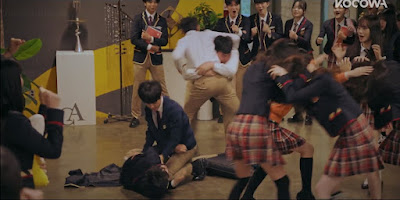
Our opera students engage in one of their frequent brawls
The mystery over who the girl was that got chucked off the balcony, and why
she was murdered, is covered in the first several episodes. It turns out that
the daughters of the rich folks are all opera students at an elite high
school. Yes, you read that right -- opera students. Along with the amusement
factor of watching tiny Korean ingenues belting out arias, we are given our
first hint that logic and reality are not to be expected in this show.
The murdered girl is Min Seol Ah. She is an orphan girl who lives in
Jewelry Village. When she first appears, she is a voice tutor for the rich
opera students. However, when the school year starts, she turns out to be
enrolled in their high school. Since she is poor all of the other students are
aghast to have her as classmate. Throughout the show almost all of the rich
people treat any poor person as subhuman scum that is barely
tolerated.
So, all of the kids hate and bully her. The parents also despise her as well,
thinking that her mere presence besmirches the honor of their school. This is
made worse when Min Seol Ah bests their darling daughters and wins an
important singing competition. In addition, she finds out that two of their
parents are having an affair and holds that over their heads.
The end result is that she ends up tied up in an equipment room and virtually
all of the characters wander in from time to time to slap her around. They all
have the motive, and sketchy enough morals, to be the one who pushed Min Seol
Ah off the balcony.
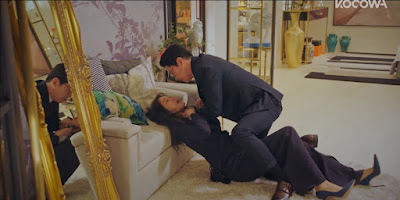
In one of their many marital spats Dan Tae tries to strangle Soo
Ryan
It gets more complicated. Shim Soo Ryun, the elegant woman we saw on the
elevator, is married to Joo Dan Tae. She's the stepmother to his twins,
while her own child has been in the hospital for 16 years in a coma. However,
all is not as it seems. Dan Tae, who is a cheerfully Eeeevil fellow and the
story's main villain, had for some unfathomable reason switched Soo Ryun's
daughter at birth with another kid who he then drugged for 16 years to keep it
in a coma. Well, aside from not making any sense (why not just drug her real
kid?), that's not very nice.
Anyway, Dan Tae's minion was supposed to toss Soo Ryun's baby into a lake.
However, being greedy like everybody else in this show, instead the minion
sold the baby to an orphanage. The orphanage head, being greedy as well,
eventually sold the orphan to a rich American family who needed a bone marrow
donor for their sick son. Once the marrow was donated, the adoptive parents
then framed the orphan for theft which got her unadopted, arrested and
deported back to Korea.
Of course, Min Seol Ah was that baby and Soo Ryun eventually figures this all
out. Needless to say, when she discovers that Min Seol Ah was her birth
daughter, she gets monumentally pissed off and swears to find the murderer and
get revenge on everyone involved.
In this case, everyone involved is pretty much the entire rest of the cast.
Aside from the 'tied up in an equipment room' business, the Hera Palace people
had been planning a fancy party when Min Seol Ah had the audacity to ruin
their plans by flopping into the arms of their beloved statue and splattering
the place with blood. Not wanting the party to be ruined, they clean up the
mess and move Min Seol Ah's body to her dingy apartment in Jewelry Village and
make it look like a suicide. They are all implicated in the crime.
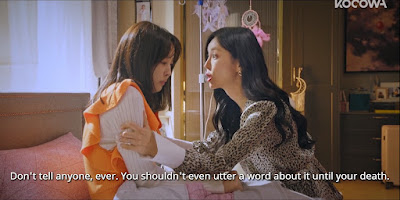
Seo Jin, aka The Mother of the Year, counsels her daughter Eun Byul
to lie through her teeth until the day that she dies
Meanwhile, in another plot thread Cheon Seo Jin, a famous opera singer, wife
of Dr. Ha Yoon Chul and head mistress of the elite opera teaching high
school, gets annoyed by a pecan pie (don't ask) so she throws herself at Soo
Ryun's husband Dan Tae and starts an affair with him.
Seo Jin is also the mother of Ha Eun Byul, another aspiring student opera
singer. Under Seo Jin's expert mothering, Eun Byul gets nuttier and nuttier as
the show goes on until Seo Jin has to feed her an experimental amnesia drug so
Eun Byol can forget about bonking another student over the head, and
apparently killing her, with a trophy they were competing over.
Seo Jin starts as a haughty, arrogant and corrupt woman who gets increasingly
demented as the show proceeds. It can be argued that by the end of the show
she even surpasses Dan Tae as the main villain. Considering what a psychopath
Dan Tae is, that's no easy feat. With her endless scheming and multiple
murders, she's a hurricane of chaos that sweeps through the story.
Seo Jin was my favorite character on the show. She tried to put up a facade of
indifferent elegance like Soo Ryun naturally possessed, but underneath it Seo
Jin was a seething cauldron of ambition and anger. Her frequent outbursts and
tantrums were hugely entertaining.
Kim So-yeon, the actress who played Seo Jin did a fantastic job with the role.
Her over-the-top acting, which suited this drama well, approached the edge but
was always under control. She created a memorable character in the scheming,
power hungry and wicked Seo Jin.
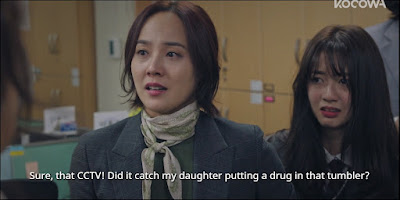
Yoon Hee defends her daughter Ro Na who has once again been framed
for a nefarious deed by her classmatess
The third female lead is Oh Yoon Hee. When we meet her, she is an
ex-opera singer/real estate agent who is struggling to make ends meet. She has
a daughter, Bae Ro Na, who -- no surprise here -- wants to be an opera
singer.
We soon learn that Yoon Hee and Seo Jin have a history and they hate each
other with a passion. They had been opera singing students in the same high
school back in the day. Seo Jin, using the father's influence, had cheated
Yoon Hee out of the top prize in a competition. They got in a fight in the
dressing room and after battering each other with pillows and smashing much
furniture Seo Jin ended it by clobbering Yoon Hee with the trophy. This
damaged her vocal cords and ended her hopes of a career in opera.
Yoon Hee doesn't want Ro Na to pursue a singing career, but Ro Na is
persistent and eventually she gets accepted to the opera singer high school.
This brings Yoon Hee and Seo Jin into direct contact with each other, with
both vowing to destroy the life of the other. Also, since Ro Na is poor,
naturally all the other students hate and bully her and even Seo Jin isn't
above messing with her.
The two women's conflict starts out with verbal sparring and quickly moves
into screaming and regular hair pulling fights. As the show goes on their
schemes against each other get ever more deadly and convoluted, with both
swearing to kill the other.
Dan Tae getting ready to murder somebody
The show's main villain, at least until Seo Jin goes completely off the rails
at the end, is Dan Tae. He's a rich businessman and the owner of the
penthouse. Seemingly cool-headed, he is in fact a psychopath. So he could
marry her for her money he killed Soo Ryun's first husband (and keeps the
fellow's chopped off finger with the wedding ring still on it in a drawer in
his office), he beats his kids, abuses his staff and most of all endlessly
plots to swindle or kill those around him.
And he does all that with a smile. Altogether, he is an extremely cheerful
villain. Nothing seems to lift his spirits quite as much as coming up with a
ridiculously elaborate plan to ruin, cheat or kill somebody.
Of course, his ludicrous schemes never exactly work, but he does leave a trail
of mayhem and bodies in his wake, and aside from frequently beating his
faithful but inept minion to a bloody pulp because he botched things, he never
gets too frustrated by their failure.
(L-R) Go Sang Ah, Lee Gyu Jin, Ha Yoon Chul, Kang Ma Ri
There are a number of supporting characters that get a lot of screen time.
Among them are Sang Ah, the bubble-headed former TV presenter who is the wife
of Gyu Jin, a money-grubbing, mamma's-boy lawyer that delights in the
misfortunes of others. The hapless Dr. Yoon Chul is Seo Jin's cuckolded
husband. Ma Ri claims her husband is in Dubai, but he's actually in prison
taking the fall for one of Dan Tae's earlier murders. She puts on airs of
being wealthy but is actually a masseuse at a spa.
In addition, and not pictured, is the mysterious Logan Lee who shows up
halfway through the first season and has an important role in all this
foolishness. There are also a number of teachers, students, minions,
staff, family members and others who act as foils, companions and accomplices
to our main characters.
Even as a high school student Seo Jin was an insufferable snob
Most of the above is only from the first few episodes. Penthouse hits the
ground running and never eases up, with virtually no filler or down spots. It
has at least one, and generally more, plot twists per episode so one is never
sure where it is going next.
A makjang is deliberately over-the-top. With its ludicrous situations and
characters all it is aiming for is entertainment. Penthouse succeeds in
delivering that entertainment. There is also a lot of humor sprinkled in and many memorable characters: our vengeance-minded heroine Soo Ryun, the Eeeevil Dan
Tae, Seo Jin and her nutty daughter Eun Byul. The supporting characters are
all fleshed out and interesting as well.
The production values are top-notch. The directing is crisp, and the
cinematography and sets are gorgeous. Much of the dialog crackles, and the
orchestral soundtrack is outstanding. As absurd as much of its plot is, it is
really a well written, produced and acted show. Two thumbs up from me.
Finally, after the jump I've included a few more clips from the show (be sure to turn the captions on). They are
spoilerish, but don't really give away much.
This time of the year I figure people may be getting sick of the same
Christmas songs, so I post weird Japanese (and Korean) Christmas songs for a
change of pace.
Christmas was introduced by foreigners living in Japan who would celebrate the
holiday, Although the Christian underpinnings of the day were of no interest
to the Japanese, they quite liked, and adopted, the secular elements: decorated trees,
lights, Santa, candy canes, peace on Earth, jingle bells, and a traditional bucket of fried chicken from KFC.
Also, it has evolved into a couple's day similar to Valentine Day. You can see
that in the above video Christmas? what is that? Is it delicious?
where they've changed jingle bells into single hell.
Following that is another two rather frantic Japanese Christmas songs, one
keeping jingle bells and the other being just plain weird. Finally, there are two Korean Christmas songs by Girl's
Generation and Crayon Pop respectively.
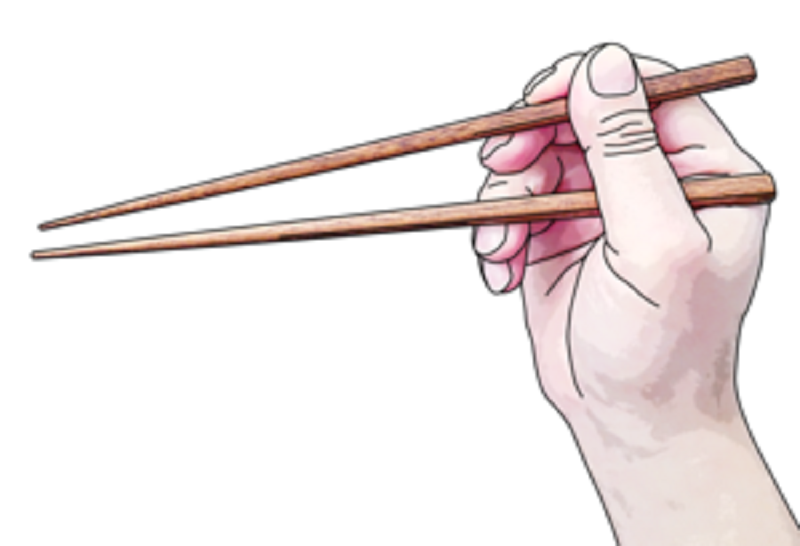
I guess I've always thought a chopstick was just a chopstick, but as the the Chinese, Korean and Japanese ladies show us in the above video there are differences between their shapes and weights. The variations were large enough to make it awkward for them to use the other nationalities' chopsticks.
As an aside I learned how to use chopsticks while I was in the Navy. As a sailor -- well, more accurately as a drunken sailor -- I learned how to use them when was a little, or a lot, tipsy. To this day I'm still clumsy with them when I'm sober.
If you want to learn how to use them, sober or otherwise, the post How to Use Chop Sticks is a good guide.
Also, if you want to be an insufferable bore at a Asian themed dinner party, in Chinese chopsticks are called kuàizi, in Korean they are called jeotgarak, and in Japanese they are hashi. Be sure to mutter about cultural appropriation when you correct people about their proper names.
This video is a bit longer than I usually post, but it is entertaining. It is a sort of Koran version of Cops, but with out all the trailer parks. However, since it is set in the Itaewon nightclub there are a lot of drunks (behold the wonders of our shared humanity). Be sure to turn on the captions to get English subtitles.
It follows a trainee and her mentor as they patrol the district on a Friday. The first incident they encounter is a fight between two groups of foreigners. In trying to sort out what happened we hear the one group saying the fight was over a stolen phone and chain. The mentor can't really figure out what happened -- he either doesn't speak English well or doesn't really care -- so he writes it off as being caused by bumping into each other while dancing, an excuse he seems to have used more than once in the past.
As the night wears on most of what they deal with, both on the street and in their station, involves drunks. The police come across as being very patient with the drunks. It struck me that some of the more obnoxious ones deserved getting the bejeebles tazed out of them, but that didn't happen -- maybe it was just for the show.
There's one segment where an alarm at the nearby U.S. base sounds which throws everybody into a panic until they realize that North Korean artillery shells and missiles aren't raining down on them, so they relax and go back to their clubbing. Altogether it is an interesting watch.
A while back I did a post on Cossack sword dancing. Today we follow that post up with some Korean sword dancing. Above is a video of young ladies from Chungnam Arts High School doing a sword dance. Their swords are no where near as long and dangerous looking as the Cossack swords, but the costuming and choreography is very nice.
Korean sword dances are called Geom-mu(검무). All the examples of Korean sword dancing I saw featured women; I'm not sure what the story behind that is. The dances appear to be more formalized and theatrical than the Cossack dances. Below are a couple of other examples of Korean sword dances.
In this article George Friedman discusses the reasons for the continuing presence of American troops in South Korea.
As he points out, the original American Asian strategy in the aftermath of WWII was to establish a string of island bases and avoid the mainland. However, when North Korea invaded the South Truman opted to intervene to show allies that we would support them.
The American garrisoning of the Peninsula became first an artifact, then a relic of the Cold War era. To a large degree we only remain there out of inertia, since it could be argued that there is no longer a pressing reason to keep such a large commitment of troops in South Korea.
For the article's Hot Stratfor Babe I naturally turned to Korean actresses for inspiration. After my usual careful study of the matter, and 10 minutes or so of Googling, I selected the South Korean actress and model Song Hye-kyo for the singular honor.
Ms Hye-kyo started acting at a young age on Korean television, appearing in numerous dramas and situation comedies. Her role in Autumn of my Heart, a South Korean soap/novella, led her to gain Asian-wide fame. That led to a transition to film, where her track record is spotty. She has appeared in a Hollywood independent film Make Yourself at Home (formerly titled Fetish), which I gather came and went without much notice.
Still, she seems to be extremely popular in Asia. Recently, and this should come as no surprise, she appears to have gone the route of many a Hot Stratfor Babe in recording some songs and trying to add musician to her resume.
The United States in Korea: A Strategy of Inertia
By George Friedman, March 27,2012
After U.S. President Barack Obama visited the Korean Demilitarized Zone on March 25 during his trip to South Korea for a nuclear security summit, he made the obligatory presidential remarks warning North Korea against continued provocations. He also praised the strength of U.S.-South Korean relations and commended the 28,500 U.S. troops stationed there. Obama's visit itself is of little importance, but it is an opportunity to ask just what Washington's strategy is in Korea and how the countries around North Korea (China, Russia, South Korea and Japan) view the region. As always, any understanding of current strategy requires a consideration of the history of that strategy.
The Korean War and the U.S. Proto-Strategy
Korea became a key part of U.S. Cold War-era containment strategy almost by accident. Washington, having deployed forces in China during World War II and thus aware of the demographic and geographic problems of operating on the Asian mainland, envisioned a maritime strategy based on the island chains running from the Aleutians to Java. The Americans would use the islands and the 7th Fleet to contain both the Soviets and the Chinese on the mainland.
Korea conceptually lay outside this framework. The peninsula was not regarded by the United States as central to its strategy even after the victory of the communists in the Chinese civil war. After World War II, the Korean Peninsula, which had been occupied by the Japanese since the early 1900s, was divided into two zones. The North came under the control of communists, the South under the control of a pro-American regime. Soviet troops withdrew from the North in 1948 and U.S. troops pulled out of the South the following year, despite some calls to keep them in place to dissuade communist aggression. The actual U.S. policy toward an invasion of the South by the North is still being debated, but a U.S. intervention on the Korean Peninsula clearly violated Washington's core strategic principle of avoiding mainland operations and maintaining a strategic naval blockade.
U.S. strategy changed in 1950, when the North Koreans invaded the South, sparking the Korean War. Pyongyang's motives remain unclear, as do the roles of Moscow and Beijing in the decision. Obviously, Pyongyang wanted to unite the peninsula under communist control, and obviously, it did not carry out its invasion against Chinese and Russian wishes, but it appears all involved estimated the operation was within the capabilities of the North Korean army. Had the North Korean military faced only South Korean forces, they would have been right. They clearly miscalculated the American intent to intervene, though it is not clear that even the Americans understood their intent prior to the intervention. However, once the North Koreans moved south, President Harry Truman decided to intervene. His reasoning had less to do with Korea than with the impact of a communist military success on coalition partners elsewhere. The U.S. global strategy depended on Washington's ability to convince its partners that it would come to their aid if they were invaded. Strategic considerations aside, not intervening would have created a crisis of confidence, or so was the concern. Therefore, the United States intervened.
After serious difficulties, the United States managed to push the North Korean forces back into the North and pursue them almost to the Yalu River, which divides Korea and China. This forced a strategic decision on China. The Chinese were unclear on the American intent but did not underestimate American power. North Korea had represented a buffer between U.S. allies and northeastern China (and a similar buffer for the Soviets to protect their maritime territories). The Chinese intervened in the war, pushing the Americans back from the Yalu and suffering huge casualties in the process. The Americans regrouped, pushed back and a stalemate was achieved roughly along the former border and the current Demilitarized Zone. The truce was negotiated and the United States left forces in Korea, the successors of which President Obama addressed during his visit.
North Korea: The Weak, Fearsome Lunatic
The great mystery of the post-Cold War world is the survival of the North Korean regime. With a dynamic South, a non-Communist Russia and a China committed to good economic relations with the West, it would appear that the North Korean regime would have found it difficult to survive. This was compounded by severe economic problems (precipitated by the withdrawal of economic support from the Chinese and the Russians) and reported famines in the 1990s. But survive it did, and that survival is rooted in the geopolitics of the Cold War.
From the Chinese point of view, North Korea served the same function in the 1990s as it did in 1950: It was a buffer zone between the now economically powerful South Koreans (and the U.S. military) and Manchuria. The Russians were, as during the Korean War, interested in but not obsessed by the Korean situation, the more so as Russia shifted most of its attention west. The United States was concerned that a collapse in North Korea would trigger tensions with the Chinese and undermine the stability of its ally, South Korea. And the South Koreans were hesitant to undertake any actions that might trigger a response from North Korean artillery within range of Seoul, where a large portion of South Korea's population, government, industry and financial interests reside. In addition, they were concerned that a collapsing North would create a massive economic crisis in the South, having watched the difficulties of German integration and recognizing the even wider economic and social gap between the two Koreas.
In a real sense, no one outside of North Korea was interested in changing the borders of the Peninsula. The same calculations that had created the division in the first place and maintained it during and after the Korean War remained intact. Everyone either had a reason to want to maintain an independent North Korea (even with a communist regime) or were not eager risk a change in the status quo.
The most difficult question to answer is not how the United States viewed the potential destabilization of North Korea but rather its willingness to maintain a significant troop level in South Korea. The reason for intervening in the first place was murky. The U.S. military presence between 1953 and 1991 was intended to maintain the status quo during the Cold War. The willingness to remain beyond that is more complex.