Monday morning, start of the workweek blues by Shemekia Copeland.
Monday, July 16, 2012


Sunday, July 15, 2012
This won't end good

What a ghastly picture. I could find no information about it. I wonder what happened one second later? Via this isn't happiness.
Saturday, July 14, 2012
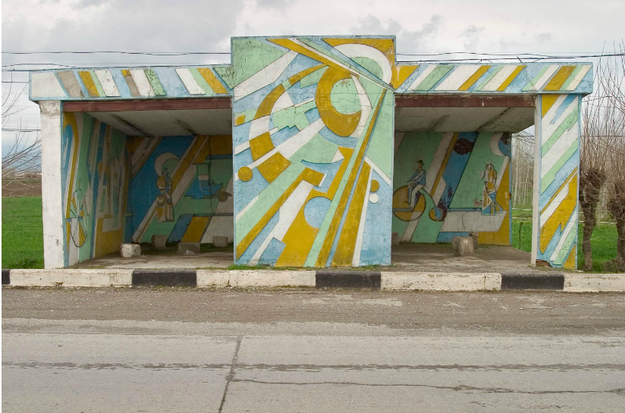
Old Soviet era bus shelters
 |
| Click any image to enlarge |
Whatever the answer to those questions, they are marvelous little buildings. A surprising amount of effort went into designing and decorating them. I wonder what the buses that service them are like?
There are more samples after the jump, and even more at the above link.

Modern dance
If anybody makes it through the entire thing, please be sure to leave a comment telling the rest of us how it ends. Via Diehipster.
Friday, July 13, 2012
They must have forgot to send me my ticket
As regular blog readers will know I am a self-proclaimed mover and shaker and all around high and mighty muckity-muck in the Green movement. So, imagine my surprise when I realized that the Green Party convention had started without sending me an invitation. WTF -- is that any way for them to treat their future Ambassador to Brazil? Bah, with an organization this slip-shod it is no wonder we never win the Presidency.
Anyway, Dr. Jill Stein won the nomination over Rosanne Barr. Naturally, that posed the problem of finding a running mate for Dr. Jill who wouldn't over-shadow the top of the ticket. After a long search for such a non-entity, Dr. Jill settled on Cheri Honkala. This is from Cheri's biographical info:
Compelled by her own experience as a homeless, single mom, Honkala has spent nearly three decades working directly alongside the poor to build the movement to end poverty, and has organized tens of thousands of people to take action via marches, demonstrations and tent cities.Tent cities? I wonder why Obama never tapped her to be the director of HUD?
At any rate, below is a live feed from the Green Party Convention. The sound was a little dodgy earlier, but they seem to have gotten that cleaned up for their speechifying and folk singing. Enjoy, and feel free to leave any observations in the comments section.
Watch live streaming video from greenpartyus at livestream.com
Stratfor and Patricia Owens

I'm not sure Scott is entirely successful in attempting that approach, but his details of how arms interdiction is now being done are an under reported facet of the story.
The beginning of his article is excerpted below, with a link to the full article at the end of the excerpt.
For the Hot Stratfor Babe the 1958 movie The Gun Runners naturally sprang to mind. Its about a dodgy group smuggling arms to Castro's revolutionaries rather than Mexican drug cartels, but as long as guns are being smuggled that's close for me, so the film's female lead, Patricia Owens gets the honors.
Ms Owens had a long and successful career, first in the moveis and then on TV. While she may have considered starring opposite of Marlon Brando in Sayonara the highpoint of her career, I'm sure you'll agree with me that her appearing with Vincent Price in The Fly was really the apex.
As a curious footnote to her biography, her father Arther Owens was a German spy in WWII who ended up getting turned and working as a double agent for the British. You can read about that in the Telegraph article: Britain’s first double agent: the spy who tricked us all. Needless to say, Patricia went through great pains to keep that story a secret lest it torpedo her Hollywood career.
The Other Consequences of Fast and Furious
By Scott Stewart, July 12, 2012
On the night of Dec. 14, 2010, U.S. Border Patrol agent Brian Terry was shot and killed while on patrol in an Arizona canyon near the U.S.-Mexico border. Two guns found at the scene were linked to an investigation being run by the U.S. Bureau of Alcohol, Tobacco, Firearms and Explosives (ATF) called "Operation Fast and Furious," sparking a congressional inquiry into the program and generating considerable criticism of the ATF and the Obama administration. Because of this criticism, in August 2011 ATF acting director Kenneth Melson was reassigned from his post and the U.S. attorney for Arizona was forced to resign.
Currently, the congressional inquiry is focused on U.S. Attorney General Eric Holder, who has been accused of misleading Congress about what he knew about Fast and Furious and when he learned it. The Obama administration has invoked executive privilege to block the release of some of the Department of Justice emails and memos sought by Congress pertaining to the operation. The controversy escalated June 28 when the U.S. House of Representatives voted to hold Holder in contempt of Congress for ignoring its subpoenas.
As all Second Amendment issues are political hot buttons, and with this being a presidential election year in the United States, the political wrangling over Fast and Furious is certain to increase in the coming months. The debate is also sure to become increasingly partisan and pointed. But, frankly, this political wrangling is not what we find to be the most interesting aspect of the operation's fallout. Rather, we are more interested in the way that criticism of Fast and Furious has altered law enforcement efforts to stem the flow of guns from the United States to Mexico and the way these changes will influence how Mexican cartels acquire weapons.
Law Enforcement Shifts
Several of these law enforcement changes already have been enacted. For example, the number of ATF inspectors has been increased due to additional funding for an inspection program through the U.S. Southwest Border Initiative. This means that there are more inspectors to audit the sales records of licensed gun dealers. In southern Arizona, for example, the number of inspectors was increased from three to eight. According to the ATF, these inspectors oversee the operations of some 430 federally licensed firearms dealers in six border counties.
These firearms dealers include gun store proprietors as well as independent dealers working the gun show circuit. The increase in ATF inspection staff and activity has sparked an outcry from gun show dealers who claim they are being unfairly harassed by inspectors. ATF sources have told Stratfor that they do not harass dealers, but that the staff increase has allowed the bureau to catch up on inspections it was not able to conduct in the past. The sources also said they believe that their increased presence at gun shows is scaring away cartel buyers, although, obviously, some gun show firearms are still finding their way into cartel hands.
Another procedural change occurred in August 2011, when the ATF began a new program in which licensed gun dealers in Texas, New Mexico, Arizona and California are required to report to the ATF bulk sales of certain types of rifles, namely semi-automatic rifles larger than .22 caliber with detachable magazines such as the semi-automatic AR-15 and AK-47 variants favored by the cartels. The new rule requires gun dealers to report people without federal firearms licenses who buy two or more of such rifles to the ATF within five working days. The rule has raised the ire of some Second Amendment activists, but the ATF notes that it has had a similar reporting regimen for multiple sales of handguns in place since 1975.
The attention that Fast and Furious attracted to the gun smuggling problem also has led to an increase in interdiction efforts by other U.S. federal, state and local law enforcement agencies, including Immigration and Customs Enforcement. Furthermore, weapons cases have reportedly been given increased prosecutorial priority by U.S. attorneys -- meaning they are now less likely to decline prosecution of a gun case than before the controversy emerged. This has led to increased pressure on lower-level violators such as straw purchasers -- people paid by arms traffickers to buy guns from dealers. Greed will ensure that people continue to work as straw purchasers, but considering the increased risk of prosecution and the new reporting requirements, straw purchasers and the traffickers who employ them will be more exposed.
In May 2012, the ATF claimed that the reporting requirements have led to a decrease in large-volume sales of semi-automatic rifles (10 or more in a single purchase). The ATF also said that traffickers are adapting their weapons procurement methods to the new regulations.
Arms Smugglers Adapt
Despite their impact, the law enforcement and reporting changes cannot stem the tide of weapons entirely. In the same way that drug flows adapt to law enforcement interdiction efforts, weapons flows will also adjust. Previous federal investigations have shown that Mexican cartels have contacts in many different parts of the United States, including cities such as Chicago and Atlanta, far from the border. One way to bypass the increase in ATF inspections and the border state reporting requirements is to buy guns in states located farther from the border. Of course, this would require the weapons to be transported longer distances to get to Mexico, increasing transportation costs as well as exposure to interdiction efforts. A shift in the points of purchase would also almost certainly result in the expansion of the new reporting requirements to other states.
Although it will never be possible to completely cut off the flow of guns to Mexico from the United States, it can be reduced. This would force the cartels to search for new sources of weapons.
Read more: The Other Consequences of Fast and Furious | Stratfor
Thursday, July 12, 2012
Worlds without number
Worlds Without Number -- Sekiso
Hundreds of open flowers
All come from the one branch.
Look,
All their colors
Appear in my garden.
I open the chattering gate,
And in the wind
I see
The spring sunlight.
Already it has reached
Worlds without number.
Airline travel tips
With vacation season upon us I thought that as a public service I would present some airline travel tips. The film may be a little dated, but I'm sure its information is still relevant. So, gents be sure to don your suits and ladies wear a nice dress and heels because boarding will be a breeze, attractive young stews will see to your needs, the food will be delish and who knows -- you may meet a famous actor or a rich industrialist as you fly coach.
Wednesday, July 11, 2012
Lex Barker as Tarzan
 |
| Sometimes a banana is just a banana? (click any image to enlarge) |
Lex Barker was the 10th actor to portray Tarzan. after his American movie career dried up he moved to Europe where he had further success. Surprisingly he was married to Lana Turner at one time, although their marriage broke-up and there were rumors that one of the reasons for the divorce was him molesting her 13 year old daughter. Sick stuff if true.
There are more sample covers after the jump, and many, many more at the ERBzine site.


Maggie's Farm
 |
| Maggie's Farm |
Hopefully you know that the above image is in the banner of the blog Maggie's Farm, because that will mean you visit it. If not, they're requesting we recommend them. As they describe themselves:
We are a boutique website I spose, but I continue to believe that there are millions out there somewhere who would enjoy - or benefit from - our eclectic mix of stuff.They've been in out blogroll since Flares started, and have been a daily read of mine for years, so I have no problem making that recommendation. By the way, like Flares they're old school in that they have no ads or tip jar.
As I always say, a growing readership is our only reward here on the Farm. Well, the fun of doing it also helps.
We try to stay 30% political or less, and to post political things the MSM doesn't want people to read. We are, in fact, centrist and common-sensical, and lots of Libs read us. We have never been categorized as a political website despite our traditional American tendencies.
Highly realistic fight scene from Undefeatable
Here's another ridiculous fight scene to get you over yet another hump day. I'm apologize for the poor video quality, but it has everything -- knife licking, grunting, ludicrous looking simulated slow motion punches, shirt tearing, a girl saving the hero with some towel-fu, eyes getting poked out, meat hooks, snappy dialog and more!
Tuesday, July 10, 2012
Stratfor and Fadwa Soliman

However, in this Stratfor article Bhalla and Bokhari begin to seriously examine what the overthrowing of the Alawite faction and its replacements by Sunnis would mean to the regional balance of power.
While I think they continue to overstate the strength of Iran's position -- for example, while they've made gains in Iraq, the Iraqi democracy has destabilized their regimes grip on power in their own country considerably -- it is none the less a very good article and is well worth a careful reading.
The beginning of the article is excerpted below, with a link to the entire article at the end of the excerpt.
As an aside, I would also warn against conflating the Syrian situation with the Arab Spring of North Africa. I think the Arab Spring is primarily food riots that have spun wildly out of control, while Syria is more a product of the long simmering Arab/Persian fault line. Don't expect the two events to follow the same trajectory as they unfold.
As for the article's Hot Stratfor Babe, I have a serious choice this time. Fadwa Soliman is a Syrian actress of Alawite descent who has publicly stood in opposition to Bashir al Assad and in support of the uprising. It is an act of bravery and she has been forced into hiding for taking it.
I tip my hat to her for having the courage to stand by her convictions.
Considering a Sunni Regime in Syria
By Reva Bhalla and Kamran Bokhari, July 10, 2012
Last week's publicized defection of the Tlass family marked a potential turning point for Syria's al Assad regime.
The Tlass family formed the main pillar of Sunni support for the minority Alawite regime. The patriarch of the family, former Defense Minister Mustafa Tlass, had a strategic, brotherly bond with late Syrian President Hafez al Assad. The two military men served as members of the ruling Baath Party in Cairo from 1958 to 1961 when Syria and Egypt existed under the Nasserite vision of the United Arab Republic. The failure of that project brought them back home, where together they helped bring the Baath Party to power in 1963 and sustained a violent period of coups, purges and countercoups through the 1960s.
With Tlass standing quietly by his side, Hafez mounted a bloodless coup and appointed Tlass as his defense minister in 1970. Since then, Tlass has been the symbol of Syria's old guard regime. Without Tlass' godfather-like backing, it is questionable whether Bashar al Assad, then a political novice, would have been able to consolidate his grip over the regime in 2000 when his father passed away. Through the Tlass family's extensive military and business connections, the Sunni-Alawite bond endured for decades at the highest echelons of the regime.
But blood still runs thick in clan politics, and as Sunni blood was spilling into Syria's streets in the current uprising, the Tlass family likely felt growing pressure to side with its fellow Sunnis. Perhaps more critical, the Tlass family assessed it was time to make a move before it paid a price for its allegiance to the regime. Whatever the primary motivation of the decision, the Tlass' choice to break a decadeslong pact with the al Assad family has now increased pressure on other elite members of the military and business communities to pick a side.
As one astute observer of the Syrian conflict explained, the al Assad regime is like a melting block of ice. The Alawite core of the block is frozen intact because the minorities fear the consequences of losing power to a Sunni majority. We have not yet seen the mass defections and breakdown in command and control within the military that would suggest that large chunks of this block are breaking off. But the Sunni patronage networks around that core that keep the state machinery running are slowly starting to melt. The more this block melts, the more fragile it becomes and the more likely we are to see cracks form closer and closer to the center. At that point, the al Assad regime will become highly prone to a palace coup scenario.
Syria's Eventual Return to Sunni Rule
The al Assad regime has not cracked yet, but this is a useful moment to step back and think seriously about the regional implications should Syria return to Sunni hands. In particular, we would like to examine what such a scenario would mean for Iran's position in the region.
Let's first recall why Syria is up for grabs. Human rights interests alone do not come close to explaining why this particular uprising has received a substantial amount of attention and foreign backing over the past year. The past decade enabled Iran to wrest Baghdad out of Sunni hands and bring Mesopotamia under Shiite control. There is little question now that Iraq, as fractured as it is, sits in the Iranian sphere of influence while Iraqi Sunnis have been pushed to the margins. Iran's gains in Baghdad shifted the regional balance of power, creating a Shiite crescent stretching from western Afghanistan to the Mediterranean coast.
This disturbance in the regional balance of power has aggravated a number of regional stakeholders. With U.S. backing, Saudi Arabia, Turkey and Qatar have banded together to lead a countercoalition to Iran. Iraq may have been reluctantly conceded to Iran, but the uprising in Syria offered a new opportunity to undercut Iran's Mediterranean outlet in the Levant. Saudi Arabia has been trying to manage simmering Shiite unrest on the Arabian Peninsula, while Turkey is looking to lay a Sunni foundation for its regional resurgence. As a result, increased amounts of money, supplies, weaponry, training and intelligence support have made their way to the Syrian rebels through covert channels. The hope was that a covert campaign would obviate the need for a costly foreign military intervention and lead to the collapse of the regime from within. In theory, the plan sounds reasonable. In practice, it's a lot more complicated.
A Complicated Transition
A transition to Sunni rule in Syria is bound to be messy. Syria's Alawites have become well established in Damascus and in other key urban centers across the country. The heterodox community has also dominated the most elite units of the military, security and intelligence apparatus and will be carrying those skills with it should it be sidelined from power. Even though the Alawites and fellow minorities are outnumbered, it is unlikely that they will be easily pushed back to the hilly coastal lands of their forefathers in the northwest.
Instead, the Alawites, with Iranian backing, could be expected to mount a militant resistance against Turkish- and Arab-backed Sunnis. The Alawites, who currently dominate Syria's ruling Baath Party, observed the rapidity with which the (Sunni-dominated) Iraqi Baathist military crumbled after the fall of Saddam Hussein and the now marginalized status of Iraq's former Baathists. The Alawites will be fighting an existential crisis to avoid a similar fate in the face of a proxy war, while Iran will be reinforcing the Alawites to try to maintain a foothold in the region. This conflict will inevitably spill over into Lebanon, a state whose existence has been defined by this broader sectarian struggle and that will continue to serve as a battleground for proxy interests.
Transnational jihadists would also play a large role in a post-al Assad Syria. The Syrian rebellion contains a growing assortment of Sunni Islamists, Salafist jihadists and transnational al Qaeda-style jihadists. Foreign fighters belonging to the latter two categories are believed to be making their way into Syria from Lebanon, Jordan and Iraq.
Read more: Considering a Sunni Regime in Syria | Stratfor
A fish with a transparent head
Above is the first view of a deep sea fish called the barreleye filmed by a submersible It has a transparent dome in its head that encases the lens of its eyes. They generally look up, but the barreleye can rotate them to look forward. although small and harmless, it gives me the creeps just looking at it.
Monday, July 09, 2012
Glass weapons
 |
| Click any image to enlarge |


Sunday, July 08, 2012
Do kids even play with marbles these days?
 |
| Click any image to enlarge |
You can see many more at the Accidental Mysteries post Bumbos, Swirlys and a Chinese Birdcage: A Snapshot of Marbles, which includes some comments about marble collecting and also links the price each pictured amrnle fetched.


Saturday, July 07, 2012
Exploded Mercedes
 |
| Click any image to enlarge |
The picture was created for an ad campaign and it is not done via CGI. Rather, arranging the model parts he photographed each separately and then combined the images via Photoshop.It took him 3 days to photograph the parts and then create the composite image.
He has a blog where he explains how it was done in the post "Making of Mercedes. 1545 parts.", which also has more pictures of the process.
 |
| A single part photographed, using the wheels as a reference for its position |
 |
| Detail of the finished work |
Old engine rebuilt to Hall of the Mountain King
Rebuilding the engine would be enough work for most people, This fellow made a time lapse video of disassembling the engine, cleaning it, putting it back together and dropping it into his car. An amazing amount of the effort must have gone into this.
Friday, July 06, 2012
Stratfor and Evan Rachel Wood

Not until very late in the article does he make the distinction between protests in open democratic countries compared to totalitarian ones. I think, since he is principally talking about protest movements against repressive states, that it would have helped the article had he made that point earlier.
As an aside, Commentarama had an entertaining post, How To Stop A Revolution, about the July 4th Occupy protest in Philedelphia getting side-tracked by a Ben and Jerry's ice cream truck handing out free ice cream. It is worth a read.
Back to the Stratfor article, it is excerpted below, with a link to the full article at the end of the excerpt.
Of course protest naturally bring to mind hippies, and so for the article's Hot Stratfor Babe I scoured the multitude of hippy protest movies to find a suitable candidate. After an extensive search, and ponering the matter carefully, I decided that Evan Rachel Wood deserved the honor for her starring role in the movie Across the Universe.
Strictly speaking, I've never actually seen the movie, I've only seen bits and pieces of it when I click through channels so I can't vouch for certain that there is a protest in it. However, from what I've seen it is chock full of Beatles music and knee deep in hippies, so I assume there is a protest in it some where or other.
As for Ms Wood, she started out on television as a child actress and transitioned to movies when she was a teen. Her acting ability is well regarded, so she seems to be making a successful transition to an adult actress as she splits her time between movies and TV.
Protest Movements as Political Strategy
By Ben West, July 6, 2012
Recent protests throughout Sudan are the latest in an ongoing trend of protest movements around the world, from Muslim Brotherhood supporters in Egypt to oil workers in Norway and opposition parties in Thailand. Protests have proved an effective strategy against autocratic regimes, political repression and austerity measures. As with insurgency strategy, protests rely on underlying support from the population rather than on superior weapons. Both insurgency and protests are forms of asymmetric opposition in which the insurgents or protesters cannot succeed by using force to overwhelm the state but must find (or create) and exploit specific weaknesses of the state.
However, protest movements are not as aggressive as insurgencies. Violence is integral to insurgent strategy, but protest movements may be simply a negotiation tactic to extract concessions from a state or a corporation. Strikes are one of the most common forms of protest used to leverage labor resources for higher wages or more benefits. Thousands of protests, such as strikes, occur around the world every week. Most are small and insignificant outside the protesters' community. In order to address the geopolitical importance of protest movements, this analysis will focus on protests intended to create political change.
Sometimes protests can spur insurgencies. In the case of Syria, civilians congregated in the streets and public places to call for political change. As the state's responses became increasingly violent, elements of the movement formed a militia that began a parallel insurgency. As violence escalated in Syria, insurgent tactics eventually replaced protest tactics.
Not all protests evolve into insurgencies, though. Some are repressed by the regime, while others are able to achieve their objectives through other means. The ultimate challenge of analyzing protest movements is to distinguish between movements that could successfully change the order of a country and movements that fizzle after grabbing a few headlines. Stratfor distinguishes the two by looking at the tactics a given group of protesters uses and the strategic imperatives of the state against which the protesters are demonstrating.
Protest Tactics
Protest movements usually start with far fewer resources and far less organization than the established entity against which they are protesting. They are fighting an asymmetric battle against a state that has far more resources to use against protesters. For example, the April 6 movement that was behind Egypt's 2011 protests got its name from April 6, 2008, the day Egyptian authorities clamped down on a fledgling political youth movement with a series of arrests. The Egyptian state was able to end the 2008 protest movement relatively quietly; this is how most protest movements end.
Those groups that do survive must have a fluid yet responsive organizational capability, and they must control the perception of what they -- and their opponents -- stand for.
Organization
Organizing protests becomes increasingly dangerous as the movement becomes more successful. Most authorities will tolerate a certain amount of activism because it is seen as a way to let off steam. They appease the protesters by letting them think that they are making a difference -- as long as the protesters do not pose a threat. But as protest movements grow, authorities will act more aggressively to neutralize the organizers. Sincere protest movements may prove successful if they can survive a round of arrests, a baton charge from the police or a counterprotest from government supporters.
Another element to look for in protest organization is the unity of message. Using the same slogans and carrying mass-produced signs, especially if the protesters are in multiple cities, shows a level of unity that indicates a single organizer, whether that be an individual or a committee. The centralization of a protest movement is key because it means better coordination and swifter decision-making in response to obstacles. And later on, if the protest movement is successful, there is an individual or small group of individuals who can exploit the power generated by the protest movement for political gains.
The level of discipline shown by the members is another important indicator of a movement's organization. It is absolutely critical that a protest movement maintain the moral high ground; otherwise it is too easy for their opponents to smear the protesters as thieves, thugs or hooligans. Once protest movements number in the tens or hundreds of thousands it is impossible for organizers to enforce discipline themselves. However, organizers can recognize the importance of discipline and instill a zero-violence rule across the movement, while relying on grassroots security efforts to enforce it.
Protest movements become successful when large groups of people gather, yet abstain from the obvious power they have to loot, steal or commit other crimes in the chaos of street protests. That abstention shows discipline, and discipline indicates control over what is effectively a civilian army.
Perceptions
In the beginning, protest organizers must overcome the authorities' attempts to disperse the movement as well as the movement's initial lack of legitimacy. Protest movements typically start small and represent a fringe opinion. In order to increase the movement's numbers, organizers have to convince others that their interests are best pursued through protest. One way to do this is to make the smaller demonstrations appear larger in order to convince people that the protests represent the interest of more of a majority.
Read more: Protest Movements as Political Strategy | Stratfor
Thursday, July 05, 2012
The art of screwing
 |
| Click any image to enlarge |


Life doesn't get any better than this
I while back I introduced readers to the exciting world of bus driving simulation with the post Monotony raised to Nth power. I've managed to find an even more exciting simulated pastime: virtual garbage truck operation via the simulator Big City Rigs Garbage Truck Driver.
As you can see in the video above, you start by naming your company, picking a logo and color scheme and examining the types of trash -- residential, recyclables, etc. -- that you'll have to pick up on your appointed rounds. You then float a bank load to hire a crew and buy a truck.
But that's only the start of the excitement! You then set off on a mission where you drive up to a garbage can, hop off of your truck to retrieve it and dump its contents into your truck. That done, you drive 10 or 20 feet, stop, and do it all over gain. From watching the video above I can only say that it looks every bit as exciting as it sounds.
If you've ever had a hankering to be a waste management tycoon, then this is the game for you.
Wednesday, July 04, 2012
A day in Florida - Tea Parties and Hollywood
 |
| Patrick Henry harangues the crowd (click any image to enlarge) |
When I arrived the fellow pictured above was quoting Patrick Henry and delivering a stem-winder of a speech. This was two days after the Obamacare decision and so the crowd was quite naturally receptive to getting riled up and they hooted their approval of his fiery speech.

The layout of the park had a large bricked area immediately in front of the stage the speakers were orating from. About thirty yards away was a grassy area shaded by trees, and that's where most of the crowd was.
Walking back there, it became clear that this was a candidate forum. A lot of candidates had booths set up and the candidates themselves began giving speeches once the Patrick Henry fellow was through with his. I even got my hand shook by one hopeful. I told him I was from out of town and couldn't vote for him, but I wished him luck.

The local Tea Party was there and appeared to be the organizers. They had a big sign, which I didn't take a picture of, waning about the UN's Agenda 21. If you're not familiar with it, it is an obnoxious bit of one-worlder social engineering that needs to be slapped down when it rears its ugly head. Because of the prominence of the sign I wondered if they were having problems with their local planning department running amuck.

By the way, when my wife rejoined me from her visit to the lake she said that they had a monument to an event in Lake City's history when they gathered together and tossed the carpet baggers guns into the lake.
For lunch we ate at a rather eccentric old-style diner called Rupert's Bakery & Cafe. The cheeseburger I had was one of the better I've gotten in some time. You probably wouldn't want to exist on a steady diet of them, but if you're driving through Lake City stop and give the place a try -- if for no other reason than to figure out how the words 'eccentric' and 'old-style' can be combined and still make sense.

We then drove down to Ocala where we were going to spend the night. We went to Ocala's old town square looking for a place to eat and stumbled across another crowd. This crowd was dressed in suits and expensive dresses and lined up in front of the Marion theater. There was a red carpet laid out and a young lady, she's behind the fellow in the blue shirt in the picture above, playing a saxophone.

Inquiring what this was about we were told that the theater was hosting a premier of the movie Savages, and that John Travolta, one of its stars, was rumored to be making an appearance at the premier. It being a nice night we decided to wait and see if the rumor was true. The crowd gathered and we found a spot behind some construction barricades that gave us a good view of the alley we expected he would enter the theater from.

Sure enough, the rumor was true. Shortly before the scheduled start of the premier a black Escalade pulled up and out popped john Travolta and a woman who I think was his wife Kelly Preston. Unfortunately she is blocked by the fellow in the white shirt in the picture above.
Stormy seas
Stormy Seas -- David Johnson
Gail force winds provide sails
with tension and thrust
to push the vessel through.
Sails to hum and shake
like the whip of cloth layed out on a bed of angry sea.
Sails like the flap of prehistoric wings sounding on stormy oceans stark,
sounding in the sky of depth and dark.
The sky of no end.
The wishing well in which no coin has fallen
and no wish ever made.
No gull has dipped in a wing and split the rush of wind
with feathers smooth, confident and true.
The waves volley the wooden frame as it whimpers in the dark
and nails in the haul stress and cling tight to twisting wood.
The Crew prays the day will whisper in more gentler winds.
Happy Independence Day
 |
| Click any image to enlarge |


Tuesday, July 03, 2012
Stratfor and Sarah Shahi

He points out that there is a certain element of diplomatic theater in the sanctions. Iran can evade them through its use of cutouts and shell companies, and besides the U.S. has granted a large number of waivers to them.
As for his comments about negotiations, I'm a bit confused by what he's driving at since there are no bilateral negotiations between the two countries. I assmue he means back channel negotiations, although he really only seems to lay out the red lines of the two governments. And of course all of this is complicated by the upcoming Presidential elections.
The beginning of his article is excerpted below, with a link to the entire article at the end of the excerpt.
For the article's Hot Stratfor Babe I wanted to select a woman that bridged the gap between America and Iran. Using my encyclopedic knowledge of Iranian actresses, with a small assist from Google, it was immediately obvious that Sarah Shahi was the obvious choice for the honor.
Ms Shahi was born in Texas of an Iranian father who had left Iran just prior to its revolution. Her mother was Spanish. She's the great-great grand daughter of Fat′h-Ali Shah Qajar who ruled Iran in the early 19th century.
She started her public career as a Dallas Cowboy Cheerleader before moving to Hollywood and beginning her acting career. Since then she's acted extensively in television, working her way from guest appearances and supporting roles to the starring spot in the series Life and Fairly Legal.
Negotiations Behind U.S. Sanctions Against Iran
By Reva Bhalla, July 3, 2012
Over the past week, the latest phase of U.S.-led sanctions against Iran has dominated the media. For months, the United States has pressured countries to curtail their imports of Iranian crude oil and is now threatening to penalize banks that participate in oil deals with Iran. In keeping with the U.S. sanctions campaign, the European Union on July 1 implemented an oil embargo against Iran. The bloc already has begun banning European countries from reinsuring tankers carrying Iranian oil.
On the surface, the sanctions appear tantamount to the United States and its allies serving an economic death sentence to the Iranian regime. Indeed, sanctions lobbyists and journalists have painted a dire picture of hyperinflation and plummeting oil revenues. They argue that sanctions are depriving Tehran of resources that otherwise would be allocated to Iran's nuclear weapons program. This narrative also tells of the Iranian regime's fear of economically frustrated youths daring to revive the Green Movement to pressure the regime at its weakest point.
But Iran's response to sanctions deadlines has been relatively nonchalant. Contrary to the sanctions lobbyist narrative, this response does not suggest Iran will halt its crude oil shipments, nor does it portend a popular uprising in the streets of Tehran. Instead, it suggests that sanctions are likely a sideshow to a much more serious negotiation in play.
Loopholes in the Sanctions Campaign
The sanctions applied thus far certainly have complicated Iran's day-to-day business operations. However, Iran is well versed in deception tactics to allow itself and its clients to evade sanctions and thus dampen the effects of the U.S. campaign.
One way in which Iran circumvents sanctions is through a network of front companies that enable Iranian merchants to trade under false flags. To enter ports, merchant ships are required to sail under a flag provided by national ship registries. Tax havens, such as Malta, Cyprus, the Bahamas, Hong Kong, the Seychelles, Singapore and the Isle of Man, profit from selling flags and company registries to businesses looking to evade the taxes and regulations of their home countries. Iranian businessmen rely heavily on these havens to switch out flags, names, registered owners and agents, and addresses of owners and agents.
The U.S. Treasury Department has become more adept at identifying these firms, but a government bureaucracy simply cannot compete with the rapid pace at which shell corporations are made. Several new companies operating under different names and flags can be created in the time it takes a single sanctions lawsuit to be drawn up.
Many of Iran's clients turn a blind eye to these shell practices to maintain their crude oil supply at steep discounts. Notably, the past few months have been rife with reports of countries cutting their Iranian oil imports under pressure from the United States. However, after factoring in the amount of crude insured and traded via shell companies, the shift in trade patterns is likely not as stark as the reports present.
The United States already has exempted China, Singapore, India, Turkey, Japan, Malaysia, South Africa, South Korea, Sri Lanka, Taiwan and the 27 members of the European Union from the sanctions. Many of these countries imported higher than average quantities of Iranian crude in the months leading up to their announcements that they had cut down their supply of Iranian crude. China, South Korea, India and Japan also are finding ways to provide sovereign guarantees in lieu of maritime insurance to get around the latest round of sanctions. Even though many of these countries claim to have reduced their oil imports from Iran to negotiate an exemption, falsely flagged tankers carrying Iranian crude likely compensate for much of Iran's officially reduced trade.
U.S. lawmakers are drawing up even stricter sanctions legislation in an effort to track down more Iranian shell companies, but the U.S. administration is likely aware of the inadequacies of the sanctions campaign. In fact, while Congress is busy trying to expand the sanctions, the U.S. administration is rumored to be preparing a list of options by which it can selectively repeal the sanctions for when it sits down at a negotiating table with Iran.
The Real Negotiation
While talk of sanctions has dominated headlines, a more subtle dialogue between Iran and the United States has been taking place. In an editorial appearing in U.S. foreign policy journal The National Interest, two insiders of the Iranian regime, Iranian political analyst Mohammad Ali Shabani and former member of Iranian nuclear negotiating team Seyed Hossein Mousavian, communicated several key points on behalf of Tehran:
Read more: Negotiations Behind U.S. Sanctions Against Iran | Stratfor
You are very much otherwise
 |
| Writing the Declaration of Independence |
In 1822 John Adams wrote a letter to Timothy Pickering about the writing of the Declaration of Independence. In the original draft, a quarter of which was eventually stricken, Jefferson condemed slavery. These are Jefferson's comments on slavery in the original draft that were removed:
He has waged cruel War against human Nature itself, violating its most sacred Rights of Life and Liberty in the Persons of a distant People who never offended him, captivating and carrying them into Slavery in another Hemisphere, or to incur miserable Death, in their Transportation thither. This piratical Warfare, the opprobrium of infidel Powers, is the Warfare of the Christian King of Great Britain.Today, in light of the contemptible Robert's decision, it is instructive that Jefferson was to lose his fight over his remarks about slavery. Liberty often loses to expediency. It is a hard sell that 'all men are created equally' because at its core it elevates the dignity of the least of society, be they slaves, the dirt poor, or dunks at the end of the bar, to the same level as the pillars of society. It is a notion that legitimizes the pursuits of all, as long as they're legal, and insulates them from the tinkering, for our own good of course, of our betters.
He has prostituted his Negative for Suppressing every legislative Attempt to prohibit or to restrain an execrable Commerce, determined to keep open a Markett where Men should be bought and sold, and that this assemblage of Horrors might want no Fact of distinguished Die
Jefferson lost the battle over his brief passages about slavery, but enough people continued to press the cause of Liberty that his lost battle is all but forgotten as, whatever we think of his politics, we have a black man as President and that battle won the fronts of the war have moved on.
We speak of the left's long march through the institutions. Chin up, for it will be a long counter-march.
Below is part of that letter Adams wrote to Pickering (source: Eyewitnesstohistory.com).
You inquire why so young a man as Mr. Jefferson was placed at the head of the committee for preparing a Declaration of Independence? I answer: It was the Frankfort advice, to place Virginia at the head of everything. Mr. Richard Henry Lee might be gone to Virginia, to his sick family, for aught I know, but that was not the reason of Mr. Jefferson's appointment. There were three committees appointed at the same time, one for the Declaration of Independence, another for preparing articles of confederation, and another for preparing a treaty to be proposed to France. Mr. Lee was chosen for the Committee of Confederation, and it was not thought convenient that the same person should be upon both. Mr. Jefferson came into Congress in June, 1775, and brought with him a reputation for literature, science, and a happy talent of composition. Writings of his were handed about, remarkable for the peculiar felicity of expression. Though a silent member in Congress, he was so prompt, frank, explicit, and decisive upon committees and in conversation - not even Samuel Adams was more so - that he soon seized upon my heart; and upon this occasion I gave him my vote, and did all in my power to procure the votes of others. I think he had one more vote than any other, and that placed him at the head of the committee. I had the next highest number, and that placed me the second. The committee met, discussed the subject, and then appointed Mr. Jefferson and me to make the draft, I suppose because we were the two first on the list.
The subcommittee met. Jefferson proposed to me to make the draft. I said, 'I will not,' 'You should do it.' 'Oh! no.' 'Why will you not? You ought to do it.' 'I will not.' 'Why?' 'Reasons enough.' 'What can be your reasons?' 'Reason first, you are a Virginian, and a Virginian ought to appear at the head of this business. Reason second, I am obnoxious, suspected, and unpopular. You are very much otherwise. Reason third, you can write ten times better than I can.' 'Well,' said Jefferson, 'if you are decided, I will do as well as I can.' 'Very well. When you have drawn it up, we will have a meeting.'
A meeting we accordingly had, and conned the paper over. I was delighted with its high tone and the flights of oratory with which it abounded, especially that concerning Negro slavery, which, though I knew his Southern brethren would never suffer to pass in Congress, I certainly never would oppose. There were other expressions which I would not have inserted if I had drawn it up, particularly that which called the King tyrant. I thought this too personal, for I never believed George to be a tyrant in disposition and in nature; I always believed him to be deceived by his courtiers on both sides of the Atlantic, and in his official capacity, only, cruel. I thought the expression too passionate, and too much like scolding, for so grave and solemn a document; but as Franklin and Sherman were to inspect it afterwards, I thought it would not become me to strike it out. I consented to report it, and do not now remember that I made or suggested a single alteration.
We reported it to the committee of five. It was read, and I do not remember that Franklin or Sherman criticized anything. We were all in haste. Congress was impatient, and the instrument was reported, as I believe, in Jefferson's handwriting, as he first drew it. Congress cut off about a quarter of it, as I expected they would; but they obliterated some of the best of it, and left all that was exceptionable, if anything in it was. I have long wondered that the original draft had not been published. I suppose the reason is the vehement philippic against Negro slavery.
As you justly observe, there is not an idea in it but what had been hackneyed in Congress for two years before. The substance of it is contained in the declaration of rights and the violation of those rights in the Journals of Congress in 1774. Indeed, the essence of it is contained in a pamphlet, voted and printed by the town of Boston, before the first Congress met, composed by James Otis, as I suppose, in one of his lucid intervals, and pruned and polished by Samuel Adams.
Monday, July 02, 2012
Obamacare's bureaucratic cost
 |
| Click to enlarge and be enlightened |
The sign is ridiculous, and faintly obnoxious on top of that. We understand that handicapped parking spots near an entrance are for the mobility impaired, what isn't clear is just what is the possible rationale for preferred parking for Chevy Volts, Ford Nucleons or some other alternative fueled "vehicle"?
Obviously there is no good reason for the signs. It would be easy to suspect some sort of conspiratorial social engineering purpose, but I imagine that its genesis was much more haphazard.
These days, floating around every large corporation, institution and government is the notion that they need to Go Green, whatever that may be. My guess is that the committee that handles Florida's rest stops was tasked to implement such a policy, and that this was the best they could come up with. There's no Florida law or regulation mandating this, so all that comes of it is signs behind garbage cans and a checkbox checked that says their making progress toward their Green goals.
In the best case scenario having hung the signs, they'll just forget them. Then again, should Prius owners notice SUVs parking in their preferred spots no doubt complaints will fly. What then? Will laws and regulations spring from the momentum of an ill-conceived bit of ersatz rule making that the public never knew about, that was never voted on, and that was never approved by the public? Sadly, probably so.
With the unfortunate Roberts' decision on Obamacare agencies, departments, divisions, committees and working groups are being assembled. Policies, mission statements and memos of all stripes are being written and sent hither and yon through the new bureaucracies. Stupid ideas, like the sign above, will multiply and gain a life of their own.
When you ask why an absurd rule is being enforced you'll be told because it is on the books. When you asked who wrote it, you'll get no answer, unless you want to follow a maze of phonecalls from desk to desk that ultimately lead no where.
To me that's the real shame of Roberts' decision. Even if if the Republicans get control of the House, Senate and Presidency and cut-off funding to these damn groups some of them will dodge the bullet and continue to grind away in whatever corner that they've drifted off to. That's the problem with big government, these countless people fidgeting with their cell phones in meetings while they come up with half-baked ideas to answer problems posed by memos that came from who knows where.
And in the end of the day there's a sign behind some garbage cans solving a problem that doesn't exist and that's just begging to turn into a festering boil of nanny-statism. Big government is still the root problem.
Subscribe to:
Posts (Atom)